

Oracle 1z0-1085-22 Certification Exam Dumps with 152 Practice Test Questions
New 1z0-1085-22 Exam Dumps with High Passing Rate
NEW QUESTION # 28
Which pricing model is NOT supported by Oracle Cloud Infrastructure?
- A. Pay-as-you-go
- B. Reserved Infrastructure
- C. Bring your own license
- D. Universal Credits - Monthly Flex
Answer: B
Explanation:
The available purchase models are:
Pay As You Go (PAYG): Billed in arrears based on consumption. Recommended for organizations who are trying new services, rapid prototyping, or for elastic scaling.
Monthly Flex: Billed in advance with a 12-month minimum. Use monthly or forfeit that month's credits. Recommended for customers with predictable production workloads or large long-running applications, such as HR, payroll, analytics, and more. Monthly Flex maximizes cost reduction with predictable monthly spend, similar to your monthly phone plan. Delivers faster time to market by offering customers the choice of using any IaaS and PaaS services.
Oracle's current PaaS offering is "license-included PaaS." It includes:
* Compute and compute support
* Automation
* License entitlement and license support
Bring your own license
BYOL stands for "bring your own license." Previously, you could bring your own licenses to Oracle IaaS, but to get the benefits of PaaS automation, you couldn't leverage existing licenses. This has been changed. We're offering Oracle BYOL to PaaS, enabling our customers to leverage their investment in existing on-premises licenses in their journey to the cloud.
Oracle BYOL to PaaS includes:
* Compute and compute support
* Automation
* Customers bring their on-premises license entitlement and get license support via their existing on-premises support contract.
* As customers leverage their existing on-premises license entitlement, they can move to the cloud at a lower cost.
Reference:
https://www.oracle.com/in/cloud/bring-your-own-license/faq/universal-credit-pricing.html OCI doesn't offer Reserved instances.
Enterprise users and technology vendors alike require cost predictability to plan their budgets and run their business. The cost for running applications, databases, and large workloads in the cloud can be extremely difficult to forecast leading to unforeseen expenses. Not with Oracle Cloud. Oracle has simple rate structures that eliminate the cost surprises associated with hard-to-estimate usage elements like data egress and storage performance. Oracle also charges the same rates for all regions, so going global on Oracle Cloud means no hidden cost variances. Thus, Oracle's cloud will provide you with industry leading price-performance and tremendous business value.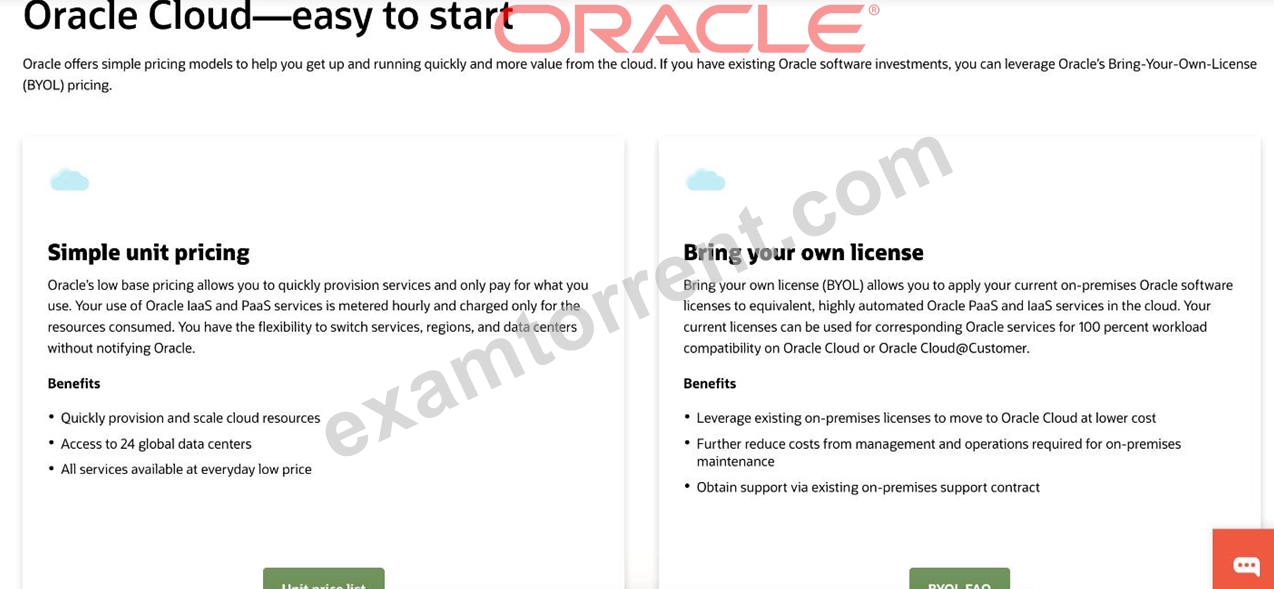
NEW QUESTION # 29
Which TWO statements are true regarding Oracle Cloud Infrastructure (OCI) Regions?
(Choose al correct answers)
- A. Some regions only provide test/dev environments.
- B. Some regions provide a single availability domain.
- C. Some regions provide multiple subregions.
- D. Some regions provide multiple availability domains.
- E. Some regions provide a single fault domain.
Answer: B,D
NEW QUESTION # 30
Which option provides the best performance for running OTLP workloads in Oracle Cloud Infrastructure (OCI)?
- A. OCI Virtual Machine Instance
- B. OCI Dedicated Virtual Host
- C. OCI Autonomous Transaction Processing
- D. OCI Autonomous Data Warehouse
Answer: C
Explanation:
https://docs.oracle.com/en/cloud/paas/atp-cloud/index.html
NEW QUESTION # 31
Which CANNOT be used with My Oracle Support (MOS)?
- A. Reset the password or unlock the account for the tenancy administrator
- B. Troubleshoot your resources in an Oracle Cloud Infrastructure Free Trial account
- C. Request a Service Limit increase
- D. Add or change a tenancy administrator
Answer: B
Explanation:
Open a support service request with MOS option is available to paid accounts. Customers using only Always Free resources are not eligible for Oracle Support. Limited support is available to Free Tier accounts with Free Trial credits. After you use all of your credits or after your trial period ends (whichever comes first), you must upgrade to a paid account to access Oracle Support. If you choose not to upgrade and continue to use Always Free Services, you will not be eligible to raise a service request in My Oracle Support.
In addition to support for technical issues, use My Oracle Support if you need to:
* Reset the password or unlock the account for the tenancy administrator
* Add or change a tenancy administrator
* Request a service limit increase
Reference:
https://docs.cloud.oracle.com/en-us/iaas/Content/GSG/Tasks/contactingsupport.htm
NEW QUESTION # 32
Which three components are part of Oracle Cloud Infrastructure Identity and Access Management service?
- A. Roles
- B. Policies
- C. Users
- D. Regional Subnets
- E. Dynamic Groups
- F. Compute Instances
- G. Virtual Cloud Networks
Answer: B,C,E
Explanation:
IAM components are
RESOURCE
The cloud objects that your company's employees create and use when interacting with Oracle Cloud Infrastructure. For example: compute instances, block storage volumes, virtual cloud networks (VCNs), subnets, route tables, etc.
USER
An individual employee or system that needs to manage or use your company's Oracle Cloud Infrastructure resources. Users might need to launch instances, manage remote disks, work with your virtual cloud network, etc. End users of your application are not typically IAM users. Users have one or more IAM credentials (see User Credentials).
POLICY
A document that specifies who can access which resources, and how. Access is granted at the group and compartment level, which means you can write a policy that gives a group a specific type of access within a specific compartment, or to the tenancy itself. If you give a group access to the tenancy, the group automatically gets the same type of access to all the compartments inside the tenancy. For more information, see Example Scenario and How Policies Work. The word "policy" is used by people in different ways: to mean an individual statement written in the policy language; to mean a collection of statements in a single, named "policy" document (which has an Oracle Cloud ID (OCID) assigned to it); and to mean the overall body of policies your organization uses to control access to resources.
GROUP
A collection of users who all need the same type of access to a particular set of resources or compartment.
DYNAMIC GROUP
A special type of group that contains resources (such as compute instances) that match rules that you define (thus the membership can change dynamically as matching resources are created or deleted). These instances act as "principal" actors and can make API calls to services according to policies that you write for the dynamic group.
NETWORK SOURCE
A group of IP addresses that are allowed to access resources in your tenancy. The IP addresses can be public IP addresses or IP addresses from a VCN within your tenancy. After you create the network source, you use policy to restrict access to only requests that originate from the IPs in the network source.
COMPARTMENT
A collection of related resources. Compartments are a fundamental component of Oracle Cloud Infrastructure for organizing and isolating your cloud resources. You use them to clearly separate resources for the purposes of measuring usage and billing, access (through the use of policies), and isolation (separating the resources for one project or business unit from another). A common approach is to create a compartment for each major part of your organization. For more information, see Setting Up Your Tenancy.
TENANCY
The root compartment that contains all of your organization's Oracle Cloud Infrastructure resources. Oracle automatically creates your company's tenancy for you. Directly within the tenancy are your IAM entities (users, groups, compartments, and some policies; you can also put policies into compartments inside the tenancy). You place the other types of cloud resources (e.g., instances, virtual networks, block storage volumes, etc.) inside the compartments that you create.
HOME REGION
The region where your IAM resources reside. All IAM resources are global and available across all regions, but the master set of definitions reside in a single region, the home region. You must make changes to your IAM resources in your home region. The changes will be automatically propagated to all regions. For more information, see Managing Regions.
FEDERATION
A relationship that an administrator configures between an identity provider and a service provider. When you federate Oracle Cloud Infrastructure with an identity provider, you manage users and groups in the identity provider. You manage authorization in Oracle Cloud Infrastructure's IAM service. Oracle Cloud Infrastructure tenancies are federated with Oracle Identity Cloud Service by default.
Reference:
https://docs.cloud.oracle.com/en-us/iaas/data-safe/doc/iam-components.html
NEW QUESTION # 33
Which option provides the best performance for running OLTP workloads in Oracle Cloud Infrastructure?
- A. OCI Virtual Machine Instance
- B. OCI Exadata DB Systems
- C. OCI Dedicated Virtual Host
- D. OCI Autonomous Data Warehouse
Answer: B
Explanation:
On an Exadata DB system, all databases share dedicated storage servers which include flash storage. By default, the databases are given equal priority with respect to these resources. The Exadata storage management software uses a first come, first served approach for query processing. If a database executes a major query that overloads I/O resources, overall system performance can be slowed down.
The I/O Resource Management (IORM) allows you to assign priorities to your databases to ensure critical queries are processed first when workloads exceed their resource allocations. You assign priorities by creating directives that specify the number of shares for each database. The number of shares corresponds to a percentage of resources given to that database when I/O resources are stressed.
Directives work together with an overall optimization objective you set for managing the resources. The following objectives are available:
1) Auto - Recommended. IORM determines the optimization objective and continuously and dynamically determines the optimal settings, based on the workloads observed, and resource plans enabled.
2) Balanced - For critical OLTP and DSS workloads. This setting balances low disk latency and high throughput. This setting limits disk utilization of large I/Os to a lesser extent than low latency to achieve a balance between good latency and good throughput.
3) High throughput - For critical DSS workloads that require high throughput.
4) Low latency - For critical OLTP workloads. This setting provides the lowest possible latency by significantly limiting disk utilization.
NEW QUESTION # 34
A customer wants a dedicated and secure connection to their on-premises data center from their Oracle Cloud Infrastructure (OCI) resources.
Which TWO OCI services can be used?
(Choose all correct answers)
- A. Site-to-Site VPN
- B. FastConnect
- C. Internet Gateway
- D. Remote Peering connection
- E. NAT Gateway
Answer: C,D
NEW QUESTION # 35
___________________ is a fully-managed, scalable, and highly available service that you can use to deploy your containerized applications to the cloud.
- A. Oracle Cloud Infrastructure Container Engine for Deployment
- B. Oracle Cloud Infrastructure Container Engine for Kubernetes
- C. Oracle Cloud Infrastructure Container Engine for Containerization
- D. Oracle Cloud Infrastructure Container Engine for Docker
Answer: B
Explanation:
Oracle Cloud Infrastructure Container Engine for Kubernetes is a fully-managed, scalable, and highly available service that you can use to deploy your containerized applications to the cloud. Use Container Engine for Kubernetes (sometimes abbreviated to just OKE) when your development team wants to reliably build, deploy, and manage cloud-native applications. You specify the compute resources that your applications require, and Container Engine for Kubernetes provisions them on Oracle Cloud Infrastructure in an existing OCI tenancy.
You can access Container Engine for Kubernetes to define and create Kubernetes clusters using the Console and the REST API. You can access the clusters you create using the Kubernetes command line (kubectl), the Kubernetes Dashboard, and the Kubernetes API.
Container Engine for Kubernetes is integrated with Oracle Cloud Infrastructure Identity and Access Management (IAM), which provides easy authentication with native Oracle Cloud Infrastructure identity functionality.
NEW QUESTION # 36
A customer wants to deploy a customized e commerce Web application using multiple virtual machines, block storage, databases, load balancer and web application firewall.
What cloud model can be used to host this application?
- A. Platform as a Service (PaaS)
- B. Software as a Service (SaaS)
- C. Anything as a Service (XaaS)
- D. Infrastructure as a Service (IaaS)
Answer: D
Explanation:
https://www.oracle.com/cloud/what-is-iaas/
What Is IaaS?
Infrastructure as a service (IaaS) is a type of cloud service model in which computing resources are hosted in the cloud. Businesses can use the IaaS model to shift some or all of their use of on-premises or colocated data center infrastructure to the cloud, where it is owned and managed by a cloud provider. These infrastructure elements can include compute, network, and storage hardware as well as other components and software.
In the IaaS model, the cloud provider owns and operates the hardware and software and also owns or leases the data center. When you have an IaaS solution, you rent the resources like compute or storage, provision them when needed, and pay for the resources your organization consumes. For some resources such as compute, you'll pay for the resources you use. For others such as storage, you'll pay for capacity.
How Does IaaS Work?
In a typical IaaS model, a business-which can be of any size-consumes services like compute, storage, and databases from a cloud provider. The cloud provider offers those services by hosting hardware and software in the cloud. The business will no longer need to purchase and manage its own equipment, or space to host the equipment, and the cost will shift to a pay-as-you-go model. When the business needs less, it pays for less. And when it grows, it can provision additional computing resources and other technologies in minutes.
In contrast, in a traditional on-premises scenario, a business manages and maintains its own data center. The business must invest in servers, storage, software, and other technologies, and hire an IT staff or contractors to purchase, manage, and upgrade all the equipment and licenses. The data center has to be built to meet peak demand, even though sometimes workloads decline and those resources stand idle. Conversely, if the business grows quickly, the IT department might struggle to keep up.
NEW QUESTION # 37
A customer wants a dedicated connection with minimal network latency from their on-premises data center to Oracle Cloud Infrastructure (OCI).
Which service should they choose?
- A. Virtual Cloud Network Remote Peering
- B. Public internet
- C. OCI FastConnact
- D. IPSec Virtual Private Network (VPN)
Answer: C
Explanation:
Oracle Cloud Infrastructure FastConnect provides an easy way to create a dedicated, private connection between your data center and Oracle Cloud Infrastructure. FastConnect provides higher-bandwidth options, and a more reliable and consistent networking experience compared to internet-based connections.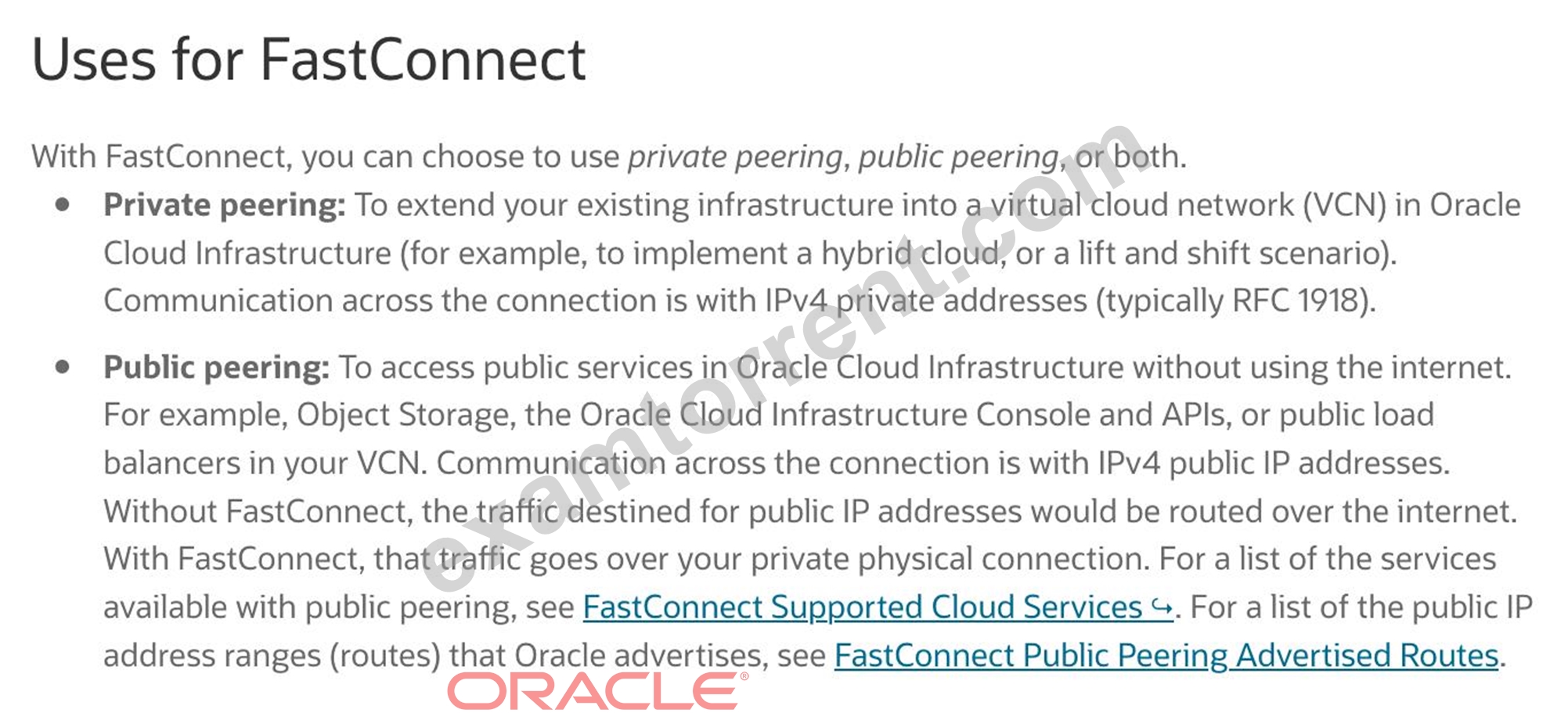
NEW QUESTION # 38
Which is an important consideration when choosing an Oracle Cloud Infrastructure (OCI) region?
- A. Choose a region that is far away from the application to eliminate single point of failure.
- B. Choose a region that offers a single availability domain for cost saving.
- C. Choose a region that is in close proximity to end users for best performance.
- D. Choose a region that offers the lowest cost.
Answer: B
NEW QUESTION # 39
Which TWO statements correctly describe Oracle Cloud Infrastructure (OCI) Service Level Agreements (SLAs)? (Choose all correct answers)
- A. Defined as a number of eights for a week and a percentage credit.
- B. Defined as a number of nines for a week and a percentage credit.
- C. Financially backed commitment to provide a minimum level of service to customers.
- D. financially backed commitment to provide a maximum level of service to customers.
- E. Defined as a number of nines for a month and a percentage credit.
- F. Defined as a number of eights for a month and a percentage credit.
Answer: C,E
NEW QUESTION # 40
Which Oracle Cloud Infrastructure (OCI) database solution will be most economical for a customer looking to have the elasticity of the cloud with minimal administration and maintenance effort for their DBA team?
- A. OCI Virtual Machine DB Systems
- B. OCI Autonomous Database
- C. OCI Bare Metal DB Systems
- D. OCI Exadata DB Systems.
Answer: D
Explanation:
Exadata DB systems allow you to leverage the power of Exadata within the Oracle Cloud Infrastructure. An Exadata DB system consists of a base system, quarter rack, half rack, or full rack of compute nodes and storage servers, tied together by a high-speed, low-latency InfiniBand network and intelligent Exadata software. You can configure automatic backups, optimize for different workloads, and scale up the system to meet increased demands.
Oracle now offers the Zero Downtime Migration service, a quick and easy way to move on-premises Oracle Databases and Oracle Cloud Infrastructure Classic databases to Oracle Cloud Infrastructure. You can migrate databases to the following types of Oracle Cloud Infrastructure systems: Exadata, Exadata Cloud@Customer, bare metal, and virtual machine.
Zero Downtime Migration leverages Oracle Active Data Guard to create a standby instance of your database in an Oracle Cloud Infrastructure system. You switch over only when you are ready, and your source database remains available as a standby. Use the Zero Downtime Migration service to migrate databases individually or at the fleet level. See Move to Oracle Cloud Using Zero Downtime Migration for more information.
NEW QUESTION # 41
Which is NOT part of the Oracle Cloud Always Free eligible resources that you can provision in your tenancy?
- A. Autonomous Database (up to two database instances)
- B. Block Volume (up to 100 GB total storage)
- C. Load Balancing (one load balancer)
- D. Fast Connect (1 Gbps public peering)
Answer: D
Explanation:
For more information on Always Free Resources refer below official documentation page
https://docs.cloud.oracle.com/en-us/iaas/Content/FreeTier/resourceref.htm?Highlight=%20Always%20free OCI FastConnect is not offered as part of the Free tier: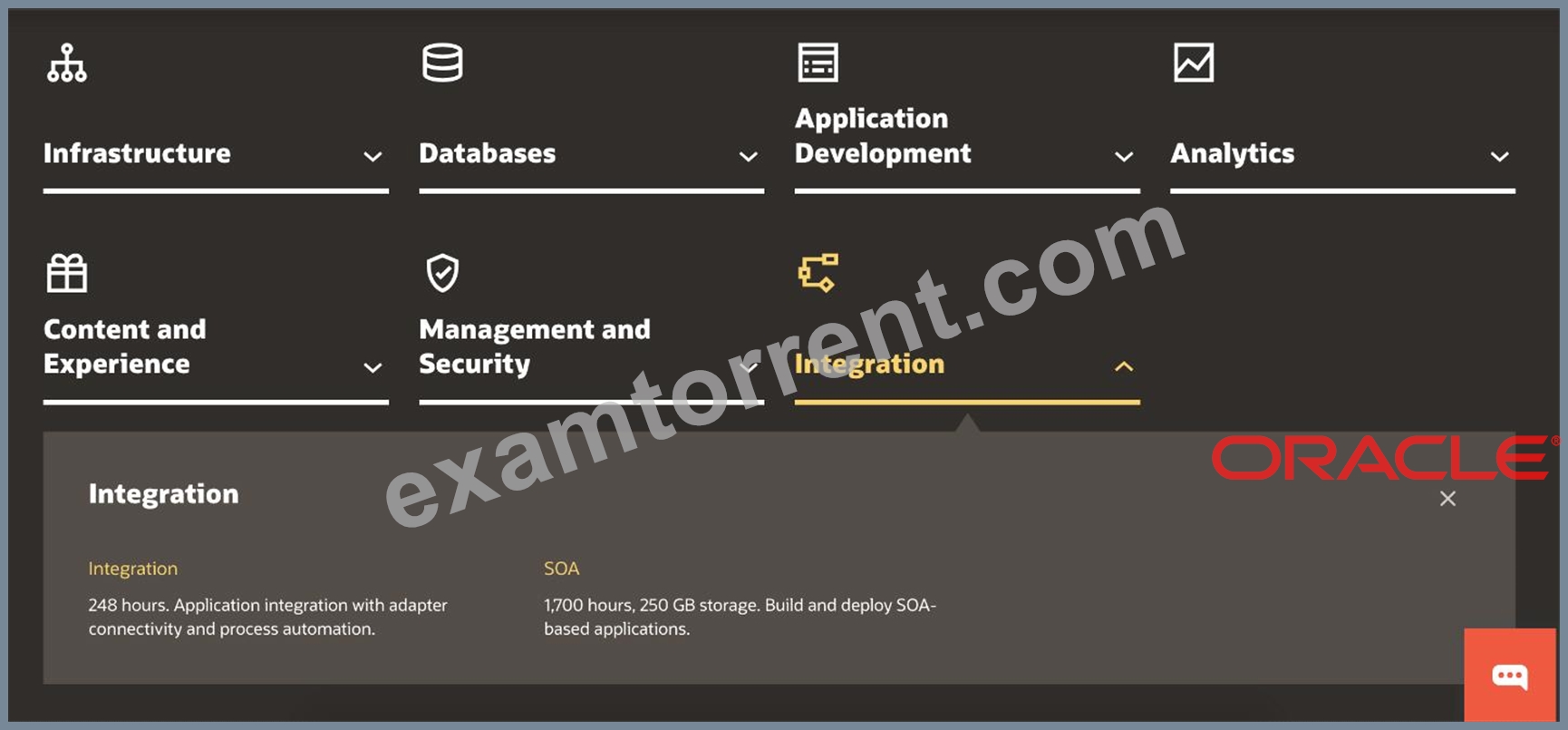
NEW QUESTION # 42
Which describes a key benefit of using Oracle Cloud Infrastructure (OCI)?
- A. OCI offers consistent performance with a predictable pricing model.
- B. With OCI, you can run only cloud-native workloads.
- C. With OCI, you can only run Java based workloads on bare metal.
- D. Only bare metal workloads are supported on OCI.
Answer: A
Explanation:
https://www.oracle.com/in/cloud/pricing.html
- OCI offers consistent performance with a predictable pricing model - is the best suited answer.
- Only bare metal workloads are supported in OCI - False, since you can work with VMs etc too
- With OCI, you can run cloud native workloads - False, since you can work with on-premise by connecting it to OCI too.
- With OCI, you can only run Java based workloads on bare metal - False since Java is not the only programming language supported by OCI.
NEW QUESTION # 43
Which resource do you manage in an Infrastructure-as-a-services (IAAS) offering?
- A. Storage
- B. Operating system
- C. Servers
- D. Network
Answer: B
Explanation:
Infrastructure as a service (IaaS) is a type of cloud service model in which computing resources are hosted in the cloud. Businesses can use the IaaS model to shift some or all of their use of on-premises or colocated data center infrastructure to the cloud, where it is owned and managed by a cloud provider. These infrastructure elements can include compute, network, and storage hardware as well as other components and software.
How Does IaaS Work?
In a typical IaaS model, a business-which can be of any size-consumes services like compute, storage, and databases from a cloud provider. The cloud provider offers those services by hosting hardware and software in the cloud. The business will no longer need to purchase and manage its own equipment, or space to host the equipment, and the cost will shift to a pay-as-you-go model. When the business needs less, it pays for less. And when it grows, it can provision additional computing resources and other technologies in minutes.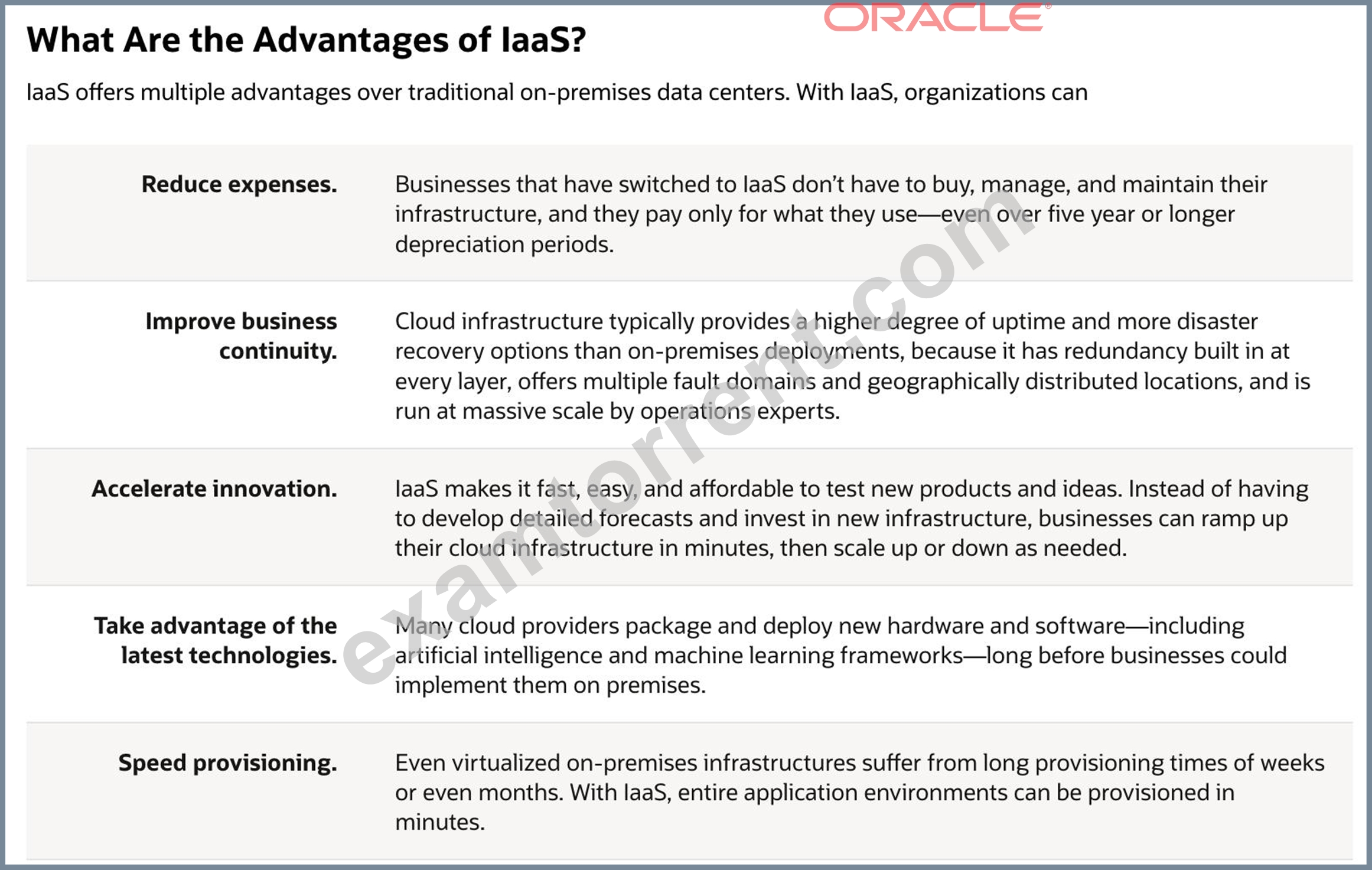
NEW QUESTION # 44
What is the primary use case for using Web Application Firewall in Oracle Cloud Infrastructure (OCI)?
- A. Hardware-based key storage
- B. Patch management
- C. Network security control
- D. Filter malicious web traffic
Answer: D
NEW QUESTION # 45
......
Get 1z0-1085-22 Braindumps & 1z0-1085-22 Real Exam Questions: https://vcetorrent.examtorrent.com/1z0-1085-22-prep4sure-dumps.html
