

[May 19, 2026] MuleSoft-Integration-Architect-I Test Prep Training Practice Exam Questions Practice Tests
Exam Questions Answers Braindumps MuleSoft-Integration-Architect-I Exam Dumps PDF Questions
Salesforce MuleSoft-Integration-Architect-I Exam Syllabus Topics:
| Topic | Details |
|---|---|
| Topic 1 |
|
| Topic 2 |
|
| Topic 3 |
|
| Topic 4 |
|
| Topic 5 |
|
| Topic 6 |
|
NEW QUESTION # 28
What aspect of logging is only possible for Mule applications deployed to customer-hosted Mule runtimes, but NOT for Mule applications deployed to CloudHub?
- A. To change tog4j2 tog levels in Anypoint Runtime Manager without having to restart the Mule application
- B. To log certain messages to a custom log category
- C. To directly reference one shared and customized log4j2.xml file from multiple Mule applications
- D. To send Mule application log entries to Splunk
Answer: C
Explanation:
* Correct answer is To directly reference one shared and customized log4j2.xml file from multiple Mule applications. Key word to note in the answer is directly.
* By default, CloudHub replaces a Mule application's log4j2.xml file with a CloudHub log4j2.xml file. This specifies the CloudHub appender to write logs to the CloudHub logging service.
* You cannot modify CloudHub log4j2.xml file to add any custom appender. But there is a process in order to achieve this. You need to raise a request on support portal to disable CloudHub provided Mule application log4j2 file.
Graphical user interface, application, Word Description automatically generated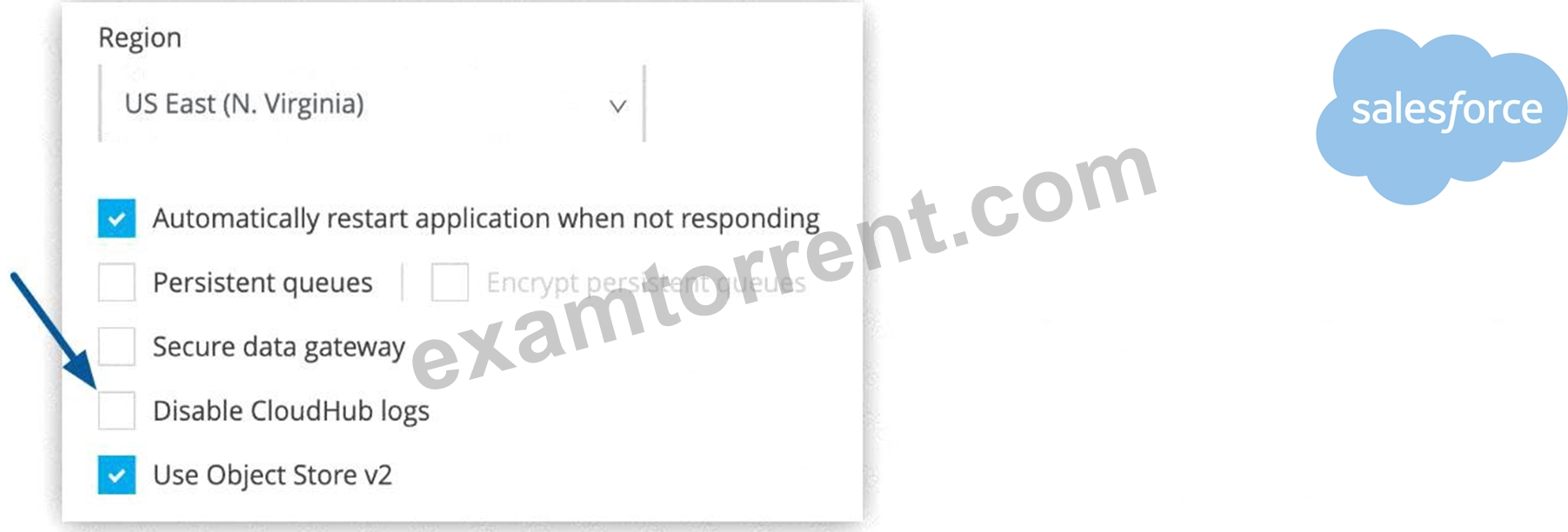
* Once this is done , Mule application's log4j2.xml file is used which you can use to send/export application logs to other log4j2 appenders, such as a custom logging system MuleSoft does not own any responsibility for lost logging data due to misconfiguration of your own log4j appender if it happens by any chance.
Graphical user interface, text, application, email Description automatically generated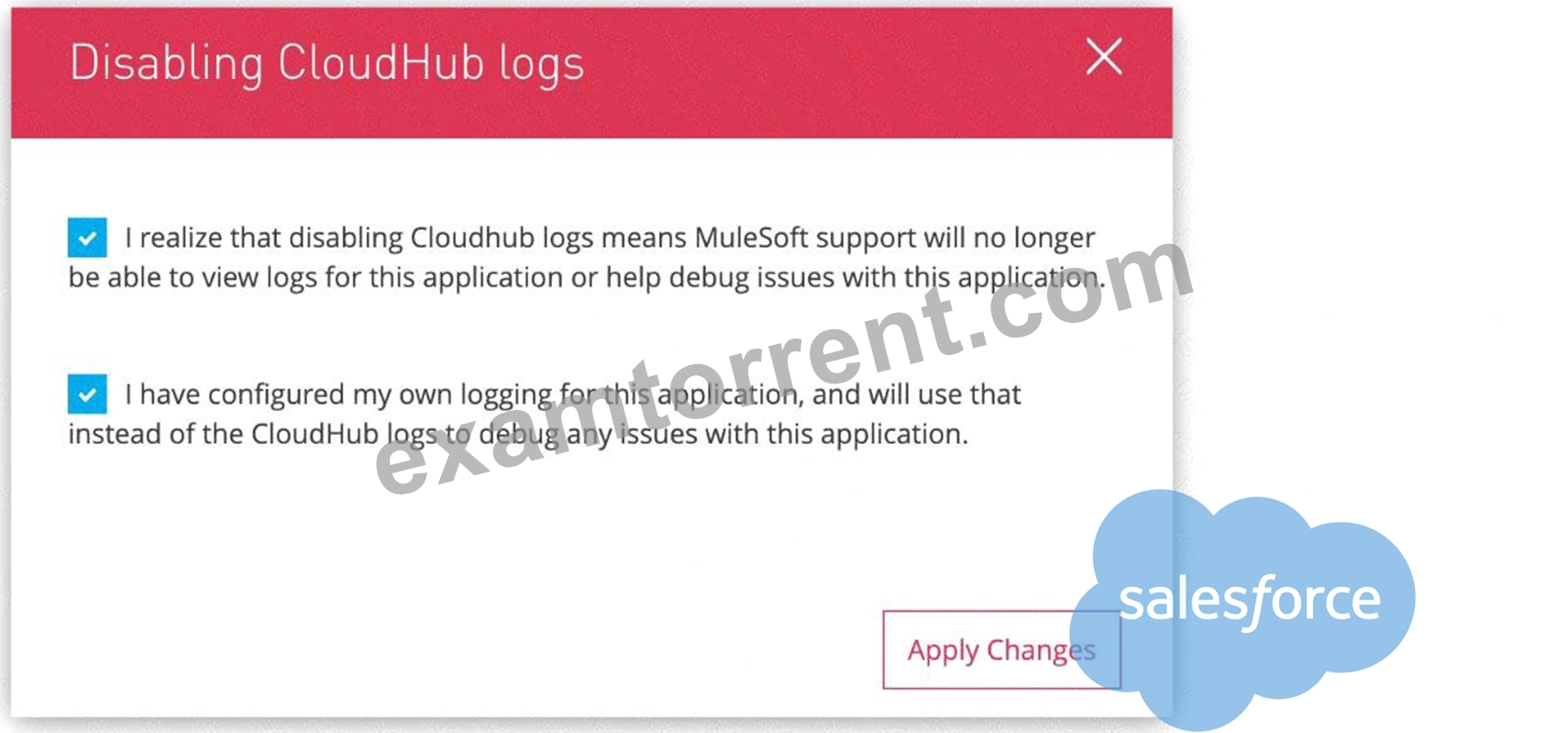
* One more difference between customer-hosted Mule runtimes and CloudHub deployed mule instance is that
- CloudHub system log messages cannot be sent to external log management system without installing custom CH logging configuration through support
- where as Customer-hosted runtime can send system and application log to external log management system MuleSoft Reference:
https://docs.mulesoft.com/runtime-manager/viewing-log-data
https://docs.mulesoft.com/runtime-manager/custom-log-appender
NEW QUESTION # 29
A company is designing an integration Mule application to process orders by submitting them to a back-end system for offline processing. Each order will be received by the Mule application through an HTTP5 POST and must be acknowledged immediately.
Once acknowledged the order will be submitted to a back-end system. Orders that cannot be successfully submitted due to the rejections from the back-end system will need to be processed manually (outside the banking system).
The mule application will be deployed to a customer hosted runtime and will be able to use an existing ActiveMQ broker if needed. The ActiveMQ broker is located inside the organization's firewall. The back-end system has a track record of unreliability due to both minor network connectivity issues and longer outages.
Which combination of Mule application components and ActiveMQ queues are required to ensure automatic submission of orders to the back-end system while supporting but minimizing manual order processing?
- A. One or more on-Error scopes to assist calling the back-end system one or more ActiveMQ long-retry queues A persistent dead-letter Object store configuration in the CloudHub object store service
- B. An Until Successful scope to call the back-end system One or more ActiveMQ long-retry queues One or more ActiveMQ dead-letter queues for manual processing
- C. A batch job scope to call the back in system An Untill successful scope containing Object Store components for long retries. A dead-letter object store configured in the Mule application
- D. One or more On Error scopes to assist calling the back-end system An Untill successful scope containing VM components for long retries A persistent dead-letter VM queue configure in Cloud hub
Answer: B
Explanation:
* To design an integration Mule application that processes orders and ensures reliability even with an unreliable back-end system, the following components and ActiveMQ queues should be used:
* Until Successful Scope: This scope ensures that the Mule application will continue trying to submit the order to the back-end system until it succeeds or reaches a specified retry limit. This helps in handling transient network issues or minor outages of the back-end system.
* ActiveMQ Long-Retry Queues: By placing the orders in long-retry queues, the application can manage retries over an extended period. This is particularly useful when the back-end system experiences longer outages. The ActiveMQ broker, located within the organization's firewall, can reliably handle these queues.
* ActiveMQ Dead-Letter Queues: Orders that cannot be successfully submitted after all retry attempts should be moved to dead-letter queues. This allows for manual processing of these orders. The dead- letter queue ensures that no orders are lost and provides a clear mechanism for handling failed submissions.
Implementation Steps:
* HTTP Listener: Set up an HTTP listener to receive incoming orders.
* Immediate Acknowledgment: Immediately acknowledge the receipt of the order to the client.
* Until Successful Scope: Use the Until Successful scope to attempt submitting the order to the back-end system. Configure retry intervals and limits.
* Long-Retry Queues: Configure ActiveMQ long-retry queues to manage retries.
* Dead-Letter Queues: Set up ActiveMQ dead-letter queues for orders that fail after maximum retry attempts, allowing for manual intervention.
This approach ensures that the system can handle temporary and prolonged back-end outages while minimizing manual processing.
References:
* MuleSoft Documentation on Until Successful Scope: https://docs.mulesoft.com/mule-runtime/4.3/until- successful-scope
* ActiveMQ Documentation: https://activemq.apache.org/
NEW QUESTION # 30
A Mule application is being designed to do the following:
Step 1: Read a SalesOrder message from a JMS queue, where each SalesOrder consists of a header and a list of SalesOrderLineltems.
Step 2: Insert the SalesOrder header and each SalesOrderLineltem into different tables in an RDBMS.
Step 3: Insert the SalesOrder header and the sum of the prices of all its SalesOrderLineltems into a table In a different RDBMS.
No SalesOrder message can be lost and the consistency of all SalesOrder-related information in both RDBMSs must be ensured at all times.
What design choice (including choice of transactions) and order of steps addresses these requirements?
- A. 1) Read and acknowledge the JMS message (NOT in an XA transaction)
2) In a NEW XA transaction, perform BOTH DB inserts - B. 1) Read the JMS message (NOT in an XA transaction)
2) Perform BOTH DB inserts in ONE DB transaction
3) Acknowledge the JMS message - C. 1) Read the JMS message (NOT in an XA transaction)
2) Perform EACH DB insert in a SEPARATE DB transaction
3) Acknowledge the JMS message - D. 1) Read the JMS message in an XA transaction
2) In the SAME XA transaction, perform BOTH DB inserts but do NOT acknowledge the JMS message
Answer: B
Explanation:
* Option A says "Perform EACH DB insert in a SEPARATE DB transaction". In this case if first DB insert is successful and second one fails then first insert won't be rolled back causing inconsistency. This option is ruled out.
* Option D says Perform BOTH DB inserts in ONE DB transaction.
Rule of thumb is when one or more DB connections are required we must use XA transaction as local transactions support only one resource. So this option is also ruled out.
* Option B acknowledges the before DB processing, so message is removed from the queue. In case of system failure at later point, message can't be retrieved.
* Option C is Valid: Though it says "do not ack JMS message", message will be auto acknowledged at the end of transaction. Here is how we can ensure all components are part of XA transaction: https://docs.mulesoft.com/jms-connector/1.7/jms-transactions Additional Information about transactions:
* XA Transactions - You can use an XA transaction to group together a series of operations from multiple transactional resources, such as JMS, VM or JDBC resources, into a single, very reliable, global transaction.
* The XA (eXtended Architecture) standard is an X/Open group standard which specifies the interface between a global transaction manager and local transactional resource managers.
The XA protocol defines a 2-phase commit protocol which can be used to more reliably coordinate and sequence a series of "all or nothing" operations across multiple servers, even servers of different types
* Use JMS ack if
- Acknowledgment should occur eventually, perhaps asynchronously
- The performance of the message receipt is paramount
- The message processing is idempotent
- For the choreography portion of the SAGA pattern
* Use JMS transactions
- For all other times in the integration you want to perform an atomic unit of work
- When the unit of work comprises more than the receipt of a single message
- To simply and unify the programming model (begin/commit/rollback)
NEW QUESTION # 31
Refer to the exhibit.
A Mule 4 application has a parent flow that breaks up a JSON array payload into 200 separate items, then sends each item one at a time inside an Async scope to a VM queue.
A second flow to process orders has a VM Listener on the same VM queue. The rest of this flow processes each received item by writing the item to a database.
This Mule application is deployed to four CloudHub workers with persistent queues enabled.
What message processing guarantees are provided by the VM queue and the CloudHub workers, and how are VM messages routed among the CloudHub workers for each invocation of the parent flow under normal operating conditions where all the CloudHub workers remain online?
- A. ALL Item VM messages are processed AT LEAST ONCE by the SAME CloudHub worker where the parent flow was invokedThis one CloudHub worker processes ALL 200 item VM messages
- B. ALL item VM messages are processed AT MOST ONCE by ONE ARBITRARY CloudHub workerThis one CloudHub worker processes ALL 200 item VM messages
- C. EACH item VM message is processed AT MOST ONCE by ONE CloudHub worker, with workers chosen in a deterministic round-robin fashion Each of the four CloudHub workers can be expected to process 1/4 of the Item VM messages (about 50 items)
- D. EACH item VM message is processed AT LEAST ONCE by ONE ARBITRARY CloudHub worker Each of the four CloudHub workers can be expected to process some item VM messages
Answer: D
Explanation:
Correct answer is EACH item VM message is processed AT LEAST ONCE by ONE ARBITRARY CloudHub worker. Each of the four CloudHub workers can be expected to process some item VM messages In Cloudhub, each persistent VM queue is listened on by every CloudHub worker - But each message is read and processed at least once by only one CloudHub worker and the duplicate processing is possible - If the CloudHub worker fails , the message can be read by another worker to prevent loss of messages and this can lead to duplicate processing - By default , every CloudHub worker's VM Listener receives different messages from VM Queue Referenece: https://dzone.com/articles/deploying-mulesoft-application-on-1-worker-vs-mult
NEW QUESTION # 32
An organization has chosen Mulesoft for their integration and API platform.
According to the Mulesoft catalyst framework, what would an integration architect do to create achievement goals as part of their business outcomes?
- A. Measure the impact of the centre for enablement
- B. agree upon KPI's and help develop and overall success plan
- C. build and publish foundational assets
- D. evangelize API's
Answer: B
Explanation:
According to the MuleSoft Catalyst framework, an Integration Architect plays a crucial role in defining and achieving business outcomes. One of their key responsibilities is to agree upon Key Performance Indicators (KPIs) and help develop an overall success plan. This involves working with stakeholders to identify measurable goals and ensure that the integration initiatives align with the organization's strategic objectives.
KPIs are critical for tracking progress, measuring success, and making data-driven decisions. By agreeing on KPIs and developing a success plan, the Integration Architect ensures that the organization can objectively measure the impact of its integration efforts and adjust strategies as needed to achieve desired business outcomes.
References:
* MuleSoft Catalyst Knowledge Hub
NEW QUESTION # 33
An organization is designing a mule application to support an all or nothing transaction between serval database operations and some other connectors so that they all roll back if there is a problem with any of the connectors Besides the database connector , what other connector can be used in the transaction.
- A. SFTP
- B. VM
- C. ObjectStore
- D. Anypoint MQ
Answer: B
Explanation:
Correct answer is VM VM support Transactional Type. When an exception occur, The transaction rolls back to its original state for reprocessing. This feature is not supported by other connectors.
Here is additional information about Transaction management:
Table Description automatically generated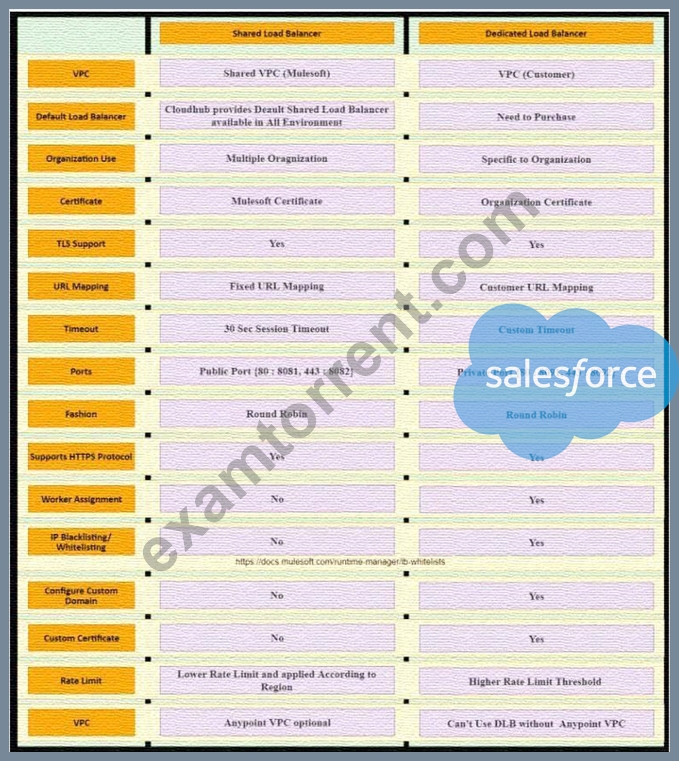
NEW QUESTION # 34
What is an advantage of using OAuth 2.0 client credentials and access tokens over only API keys for API authentication?
- A. If the access token is compromised, the client credentials do not to be reissued.
- B. If the client secret is compromised, the client credentials do not have to be reissued.
- C. If the access token is compromised, I can be exchanged for an API key.
- D. If the client ID is compromised, it can be exchanged for an API key
Answer: A
Explanation:
The advantage of using OAuth 2.0 client credentials and access tokens over only API keys for API authentication is that if the access token is compromised, the client credentials do not have to be reissued.
OAuth 2.0 is a secure protocol for authenticating clients and authorizing them to access protected resources. It works by having the client authenticate with the authorization server and receive an access token, which is then used to authenticate requests to the API. If the access token is compromised, it can be revoked and replaced without needing to reissue the client credentials.
Reference:
Chapter 7: Security
Section 7.2: OAuth 2.0
NEW QUESTION # 35
Which Salesforce API is invoked to deploy, retrieve, create or delete customization information such as custom object definitions using a Mule Salesforce connector in a Mule application?
- A. SOAP API
- B. REST API
- C. Bulk API
- D. Metadata API
Answer: B
NEW QUESTION # 36
As a part of project requirement, Java Invoke static connector in a mule 4 application needs to invoke a static method in a dependency jar file. What are two ways to add the dependency to be visible by the connectors class loader?
(Choose two answers)
- A. Configure the dependency as a shared library in the project POM
- B. Update mule-artefact.json to export the Java package
- C. Add the dependency jar file to the java classpath by setting the JVM parameters
- D. Use Maven command to include the dependency jar file when packaging the application
- E. In the Java Invoke static connector configuration, configure a path and name of the dependency jar file
Answer: A,D
Explanation:
To ensure that the Java Invoke static connector in a Mule 4 application can access a static method in a dependency jar file, you need to make the dependency visible to the connector's class loader. Here are the two effective methods to achieve this:
* Using Maven Command:
* Include Dependency via Maven: Add the dependency jar file using Maven when packaging the Mule application. This ensures that the jar file is included in the application's build and is available at runtime.
* Add the dependency to your pom.xml file:
<dependency> <groupId>com.example</groupId> <artifactId>example-library</artifactId> <version>1.0.0<
/version> </dependency>
* Use the Maven package command to build the application and include the dependency:
mvn clean package
* Configuring Dependency as a Shared Library:
* Shared Library Configuration: Configure the dependency as a shared library in the project POM.
This makes the jar available to all components within the Mule application.
* Define the shared library in pom.xml:
xml
<dependency> <groupId>com.example</groupId> <artifactId>example-library</artifactId> <version>1.0.0<
/version> <scope>provided</scope> </dependency>
* Steps for Java Invoke Configuration:
* Ensure the static method in the dependency jar file is accessible via the Java Invoke connector by correctly configuring the connector with the class and method details.
* Benefits:
* Maven Integration: Using Maven ensures that the dependency management is streamlined and integrated with the build lifecycle of the Mule application.
* Shared Library: Configuring as a shared library ensures that the dependency is managed centrally and is easily accessible by various parts of the Mule application.
MuleSoft Documentation on Java Module
Maven Documentation on Dependency Management
NEW QUESTION # 37
An organization designing a hybrid, load balanced, single cluster production environment. Due to performance service level agreement goals, it is looking into running the Mule applications in an active-active multi node cluster configuration.
What should be considered when running its Mule applications in this type of environment?
- A. A Mule application deployed to multiple nodes runs in an isolation from the other nodes in the cluster
- B. An external load balancer is required to distribute incoming requests throughout the cluster nodes
- C. Although the cluster environment is fully installed configured and running, it will not process any requests until an outage condition is detected by the primary node in the cluster.
- D. All event sources, regardless of time , can be configured as the target source by the primary node in the cluster
Answer: B
Explanation:
In a hybrid, load-balanced, single cluster production environment running Mule applications in an active- active multi-node configuration, several considerations are critical for ensuring performance and reliability.
The key consideration is the use of an external load balancer:
* Active-Active Multi-Node Cluster Configuration:
* An active-active cluster means that all nodes are actively handling traffic, providing high availability and better resource utilization.
* External Load Balancer Requirement:
* Distribution of Requests: An external load balancer is essential to evenly distribute incoming requests across all active nodes in the cluster. This prevents any single node from becoming a bottleneck and ensures balanced load distribution.
* Scalability and Failover: The load balancer provides scalability by allowing more nodes to be added seamlessly. It also handles failover, rerouting traffic to healthy nodes if one node goes down.
* Load Balancer Configuration:
* Setup: Configure the load balancer to include all the nodes of the Mule cluster.
* Health Checks: Implement health checks to monitor the status of each node and ensure traffic is only directed to healthy nodes.
* Session Persistence: If required, enable session persistence (sticky sessions) to ensure that user sessions remain consistent across requests.
* Mule Application Isolation:
* Each Mule application instance runs in isolation but shares the same configuration and state. This isolation ensures that the failure of one node does not impact others.
* Handling Requests:
* In an active-active configuration, all nodes handle incoming requests simultaneously. The load balancer's role is to manage the distribution of these requests efficiently.
* Benefits:
* High Availability: Ensures that the system remains available even if some nodes fail.
* Improved Performance: Balances the load, preventing any single node from being overwhelmed.
* Scalability: Makes it easy to scale horizontally by adding more nodes.
References:
* MuleSoft Documentation on Mule Clustering
* Best Practices for Load Balancing
NEW QUESTION # 38
A payment processing company has implemented a Payment Processing API Mule application to process credit card and debit card transactions, Because the Payment Processing API handles highly sensitive information, the payment processing company requires that data must be encrypted both In-transit and at-rest.
To meet these security requirements, consumers of the Payment Processing API must create request message payloads in a JSON format specified by the API, and the message payload values must be encrypted.
How can the Payment Processing API validate requests received from API consumers?
- A. The Mule application implementation can use the APIkit module to decrypt and then validate the JSON data
- B. A Transport Layer Security (TLS) - Inbound policy can be applied in API Manager to decrypt the message payload and the Mule application implementation can then use the JSON Validation module to validate the JSON data
- C. The Mule application implementation can use DataWeave to decrypt the message payload and then use the JSON Scheme Validation module to validate the JSON data
- D. The Mule application implementation can use the Validation module to decrypt and then validate the JSON data
Answer: B
Explanation:
To ensure that data is encrypted both in-transit and at-rest, and to validate incoming requests to the Payment Processing API, the following approach is recommended:
* TLS Inbound Policy: Apply a Transport Layer Security (TLS) - Inbound policy in API Manager. This policy ensures that the data is encrypted during transmission and can be decrypted by the API Manager before it reaches the Mule application.
* Decryption: With the TLS policy applied, the message payload is decrypted when it is received by the API Manager.
* JSON Validation: After decryption, the Mule application can use the JSON Validation module to validate the structure and content of the JSON data. This ensures that the payload conforms to the specified format and contains valid data.
This approach ensures that data is securely transmitted and properly validated upon receipt.
References:
* Transport Layer Security (TLS) Policies
* JSON Validation Module
NEW QUESTION # 39
A system API EmployeeSAPI is used to fetch employee's data from an underlying SQL database.
The architect must design a caching strategy to query the database only when there is an update to the employees stable or else return a cached response in order to minimize the number of redundant transactions being handled by the database.
What must the architect do to achieve the caching objective?
- A. Use an on table rule on employees table call invalidate cache and said new employees data to cache Use an object store caching strategy and set expiration interval to 1-hour
- B. Use a Scheduler with a fixed frequency every hour triggering an invalidate cache flow Use an object store caching strategy and set expiration interval to 1-hour
- C. Use a Scheduler with a fixed frequency every hour triggering an invalidate cache flow Use an object store caching strategy and expiration interval to empty
- D. Use an On Table Row on employees table and call invalidate cache
Use an object store caching strategy and expiration interval to empty
Answer: D
Explanation:
To achieve efficient caching and reduce redundant database transactions, the following strategy can be implemented:
* On Table Row Listener: Implement an "On Table Row" trigger on the employees' table. This trigger will monitor changes (inserts, updates, deletes) in the employee records.
* Invalidate Cache: Upon detecting changes in the employees' table, the trigger will call a flow to invalidate the current cache.
* Object Store for Caching: Utilize MuleSoft's object store to cache the employee data. This store can hold the data for quick retrieval.
* Set Expiration Interval: Configure the expiration interval for the cached data to ensure it is cleared when necessary. For this scenario, since we are invalidating cache on actual data changes, setting the expiration interval to empty can be suitable.
* Return Cached Data: If there are no updates, the cached response is returned, reducing database load.
References:
* MuleSoft Documentation on Object Store
* Caching Strategies
NEW QUESTION # 40
Which Exchange asset type represents configuration modules that extend the functionality of an API and enforce capabilities such as security?
- A. Rulesets
- B. RESTAPIs
- C. Policies
- D. Connectors
Answer: C
NEW QUESTION # 41
An insurance provider is implementing Anypoint platform to manage its application infrastructure and is using the customer hosted runtime for its business due to certain financial requirements it must meet. It has built a number of synchronous API's and is currently hosting these on a mule runtime on one server These applications make use of a number of components including heavy use of object stores and VM queues.
Business has grown rapidly in the last year and the insurance provider is starting to receive reports of reliability issues from its applications.
The DevOps team indicates that the API's are currently handling too many requests and this is over loading the server. The team has also mentioned that there is a significant downtime when the server is down for maintenance.
As an integration architect, which option would you suggest to mitigate these issues?
- A. Increase physical specifications of server CPU memory and network
- B. Add a load balancer and add additional servers in a cluster configuration
- C. Add a load balancer and add additional servers in a server group configuration
- D. Change applications by use an event-driven model
Answer: B
Explanation:
To address the reliability and scalability issues faced by the insurance provider, adding a load balancer and configuring additional servers in a cluster configuration is the optimal solution. Here's why:
* Load Balancing: Implementing a load balancer will help distribute incoming API requests evenly across multiple servers. This prevents any single server from becoming a bottleneck, thereby improving the overall performance and reliability of the system.
* Cluster Configuration: By setting up a cluster configuration, you ensure that multiple servers work together as a single unit. This provides several benefits:
* High Availability: If one server goes down, the load balancer can redirect traffic to other available servers in the cluster, minimizing downtime.
* Scalability: Additional servers can be added to the cluster to handle increased load as the business grows.
* Fault Tolerance: Clustering allows for automatic failover and recovery, ensuring that applications remain available even if one server fails.
* Maintenance: With a cluster configuration, servers can be taken offline for maintenance one at a time without affecting the overall availability of the applications, as the load balancer can redirect traffic to the remaining servers.
* VM Queues and Object Stores: In a clustered environment, the use of VM queues and object stores can be more efficiently managed as these resources are distributed across multiple servers, reducing the risk of contention and improving throughput.
MuleSoft Documentation on Clustering: https://docs.mulesoft.com/mule-runtime/4.3/clustering Best Practices for Scaling Mule Applications: https://blogs.mulesoft.com/dev/mule-dev/mule-4-scaling- applications/
NEW QUESTION # 42
An organization has various integrations implemented as Mule applications. Some of these Mule applications are deployed to custom hosted Mule runtimes (on-premises) while others execute in the MuleSoft-hosted runtime plane (CloudHub). To perform the Integra functionality, these Mule applications connect to various backend systems, with multiple applications typically needing to access the backend systems.
How can the organization most effectively avoid creating duplicates in each Mule application of the credentials required to access the backend systems?
- A. Create a Mule domain project that maintains the credentials as Mule domain-shared resources Deploy the Mule applications to the Mule domain, so the credentials are available to the Mule applications
- B. Segregate the credentials for each backend system into environment-specific properties files Package these properties files in each Mule application, from where they are loaded at startup
- C. Store the credentials in properties files in a shared folder within the organization's data center Have the Mule applications load properties files from this shared location at startup
- D. Configure or create a credentials service that returns the credentials for each backend system, and that is accessible from customer-hosted and MuleSoft-hosted Mule runtimes Have the Mule applications toad the properties at startup by invoking that credentials service
Answer: D
Explanation:
* "Create a Mule domain project that maintains the credentials as Mule domain-shared resources" is wrong as domain project is not supported in Cloudhub * We should Avoid Creating duplicates in each Mule application but below two options cause duplication of credentials - Store the credentials in properties files in a shared folder within the organization's data center. Have the Mule applications load properties files from this shared location at startup - Segregate the credentials for each backend system into environment-specific properties files. Package these properties files in each Mule application, from where they are loaded at startup So these are also wrong choices * Credentials service is the best approach in this scenario. Mule domain projects are not supported on CloudHub. Also its is not recommended to have multiple copies of configuration values as this makes difficult to maintain Use the Mule Credentials Vault to encrypt data in a .properties file. (In the context of this document, we refer to the .properties file simply as the properties file.) The properties file in Mule stores data as key-value pairs which may contain information such as usernames, first and last names, and credit card numbers. A Mule application may access this data as it processes messages, for example, to acquire login credentials for an external Web service. However, though this sensitive, private data must be stored in a properties file for Mule to access, it must also be protected against unauthorized - and potentially malicious - use by anyone with access to the Mule application
NEW QUESTION # 43
A Mule application is synchronizing customer data between two different database systems.
What is the main benefit of using eXtended Architecture (XA) transactions over local transactions to synchronize these two different database systems?
- A. An XA transaction synchronizes the database systems with the least amount of Mule configuration or coding
- B. An XA transaction writes to both database systems as fast as possible
- C. An XA transaction automatically rolls back operations against both database systems if any operation falls
- D. An XA transaction handles the largest number of requests in the shortest time
Answer: D
NEW QUESTION # 44
......
Download Free Salesforce MuleSoft-Integration-Architect-I Real Exam Questions: https://vcetorrent.examtorrent.com/MuleSoft-Integration-Architect-I-prep4sure-dumps.html
