

[Jul 17, 2025] Latest 1z0-1073-24 PDF Dumps & Real Tests Free Updated Today
1z0-1073-24 Dumps With 100% Verified Q&As - Pass Guarantee or Full Refund
Oracle 1z0-1073-24 Exam Syllabus Topics:
| Topic | Details |
|---|---|
| Topic 1 |
|
| Topic 2 |
|
| Topic 3 |
|
| Topic 4 |
|
| Topic 5 |
|
| Topic 6 |
|
| Topic 7 |
|
| Topic 8 |
|
NEW QUESTION # 19
Your customer wants to reserve material for a future project. There is no existing demand document for this purpose.How can you create this reservation?
- A. By using a miscellaneous transaction
- B. By using the project number
- C. By using user-defined demand
Answer: C
NEW QUESTION # 20
An organization uses min-max planned items to generate movement requests automatically where the item's replenishment source is another subinventory. In this case, the min-max process should automatically generate a move request but it doesn't happen.
What is the reason?
- A. The source subinventory was not set at the item subinventory level.
- B. The source subinventory was not set at the organization level.
- C. Replenishment movement requests is not enabled for status control.
- D. Min-max report was generated at the subinventory level.
Answer: A
NEW QUESTION # 21
Inventory organization M1 has:
Nettable Quantity On-hand = 24
Open Supply Quantity = 51 with all supply within the supply cutoff date Open Reserved Sales Order Quantity = 90 with all demand within the cutoff date Open Unreserved Sales Order Quantity = 10 Min-max Minimum Quantity = 100 Min-max Maximum Quantity = 500 Min-max planning report is run for organization level with Yes specified for the Net Reserved Orders parameter.
What will be Total Available Quantity and Reorder Quantity calculated?
- A. Total Available Quantity = - 14 Reorder Quantity = 514
- B. Total Available Quantity = 76 Reorder Quantity = 500
- C. Total Available Quantity = - 14 Reorder Quantity = 500
Answer: A
NEW QUESTION # 22
What are the functional components of Supply Chain Orchestration? (Choose three)
- A. Decomposition
- B. Business Services
- C. Order Capturing
- D. Orchestration
Answer: A,B,D
Explanation:
Consigned Inventory from a Supplier
NEW QUESTION # 23
What fulfillment strategy does Drop Shipment follow?
- A. Supplier-to-DC
- B. Supplier-to-Customer
- C. Supplier-to-Factory
- D. Supplier-to-Supplier
Answer: B
NEW QUESTION # 24
Which statement is true when you use kit items on a transfer order?
- A. Shipment Set Behavior is not applicable for kit items.
- B. Only component-level picking is possible.
- C. Component-level picking, shipping, and receiving are possible.
Answer: C
NEW QUESTION # 25
Item AS56001 has 10 on-hand quantities. In the Item Availability window, Available to Transact is equal to On-Hand Quantity. However, Available to Reserve is 0 and no reservations exist for this item.
What could be two reasons for 0 Available to Reserve?
- A. The item lot material status is not allowing reservations.
- B. Pending transactions exist for this item.
- C. The inventory organization is not allowing reservations.
- D. The item is lot-controlled and the lot has expired.
Answer: A,D
NEW QUESTION # 26
What happens when you accrue at receipt in receipt accounting?
- A. Less timely accounting takes place.
- B. Expenses and payables are booked when a supplier invoice is processed.
- C. Less accounting and reconciliation take place.
- D. Accrual and expense are booked upon receipt. (*)
Answer: D
NEW QUESTION # 27
Your supplier has reduced the supply quantity from 100 to 80 for a supply order with a requested quantity of
100. Supply Chain Orchestration is unable to find an alternative source of supply to meet this demand.
What will this supply line be grouped under?
- A. Mark for Review
- B. Jeopardy
- C. Exception
- D. Error
Answer: C
NEW QUESTION # 28
Which two statements are true about enterprise structures?
- A. Divisions can be represented in the chart of accounts.
- B. Client business units can be part of other legal entities in a shared service center model.
- C. An inventory organization can have more than one cost organization.
- D. A business unit can be assigned to multiple primary ledgers.
Answer: A,B
NEW QUESTION # 29
Back-to-Back Supply Creation On-Hand Flow
The back-to-back on-hand available (ATP) flow is the simplest in terms of the number of steps that constitute the flow. This flow occurs where on hand supply is available in the fulfillment warehouse for the ordered back-to-back item at the time of order promising. Because on-hand goods already exist in the form of on hand, Oracle Supply Chain Orchestration directly sends a request to reserve the on hand quantity against the back-to-back sales order. You can ship the sales order immediately after the reservation is created.
The following figure shows the back-to-back supply creation on-hand flow.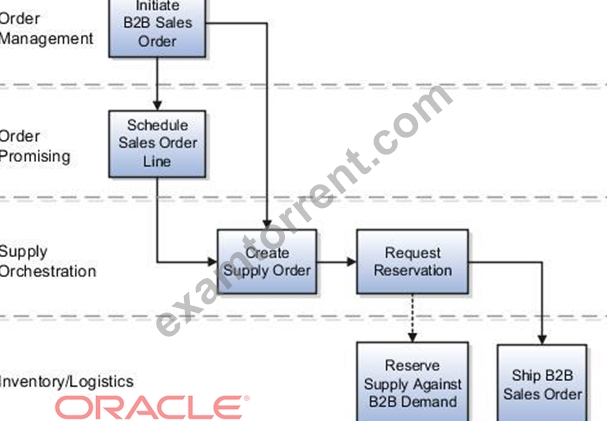
Answer:
Explanation:
See the Explanation for the complete solution.
Explanation:
Back-to-Back Supply Creation: On-Hand Flow in Oracle Cloud
1. Overview of Back-to-Back On-Hand Flow
The Back-to-Back On-Hand Flow is the simplest and fastest fulfillment method in Oracle Cloud because the required stock is already available in the fulfillment warehouse at the time of sales order entry.
Unlike Buy, Make, or Transfer Flows, no additional supply is created. Instead, Oracle Supply Chain Orchestration (SCO) directly reserves the available inventory against the sales order, making it ready for immediate shipment.
2. Step-by-Step Back-to-Back On-Hand Flow Process
Below is a detailed step-by-step breakdown of the Back-to-Back On-Hand Flow using Oracle Fusion Cloud applications.
Step 1: Enter & Schedule Sales Order
* The customer places a sales order in Oracle Order Management.
* The system checks inventory availability in Oracle Inventory Cloud.
* Oracle Global Order Promising (GOP) determines that the required stock is already available in the fulfillment warehouse.
* No procurement, manufacturing, or warehouse transfers are needed.
* The sales order is scheduled immediately for fulfillment.
# System Action: The system identifies that on-hand stock is available and proceeds to reservation.
Step 2: Reserve Available Inventory
* Oracle Supply Chain Orchestration (SCO) reserves the available stock against the back-to-back sales order.
* The system ensures that this stock is allocated only to this order, preventing other orders from using it.
# System Action: The system reserves the required quantity for the sales order.
Step 3: Ship the Sales Order
* The order moves directly to shipping in Oracle Inventory Cloud.
* The warehouse team picks, packs, and ships the goods using Oracle Shipping Execution.
* An invoice is generated in Oracle Receivables.
* The sales order is closed after shipment.
# Final Action: The system completes the order and ships it to the customer.
3. Oracle Fusion Cloud Modules Involved in On-Hand Flow
A screenshot of a computer AI-generated content may be incorrect.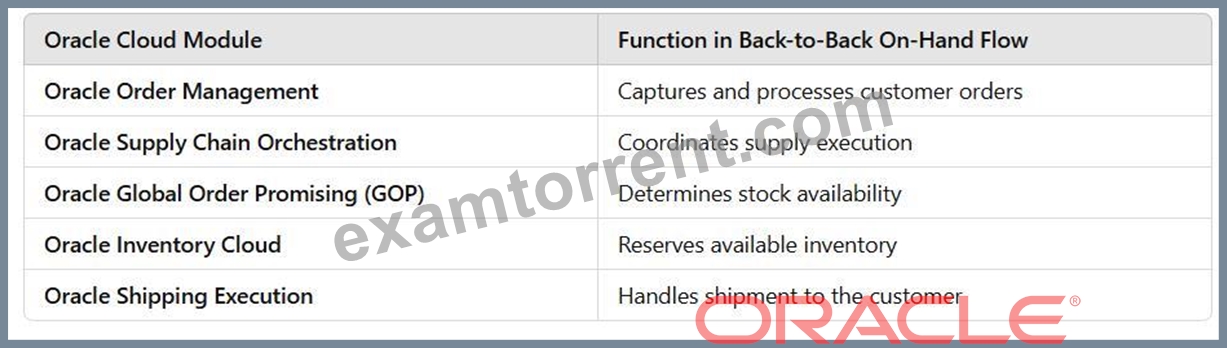
4. Benefits of Back-to-Back On-Hand Flow
# Fastest Fulfillment Process - No need for procurement, manufacturing, or transfers.# Minimizes Order Processing Time - Orders can be shipped immediately after reservation.# Eliminates Additional Costs - No purchase orders, work orders, or transfers required.# Ensures Inventory Optimization - Uses available stock efficiently.# Improves Customer Satisfaction - Quick shipping and fulfillment.
5. Real-World Use Case
Scenario: Electronics Retailer Fulfilling a Popular Smartphone Order
A retailer sells Smartphone XYZ and has 100 units in stock at its fulfillment warehouse.
Process Flow:
* A customer places an order for 10 units of Smartphone XYZ.
* Oracle Global Order Promising (GOP) identifies that stock is available.
* Oracle Supply Chain Orchestration (SCO) reserves 10 units against the sales order.
* The warehouse team picks, packs, and ships the smartphones.
* The customer receives the order, and the system closes the sales order.
# Result: The order is fulfilled immediately without additional supply creation.
NEW QUESTION # 30
You are configuring business units for your customer and have defined two business units: Business Unit America and Business Unit Singapore.
Based on discussions with the customer, you configured Business Unit Singapore as Procurement Service Providers in the Manage Service Providers: Business Unit America task.
What is the role of Business Unit Singapore?
- A. To process requisitions, supplier information, and payable invoices for Business Unit America
- B. To process requisitions and negotiate supplier terms for Business Unit America
- C. To process procurement orders, payable invoices, billing, and revenue for Business Unit America
Answer: B
NEW QUESTION # 31
What happens when you enable the Release Approved Lines option while running Print Movement Request Pick Slip Report?
- A. Manual pick is not necessary.
- B. All movement request lines are pick confirmed.
- C. All movement request lines are available for manual pick.
Answer: A
NEW QUESTION # 32
Your supplier is using the Supplier Portal and sends you an Advance Shipment Notice (ASN) whenever they ship goods. You have already created a consignment agreement with this supplier with the following consignment terms:
Aging Onset Point: Shipment
* Aging Period Days:3 Consumption Advice Frequency: Daily
* Consumption Advice Summary: All Organizations
For some reason, it took five days for the goods to arrive, and you have noticed that the goods are damaged.
You have now decided to send them back.
At that point, when you return the goods, who is the owner of the goods?
- A. The goods are under third-party ownership who is the shipping service provider.
- B. The goods are under the buyer's ownership.
- C. The goods are still under the supplier's ownership.
- D. The goods are under nobody's ownership because they were damaged in transit.
Answer: B
NEW QUESTION # 33
What happens when Transfer Order Required is not enabled on the Manage Interorganization Parameters page for Direct Organization Transfer between Source Organization Atlanta and Destination Organization Seattle?
- A. Transfer orders cannot be created from Atlanta to Seattle.
- B. Both interorganization transfers and transfer orders can be created from Atlanta to Seattle.
- C. Transfer orders can be created from Atlanta to Seattle, but approval is mandatory.
Answer: B
NEW QUESTION # 34
Which three statements are true regarding material status control?
You can change the material status at the time the items are received. (*)
- A. The Material Status Enforced profile option must be set to Yes to enable material status control. (*)
- B. If you do not enable material status control for a transaction type, the transaction type is always disallowed.
- C. The transaction type for which you enable status control defaults as disallowed transaction type for new material statuses that you create.
- D. The default lot status can be assigned to an item in item master. (*)
Answer: B,D
NEW QUESTION # 35
Your supplier is unable to deliver goods on the promise date against a back-to-back order and updates the promise date on the purchase order schedule to a later date.
How is the change handled on the source side?
- A. Status quo is maintained on the supply order and sales order.
- B. Order automatically goes on hold in supply orchestration, and the schedule ship date is adjusted in order management.
- C. Date Pushed Out exception is generated in supply orchestration, and order management is notified.
Answer: C
NEW QUESTION # 36
Which two actions are possible on an expired lot?
- A. Consider as on-hand for min-max planning.
- B. Include in cycle count. (*)
- C. Reserve for date beyond expiration date.
- D. Include in physical inventory and tag entry. (*)
Answer: B,D
NEW QUESTION # 37
Your customer wants to implement locator control for a few subinventories in an inventory organization.
Which configuration will help you achieve this?
- A. Enable appropriate subinventories under the Manage Locator task.
- B. Set the Locator Control parameter under the inventory organization parameters.
- C. Enable the Locator Required check box while creating subinventories.
Answer: B
NEW QUESTION # 38
Your customer wants to track and approve inventory transactions between two inventory organizations handling high value goods.
What are the two types of inventory transactions recommended?
- A. Movement request with a subinventory transfer transaction type
- B. Subinventory transfer
- C. Interorganization transfer
- D. Requisitions and purchase orders
Answer: A,D
NEW QUESTION # 39
......
2025 Valid 1z0-1073-24 test answers & Oracle Exam PDF: https://vcetorrent.examtorrent.com/1z0-1073-24-prep4sure-dumps.html
