

Updated Mar-2026 Test Engine to Practice FCP_GCS_AD-7.6 Test Questions
FCP_GCS_AD-7.6 Real Exam Questions Test Engine Dumps Training With 37 Questions
Fortinet FCP_GCS_AD-7.6 Exam Syllabus Topics:
| Topic | Details |
|---|---|
| Topic 1 |
|
| Topic 2 |
|
| Topic 3 |
|
| Topic 4 |
|
| Topic 5 |
|
| Topic 6 |
|
| Topic 7 |
|
| Topic 8 |
|
| Topic 9 |
|
| Topic 10 |
|
| Topic 11 |
|
| Topic 12 |
|
| Topic 13 |
|
| Topic 14 |
|
| Topic 15 |
|
| Topic 16 |
|
| Topic 17 |
|
| Topic 18 |
|
| Topic 19 |
|
NEW QUESTION # 11
Refer to the exhibit.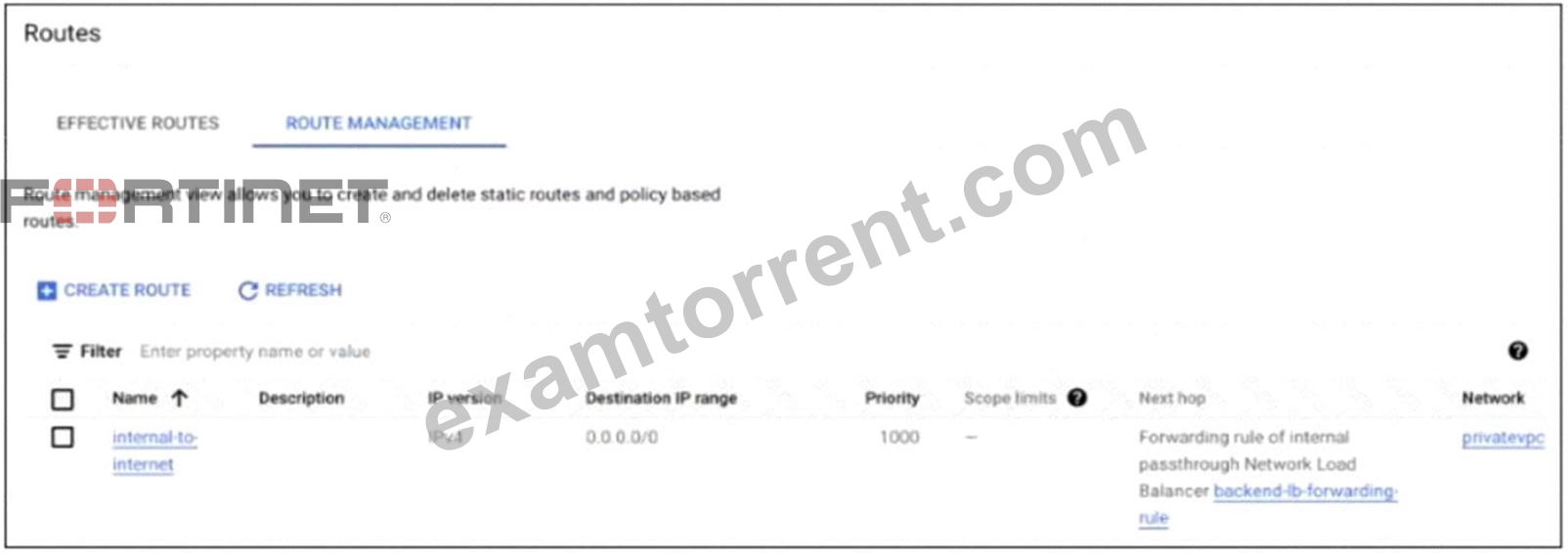
Which three conclusions can you draw from the Google Cloud custom route? (Choose three.)
- A. Atarget pool-based passthrough network load balancer was created.
- B. The next hop must be updates manually in the custom route if the current next hop goes down.
- C. A health check was created.
- D. A group-based passthrough network load balancer was created.
- E. At least one instance group was created.
Answer: B,C,E
Explanation:
The route's next hop is a forwarding rule for a backend service, which indicates a group-based passthrough load balancer.
Group-based load balancers require health checks to monitor instance health.
Backend services attach to instance groups to distribute traffic, so at least one instance group exists.
NEW QUESTION # 12
Refer to the exhibit.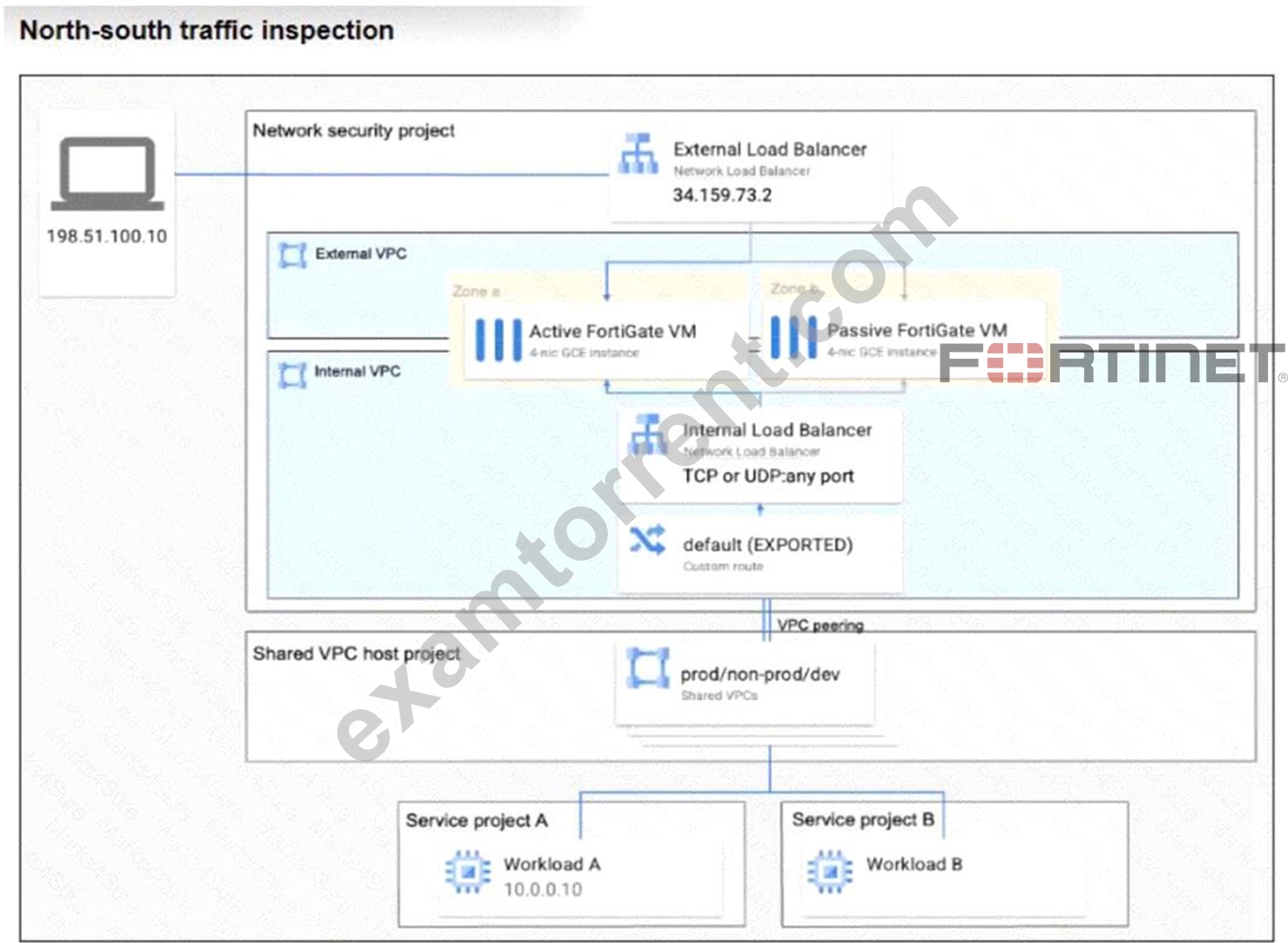
Which two types of traffic flow must the FortiGate cluster inspect, if the client at 198.51.100.10 sends traffic to the Workload A instance? (Choose two.)
- A. West-bound
- B. South-bound
- C. East-bound
- D. North-bound
Answer: B,C
Explanation:
South-bound traffic refers to traffic coming from outside the network (the client 198.51.100.10) into the internal environment.
East-bound traffic refers to traffic moving laterally within the internal network, such as between VPCs or workloads, which the FortiGate cluster can inspect for internal threats.
NEW QUESTION # 13
Your organization is deciding between deploying FortiGate active-passive high-availability (HA) in Google Cloud using either the software-defined network (SDN) connector or load balancers.
What two reasons should your organization choose the SDN connector over the load balancer deployment?
(Choose two.)
- A. Cost is lower.
- B. Failovers are faster because of to API calls.
- C. There isess administrative overhead.
- D. The SDN connector supports multizone failover.
Answer: A,C
Explanation:
Using the SDN connector avoids additional load balancer costs, making it more cost-effective.
The SDN connector enables multizone failover by directly managing network routing, which load balancers do not inherently support.
NEW QUESTION # 14
An organization is deploying an active-passive high availability (HA) cluster using passthrough load balancers in Google Cloud.
What is a critical factor for ensuring successful HA formation, failover, and traffic flow?
- A. Incoming traffic must be source NATed to ensure traffic flow symmetry.
- B. VDOM exceptions must be configured.
- C. There can be more than two cluster members.
- D. Unicast FortiGate Clustering Protocol (FGCP) must be used.
Answer: A
Explanation:
Source NAT ensures that traffic is symmetric by keeping the source IP consistent, which is critical for proper failover and session synchronization in an active-passive HA cluster using passthrough load balancers.
NEW QUESTION # 15
Refer to the exhibit.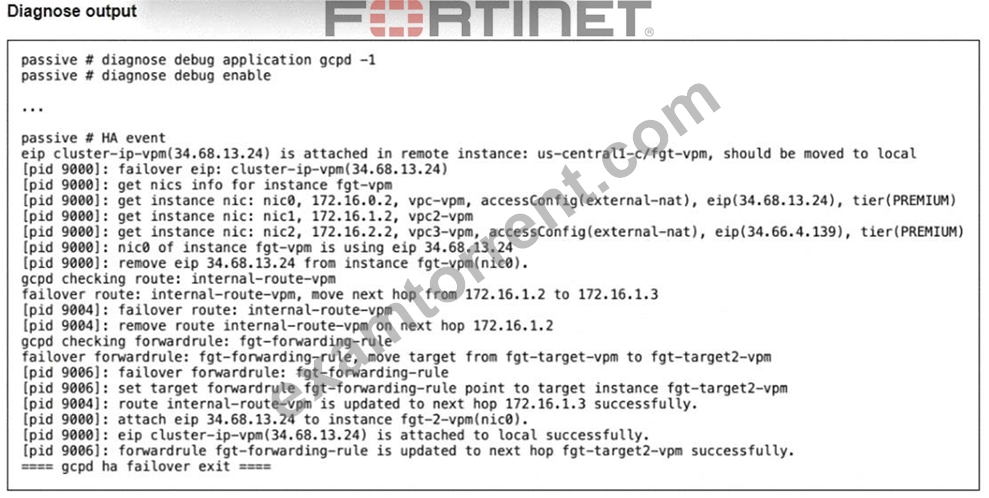
An administrator is troubleshooting an issue when a high-availability (HA) failover occurs.
Which conclusion can you draw from the debug output?
- A. The HA cluster is deployed using the software-defined network (SDN) connector.
- B. The health check has successfully updated the internal custom route to forward all internal traffic to
172.16.1.3. - C. The HA cluster is accessible using HTTPS on 34.68.13.24 and 34.66.4.139.
- D. Both cluster members are located in the same zone.
Answer: B
Explanation:
The debug output shows the internal route being updated and moved to the new next hop (172.16.1.3), indicating the health check and failover process successfully redirected internal traffic to the active HA node.
NEW QUESTION # 16
An administrator wants to use the FortiGate automation stitch feature to quarantine compromised hosts.
Which native Google Cloud service should the administrator integrate with FortiGate to achieve this?
- A. Google Cloud App_ Engine
- B. Google Cloud Run functions
- C. Google Cloud Interconnect
- D. Google Cloud IAM
Answer: B
Explanation:
Google Cloud Run allows you to run serverless containerized functions that can be triggered by FortiGate automation stitches to perform actions such as quarantining compromised hosts. It is the native service best suited for automating responses in cloud environments.
NEW QUESTION # 17
An organization is planning to deploy two FortiGate VMs in two different regions.
Which two Google Cloud core components can span both FortiGate VMs in both regions? (Choose two.)
- A. Google Cloud virtual private cloud
- B. Google Cloud zone
- C. Google Cloud project
- D. Google Cloud subnet
Answer: A,C
Explanation:
A Google Cloud VPC can span multiple regions, allowing FortiGate VMs in different regions to be part of the same network.
A Google Cloud project provides the administrative boundary that can include resources across multiple regions and VPCs, enabling centralized management of both FortiGate VMs.
NEW QUESTION # 18
A cloud administrator is tasked with protecting web applications hosted in Google Cloud.
Which three cloud offerings can the administrator use to accomplish the task? (Choose three.)
- A. Google Cloud Run
- B. FortiWeb Cloud
- C. Google Cloud IAM
- D. Google Cloud Armor
- E. FortiWeb VM
Answer: B,D,E
Explanation:
FortiWeb VM is a web application firewall (WAF) deployed on Google Cloud to protect web apps.
Google Cloud Armor provides DDoS and application-level protection.
FortiWeb Cloud offers cloud-native WAF services to protect applications hosted in Google Cloud.
NEW QUESTION # 19
Your organization is running an application in their shared services virtual public cloud (VPC) and must control network access natively in the cloud.
How can your organization meet this requirement?
- A. Create another VPC in front of the shared services VPC and deploy FortiGate.
- B. Create a firewall policy for the entire VPC that allows access from all networks.
- C. Create IAM access to allow access from specified resources only.
- D. Create a firewall rule that allows access to the application instance only.
Answer: D
Explanation:
Creating specific firewall rules that restrict access directly to the application instance allows precise native network access control within the shared services VPC.
NEW QUESTION # 20
You have been tasked with destroying all resources relating to a recent active-active high-availability (HA) FGSP Terraform deployment in Google Cloud.
What steps do you have to take to ensure a successful deletion? (Choose two.)
- A. Use the command terraform destroy to delete all resources deployed by the Terraform template.
- B. Delete all resources manually because active-active HA clusters cannot be destroyed using Terraform.
- C. Use the command terraform plan before destroying the Terraform template.
- D. Delete all dependencies to resources relating to the Terraform template.
Answer: A,D
Explanation:
Removing dependencies prevents resource conflicts during deletion.
terraform destroy is the correct command to cleanly and completely remove all resources created by the Terraform deployment.
NEW QUESTION # 21
Your organization is deciding between deploying FortiGate active-passive high-availability (HA) in Google Cloud using either the software-defined network (SDN) connector or load balancers.
What two reasons should your organization choose the SDN connector over the load balancer deployment?
(Choose two.)
- A. Cost is lower.
- B. Failovers are faster because of to API calls.
- C. There isess administrative overhead.
- D. The SDN connector supports multizone failover.
Answer: A,C
Explanation:
Using the SDN connector avoids additional load balancer costs, making it more cost-effective.
The SDN connector enables multizone failover by directly managing network routing, which load balancers do not inherently support.
NEW QUESTION # 22
Which architecture inspection type in Google Cloud is most closely associated with Google Cloud Interconnect?
- A. Outbound north-south traffic inspection
- B. East-west traffic inspection
- C. Inbound north-south traffic inspection
- D. Hybrid cloud inspection
Answer: D
Explanation:
Google Cloud Interconnect connects on-premises networks with Google Cloud, enabling hybrid cloud environments. Inspection related to this connectivity focuses on hybrid cloud traffic flows.
NEW QUESTION # 23
An administrator is tasked to deploy two FortiGate devices in two different zoned to achieve geographical redundancy.
Which two architectural considerations must the administrator address? (Choose two.)
- A. The FortiGate devices cannot be assigned the second IP address in the subnets that they are deployed in.
- B. The FortiGate devices must not be deployed in the same VPC.
- C. The FortiGate devices must be deployed in two different regions.
- D. The FortiGate devices can be deployed in the same subnet.
Answer: A,C
Explanation:
Deploying FortiGate devices in different regions ensures geographic redundancy.
The second IP address in a subnet is reserved for the default gateway in Google Cloud, so FortiGate devices cannot use that IP.
NEW QUESTION # 24
For what three reasons must you deploy a set of Google Cloud passthrough network load balancers for an active-passive high-availability (HA) FortiGate cluster instead of a set of Google Cloud proxy network load balancers? (Choose three.)
- A. Passthrough network load balancers support health checks.
- B. Passthrough network load balancers can forward all protocols.
- C. Passthrough network load balancers terminate SSL connections.
- D. Passthrough network load balancers rely on API calls from FortiGate devices during HA failovers.
- E. Passthrough network load balancers offer the highest throughput.
Answer: A,B,E
Explanation:
Passthrough load balancers support health checks to monitor backend health for failover.
They can forward all protocols, not limited to HTTP/HTTPS like proxy load balancers.
Passthrough load balancers provide higher throughput because they don't terminate sessions.
NEW QUESTION # 25
What are the two responsibilities of a Google Cloud customer in terms of security? (Choose two.)
- A. The Google Cloud customer is responsible for securing the computing resources.
- B. The Google Cloud customer is responsible for securing operating systems and applications.
- C. The Google Cloud customer is responsible for securing network traffic.
- D. The Google Cloud customer is responsible for securing cloud storage infrastructure.
Answer: B,C
Explanation:
Customers manage security for their data, applications, operating systems, and network configurations, while Google secures the underlying cloud infrastructure.
NEW QUESTION # 26
......
FCP_GCS_AD-7.6 Actual Questions Answers PDF 100% Cover Real Exam Questions: https://vcetorrent.examtorrent.com/FCP_GCS_AD-7.6-prep4sure-dumps.html
