

Try Free and Start Using Realistic Verified 300-510 Dumps Instantly
300-510 Actual Questions - Instant Download 291 Questions
NEW QUESTION # 22
Refer to the exhibit. R3 is:
- failing to accept multicast RP information from Domain-A
- advertising MSDP SA messages to R1 and R4
- receiving SA messages only from R4
Which command must the engineer implement to resolve the issue?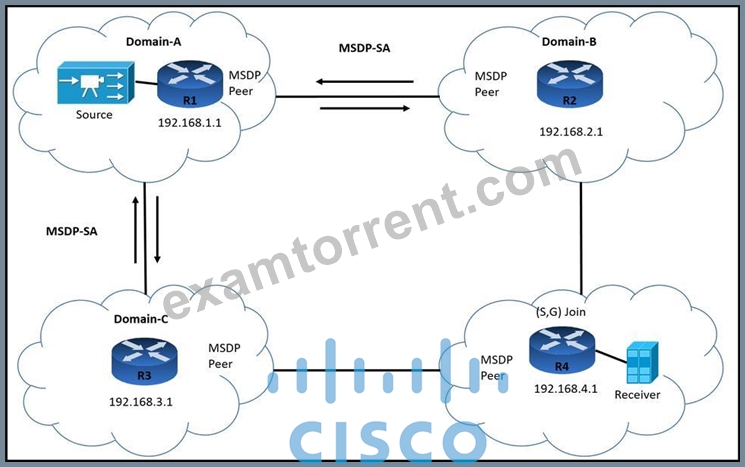
- A. R3# ip msdp sa-filter in 192.168.3.1
- B. R3# no ip msap sa-filter in 192.168.1.1
- C. R3# ip msdp sa-filter out 192.168.1.1
- D. R3# no ip msdp peer 192.168.1.1
Answer: A
Explanation:
https://allthingsnetworking.wordpress.com/2014/06/27/pim-msdp-sa-filter/
NEW QUESTION # 23
Refer to the exhibit.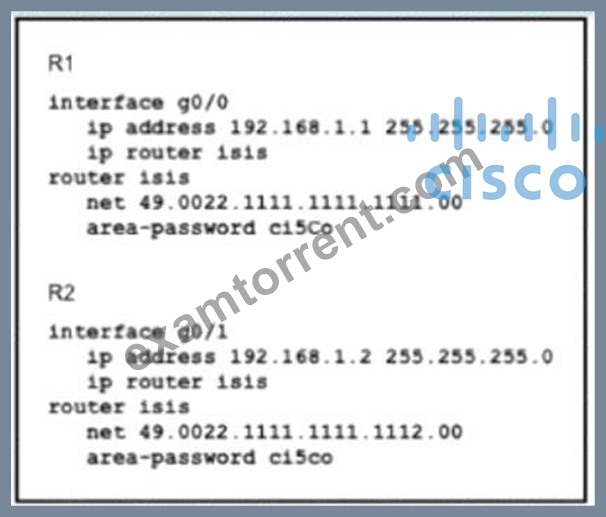
After these configurations were applied to routers R1 and R2. the two devices cannot form a neighbor relationship What is the reason tor the problem?
- A. The two routers have the same area ID.
- B. The two routers have the same network ID
- C. The two routers have different iS-types
- D. The two routers cannot authenticate with one another
Answer: D
NEW QUESTION # 24
Refer to the exhibit.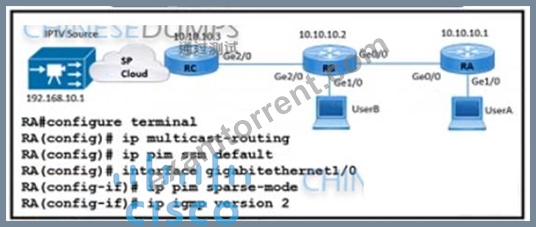
The UserA device fails to recede IPTV streaming traffic from the source While debugging the issue a network engineer finds that routers RB and RC receive the multicast traffic normally RC receives subscription messages from UserA to join the IPTV stream Which action must the engineer lake on router RA to correct this problem?
- A. Configure ip pim ssm with ip igmp version 2 on interface GigabitEthernet 1/0.
- B. Configure ip pim bidir-enable in global mode and add ip pim rp-address 10.10.10.3
- C. Remove the ip pim ssm default configuration and replace it with ip pim rp-address 10.10.1.3
- D. Change ip igmp version 2 to ip igmp version 3 on interface GigabitEthernet 1/0.
Answer: D
NEW QUESTION # 25
Refer to the exhibit.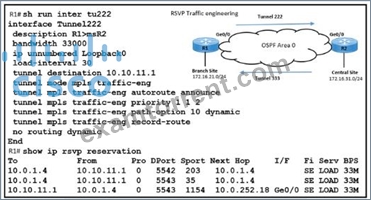
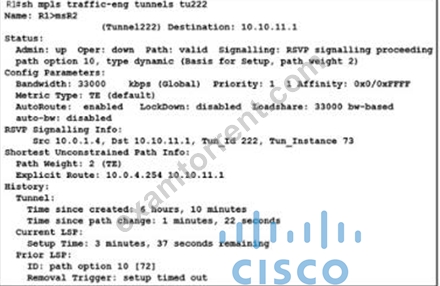
Refer to the exhibit. A network engineer is investigating a report of packet drops between the branch site and the central site.
The two sites are connected via OSPF and RSVP-TE tunnels.
Traffic from the central site to the branch site is passing normally.
Technicians at both sites successfully ping the loopback IP addresses on routers R1 and R2.
Which configuration corrects the packet-drop problem?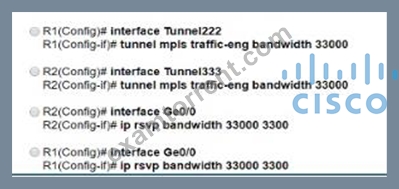
- A. Option C
- B. Option D
- C. Option B
- D. Option A
Answer: B
NEW QUESTION # 26
An ISP has an MPLS VPN-based network with 12 PE routers. How many peerings are required between the
12 routers if the engineer has not configured route reflectors?
- A. 0
- B. 1
- C. 2
- D. 3
Answer: C
NEW QUESTION # 27
An engineer is implementing LFA FRR on PE routers to allow unicast traffic to rapidly converge around link or node failures. The engineer configured IS-IS on the newly deployed routers in the data center in the same exchange as other routers. Which additional action must the engineer take before configuring LFA on the PE routers?
- A. Configure the isis network point-to-multipoint command on each router.
- B. Configure MPLS on each router.
- C. Configure IP Cisco Express Forwarding on each router.
- D. Configure the isis network point-to-point command on each router.
Answer: D
NEW QUESTION # 28
For which reason can two devices fail to establish an OSPF neighbor relationship?
- A. The two devices have different network types
- B. The two devices have different process IDs
- C. The two devices have different router IDs
- D. The two devices have the same area ID
Answer: A
Explanation:
Explanation
Explanation/Reference: https://www.cisco.com/c/en/us/support/docs/ip/open-shortest-path-first-ospf/13699-29.html
NEW QUESTION # 29
Refer to the exhibit.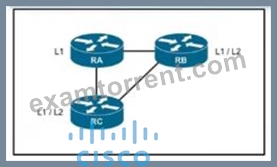
Routers RA and RB are IS-IS peers configured for NSF but router RC is an IS-IS peer without NSF capability If RA undergoes processor switchover what is the effect on the network environment?
- A. If RC is operating without the Cisco configuration option only 2 routers tear down their peering relationships and re-establish peering
- B. All peer relationships remain up and the link-state database is unchanged
- C. All peer relationships remain up, but the link-state database is rebuilt on each device
- D. If RC is operating without the Cisco configuration option all three routers tear down their peering relationships and re-establish peering
Answer: C
NEW QUESTION # 30
SIMULATION
Guidelines
This is a lab item in which tasks will be performed on virtual devices.
- Refer to the Tasks tab to view the tasks for this lab item.
- Refer to the Topology tab to access the device console(s) and perform the tasks.
- Console access is available for all required devices by clicking the device icon or using the tab(s) above the console window.
- All necessary preconfigurations have been applied.
- Do not change the enable password or hostname for any device.
- Save your configurations to NVRAM before moving to the next item.
- Click Next at the bottom of the screen to submit this lab and move to the next question.
- When Next is clicked, the lab closes and cannot be reopened.
Topology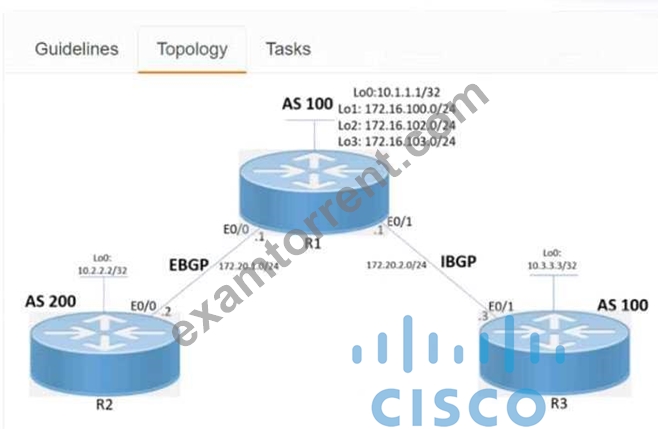
Tasks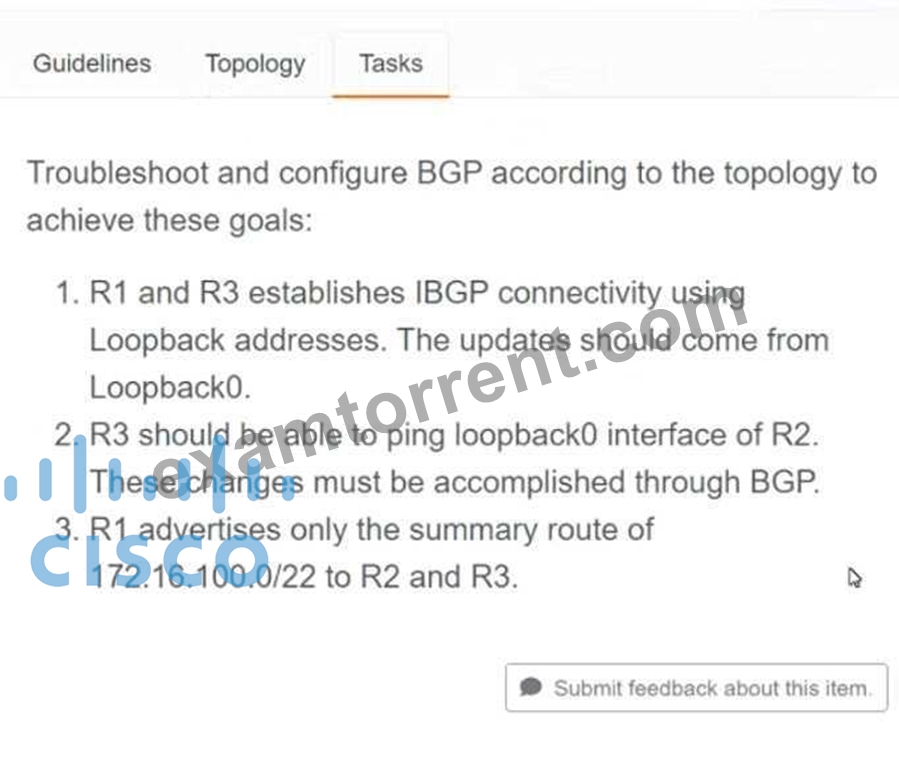
Answer:
Explanation:
R1
Router bgp 100
Neigh 10.3.3.3 remote-as 100
Neigh 10.3.3.3 update-source loopback0
Address-family ipv4
Neigh 10.3.3.3 next-hop-self
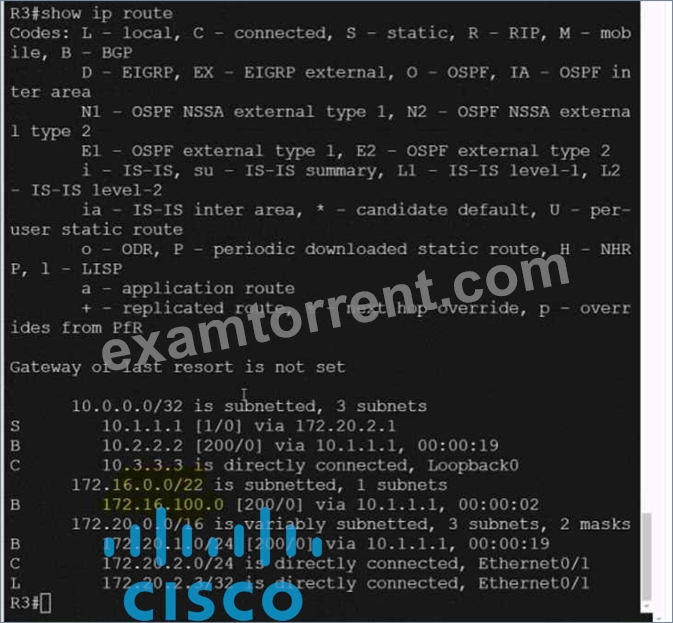
Aggregate-address 172.16.100.0 255.255.252.0 summary-only
Copy run start
R3
Router bgp 100
Neigh 10.1.1.1 remote-as 100
Neigh 10.1.1.1 update-source loopback 0
Copy run start
Verification: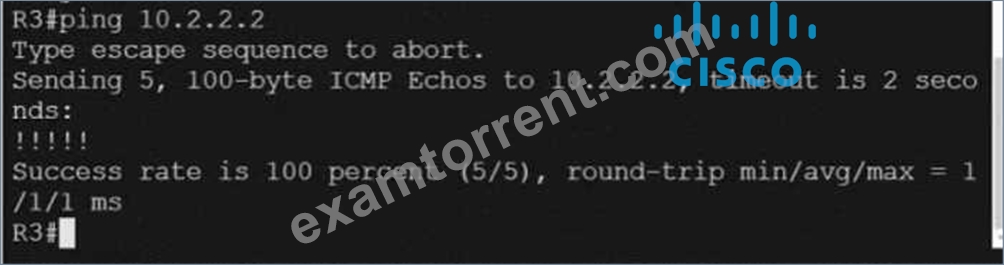
NEW QUESTION # 31
Refer to the exhibit. A service provider has LDP and segment routing running in the network.
Mobility traffic is carried through LDP and enterprise traffic is carried through segment routing.
Which configuration must be implemented to connect the bank branch with the HUB site on routers?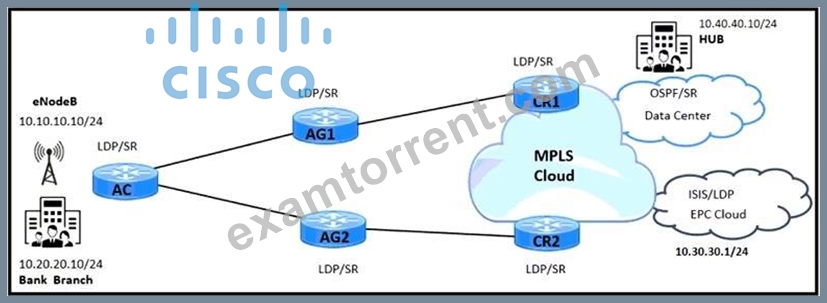
- A. Configure segment-routing Sr-prefer prefix-list on AGI and AG2 router for 10.10.10.10/24.
- B. Configure segment-routing sr-prefer prefix-list on CRI and CR2 routers for 10.20.20.10/24.
- C. Enable segment-routing Mpls Sr-prefer on AGI and AG2 routers for 10.0.0.0/8.
- D. Enable segment-routing Mpls Sr-prefer on CRI and CR2 routers for 10.0.0.0/8.
Answer: B
NEW QUESTION # 32
Refer to the exhibit. Customers A and C are experiencing packet drops when connecting to the application server. While troubleshooting the problem, the network engineer confines that the IS- IS Level-1/2 adjacency is up between routers A, B, C, and D and both customers can communicate with the database server without packet loss. Which action must the engineer take to resolve the issue?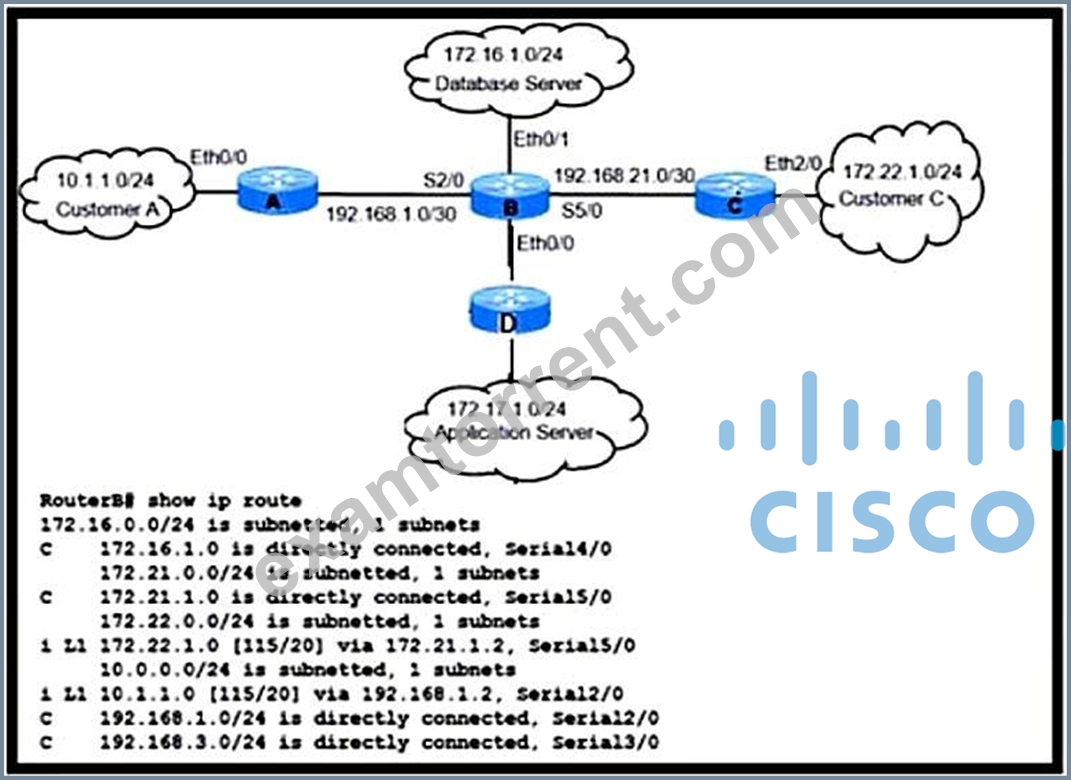
- A. Advertise a static default route to the router B IS-IS database.
- B. Leak the customer A and customer C subnets in the router A IS-IS database.
- C. Advertise the application server subnet in the router D IS-IS database
- D. Leak the 172.17.1.0/24 route in the IS-IS databases on routers A and C.
Answer: C
NEW QUESTION # 33
Refer to the exhibit.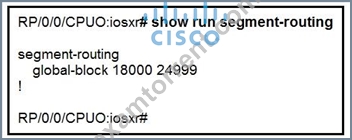
A network engineer implemented this segment routing configuration. Which statement about the output is true?
- A. This range conflicts with the segment routing local block range.
- B. The device must be reloaded for these ranges to be allocated and used.
- C. A nondefault segment routing global block range is being used on this device.
- D. The default segment routing global block range is being used on this device.
Answer: C
Explanation:
Reference:
segment-routing-book/seg-routing-global-block.html
NEW QUESTION # 34
Refer to the exhibit.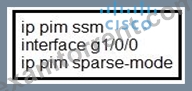
Which task must you perform on interface g1/0/0 to complete the SSM implementation?
- A. configure IGMPv3
- B. enable CDP
- C. disable IGMP
- D. configure OSPFv3
Answer: A
NEW QUESTION # 35
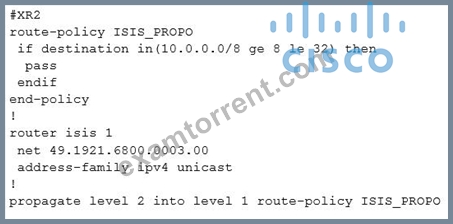
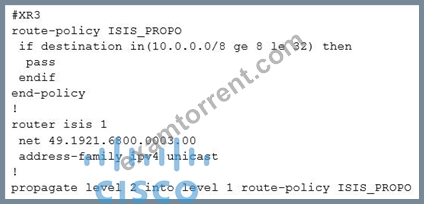
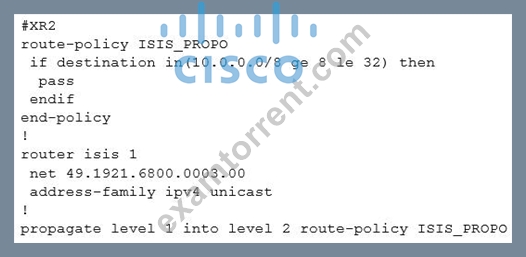
Refer to the exhibit. A network operator must inject a Level 1 route from XR2 (10.16.16.0/24) into the ISIS topology.
Which configuration allows the injection in a way that XR3 and XR1 have a valid and working route for 10.16.16.0/24?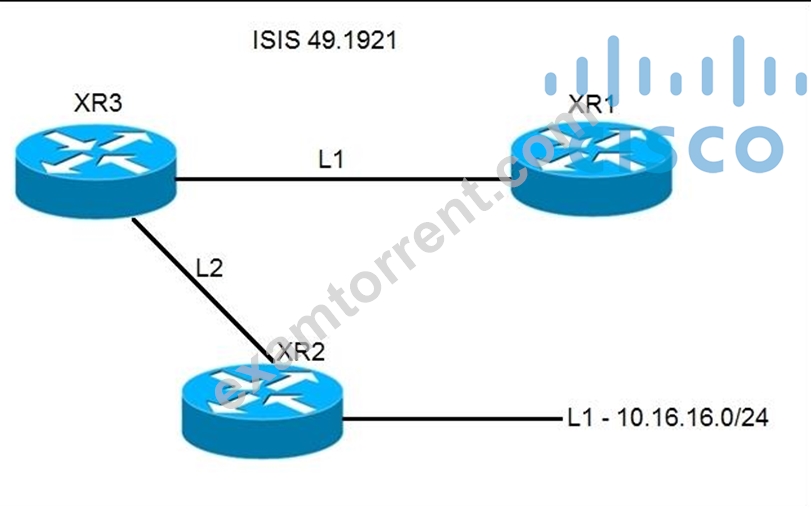
- A.
- B.
- C.
- D.
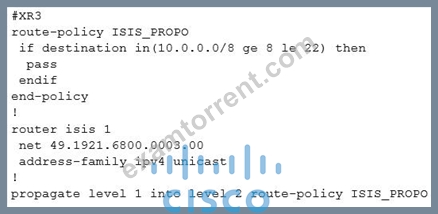
Answer: B
Explanation:
L1 route injected by XR2 won't be advertised to XR1, since L2 routes are NOT leaked to L1 by default. An [L2-L1] route leak policy should be configured on L1/L2 router (XR3).
NEW QUESTION # 36
Refer to the exhibit. A network operator is configuring BGP PIC on CE1 on already established neighborships with PE1 and PE2 inside the fully converged MPLS network. Which element needs to be implemented to make this feature function effectively?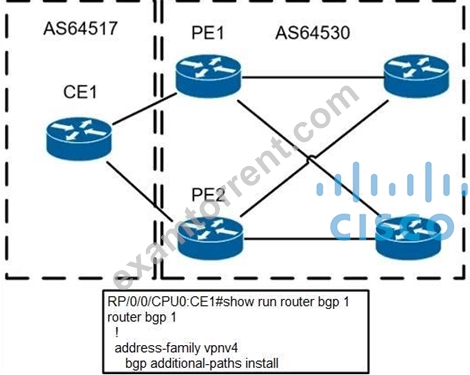
- A. The operator must ensure that all prefixes have the same next-hop from PE1 and PE2 for BGP PIC
- B. Bidirectional Forwarding Detection must be applied to the upstream facing BGP interfaces
- C. BGP import export policies must be applied on all devices for the routes needing BGP for PIC
- D. A reserved BGP community of 1:10 must be used to denote the PIC feature set to the routing protocol
Answer: B
NEW QUESTION # 37
Refer to the exhibit. Router 1 resides in a different data center than Router 2 and Router 3.
Router 1 is running the IS-IS routing protocol, and it is preconfigured with LDP and segment routing. Which configuration must the engineer apply under router isis 111 on Router 1 to implement TI-LFA on the link to Router 2 without disrupting traffic to Router 3?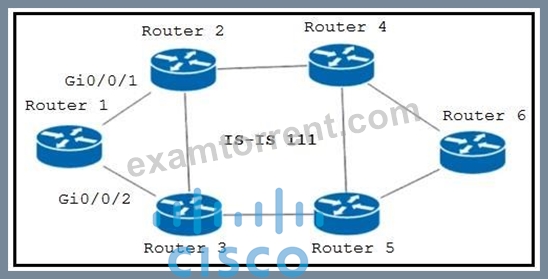
- A. interface GigabitEthernet0/0/1
fast-reroute prefix enable - B. interface GigabitEthernet0/0/1
address-family ipv4 unicast
fast-reroute per-prefix - C. interface GigabitEthernet0/0/1
fast-reroute per-prefix ti-lfa enable - D. interface GigabitEthernet0/0/1
address-family ipv4 unicast
fast-reroute per-prefix
fast-reroute per-prefix ti-lfa
Answer: D
NEW QUESTION # 38
......
Candidates for the Cisco 300-510 exam should have a strong foundation in networking technologies and protocols, as well as experience working in a service provider environment. They should be familiar with advanced routing technologies such as BGP, OSPF, IS-IS, and MPLS, and have experience designing and implementing complex routing solutions. Candidates should also be familiar with network security, network management, and network troubleshooting techniques, as these skills are critical for success in a service provider environment.
Download Free Latest Exam 300-510 Certified Sample Questions: https://vcetorrent.examtorrent.com/300-510-prep4sure-dumps.html
