

Regular Free Updates XDR-Analyst Dumps Real Exam Questions Test Engine Apr 21, 2026
Practice Test Questions Verified Answers As Experienced in the Actual Test!
Palo Alto Networks XDR-Analyst Exam Syllabus Topics:
| Topic | Details |
|---|---|
| Topic 1 |
|
| Topic 2 |
|
| Topic 3 |
|
| Topic 4 |
|
| Topic 5 |
|
NEW QUESTION # 27
Which function describes the removal of a specific file from its location on a local or removable drive to a protected folder to prevent the file from being executed?
- A. Flag for removal
- B. Search & destroy
- C. Isolation
- D. Quarantine
Answer: D
Explanation:
The function that describes the removal of a specific file from its location on a local or removable drive to a protected folder to prevent the file from being executed is quarantine. Quarantine is a feature of Cortex XDR that allows you to isolate malicious or suspicious files from the endpoint and prevent them from running or spreading. You can quarantine files manually from the Cortex XDR console, or automatically based on the malware analysis profile or the remediation suggestions. When you quarantine a file, the Cortex XDR agent encrypts the file and moves it to a hidden folder under the agent installation directory. The file is also renamed with a random string and a .quarantine extension. You can view, restore, or delete the quarantined files from the Cortex XDR console. Reference:
Quarantine Files
Manage Quarantined Files
NEW QUESTION # 28
What contains a logical schema in an XQL query?
- A. Bin
- B. Dataset
- C. Field
- D. Array expand
Answer: C
Explanation:
A logical schema in an XQL query is a field, which is a named attribute of a dataset. A field can have a data type, such as string, integer, boolean, or array. A field can also have a modifier, such as bin or expand, that transforms the field value in the query output. A field can be used in the select, where, group by, order by, or having clauses of an XQL query. Reference:
XQL Syntax
XQL Data Types
XQL Field Modifiers
NEW QUESTION # 29
As a Malware Analyst working with Cortex XDR you notice an alert suggesting that there was a prevented attempt to open a malicious Word document. You learn from the WildFire report and AutoFocus that this document is known to have been used in Phishing campaigns since 2018. What steps can you take to ensure that the same document is not opened by other users in your organization protected by the Cortex XDR agent?
- A. Enable DLL Protection on all endpoints but there might be some false positives.
- B. No step is required because the malicious document is already stopped.
- C. No step is required because Cortex shares IOCs with our fellow Cyber Threat Alliance members.
- D. Create Behavioral Threat Protection (BTP) rules to recognize and prevent the activity.
Answer: D
Explanation:
The correct answer is B, create Behavioral Threat Protection (BTP) rules to recognize and prevent the activity. BTP rules are a powerful feature of Cortex XDR that allow you to define custom rules to detect and block malicious behaviors on endpoints. You can use BTP rules to create indicators of compromise (IOCs) based on file attributes, registry keys, processes, network connections, and other criteria. By creating BTP rules, you can prevent the same malicious Word document from being opened by other users in your organization, even if the document has a different name or hash value. BTP rules are updated through content updates and can be managed from the Cortex XDR console.
The other options are incorrect for the following reasons:
A is incorrect because enabling DLL Protection on all endpoints is not a specific or effective way to prevent the malicious Word document. DLL Protection is a feature of Cortex XDR that prevents the loading of unsigned or untrusted DLLs by protected processes. However, this feature does not apply to Word documents or macros, and may cause false positives or compatibility issues with legitimate applications.
C is incorrect because relying on Cortex to share IOCs with the Cyber Threat Alliance members is not a proactive or sufficient way to prevent the malicious Word document. The Cyber Threat Alliance is a group of cybersecurity vendors that share threat intelligence and best practices to improve their products and services. However, not all vendors are members of the alliance, and not all IOCs are shared or updated in a timely manner. Therefore, you cannot assume that other users in your organization are protected by the same IOCs as Cortex XDR.
D is incorrect because doing nothing is not a responsible or secure way to prevent the malicious Word document. Even though Cortex XDR agent prevented the attempt to open the document on one endpoint, it does not mean that the document is no longer a threat. The document may still be circulating in your network or email system, and may be opened by other users who have different agent profiles or policies. Therefore, you should take steps to identify and block the document across your organization.
Reference:
Cortex XDR Agent Administrator Guide: Behavioral Threat Protection
Cortex XDR Agent Administrator Guide: DLL Protection
Palo Alto Networks: Cyber Threat Alliance
NEW QUESTION # 30
What is the action taken out by Managed Threat Hunting team for Zero Day Exploits?
- A. MTH researches for threats in the tenant and generates a report with the findings.
- B. MTH runs queries and investigative actions and no further action is taken.
- C. MTH researches for threats in the logs and reports to engineering.
- D. MTH pushes content updates to prevent against the zero-day exploits.
Answer: A
Explanation:
The Managed Threat Hunting (MTH) team is a group of security experts who proactively hunt for threats in the Cortex XDR tenant and generate a report with the findings. The MTH team uses advanced queries and investigative actions to identify and analyze potential threats, such as zero-day exploits, that may have bypassed the prevention and detection capabilities of Cortex XDR. The MTH team also provides recommendations and best practices to help customers remediate the threats and improve their security posture. Reference:
Managed Threat Hunting Service
Managed Threat Hunting Report
NEW QUESTION # 31
Which statement is correct based on the report output below?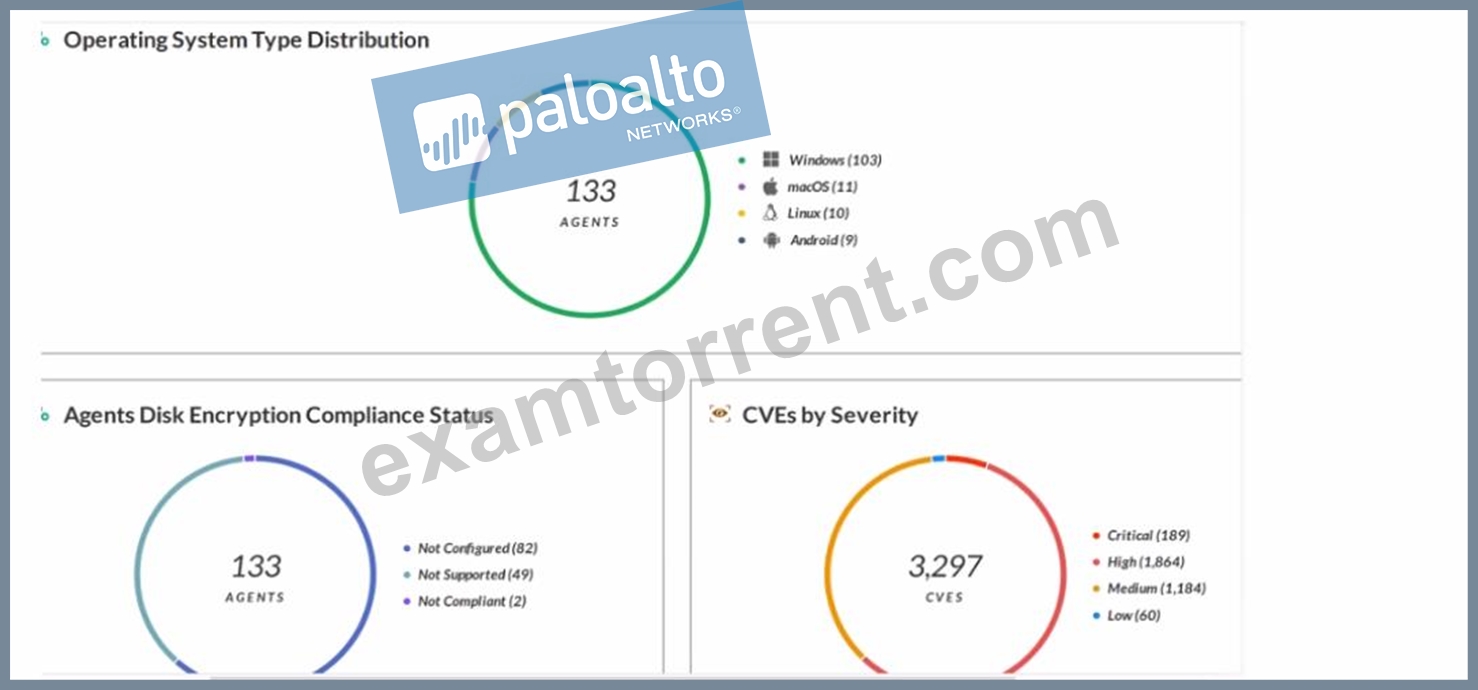
- A. 133 agents have full disk encryption.
- B. Host Inventory Data Collection is enabled.
- C. Forensic inventory data collection is enabled.
- D. 3,297 total incidents have been detected.
Answer: C
Explanation:
The report output shows the number of endpoints that have forensic inventory data collection enabled, which is a feature of Cortex XDR that allows the collection of detailed information about the endpoint's hardware, software, and network configuration. This feature helps analysts to investigate and respond to incidents more effectively by providing a comprehensive view of the endpoint's state and activity. Forensic inventory data collection can be enabled or disabled per policy in Cortex XDR. Reference:
Forensic Inventory Data Collection
Cortex XDR 3: Getting Started with Endpoint Protection
NEW QUESTION # 32
Which Type of IOC can you define in Cortex XDR?
- A. destination port
- B. full path
- C. App-ID
- D. e-mail address
Answer: B
Explanation:
Cortex XDR allows you to define IOCs based on various criteria, such as file hashes, registry keys, IP addresses, domain names, and full paths. A full path IOC is a specific location of a file or folder on an endpoint, such as C:\Windows\System32\calc.exe. You can use full path IOCs to detect and respond to malicious files or folders that are located in known locations on your endpoints12.
Let's briefly discuss the other options to provide a comprehensive explanation:
A . destination port: This is not the correct answer. Destination port is not a type of IOC that you can define in Cortex XDR. Destination port is a network attribute that indicates the port number to which a packet is sent. Cortex XDR does not support defining IOCs based on destination ports, but you can use XQL queries to filter network events by destination ports3.
B . e-mail address: This is not the correct answer. E-mail address is not a type of IOC that you can define in Cortex XDR. E-mail address is an identifier that is used to send and receive e-mails. Cortex XDR does not support defining IOCs based on e-mail addresses, but you can use the Cortex XDR - IOC integration with Cortex XSOAR to ingest IOCs from various sources, including e-mail addresses4.
D . App-ID: This is not the correct answer. App-ID is not a type of IOC that you can define in Cortex XDR. App-ID is a feature of Palo Alto Networks firewalls that identifies and controls applications on the network. Cortex XDR does not support defining IOCs based on App-IDs, but you can use the Cortex XDR Analytics app to create custom rules that use App-IDs as part of the rule logic5.
In conclusion, full path is the type of IOC that you can define in Cortex XDR. By using full path IOCs, you can enhance your detection and response capabilities and protect your endpoints from malicious files or folders.
Reference:
Create an IOC Rule
XQL Reference Guide: Network Events Schema
Cortex XDR - IOC
Cortex XDR Analytics App
PCDRA: Which Type of IOC can define in Cortex XDR?
NEW QUESTION # 33
Which of the following best defines the Windows Registry as used by the Cortex XDR agent?
- A. a system of files used by the operating system to commit memory that exceeds the available hardware resources. Also known as the "swap"
- B. a ledger for maintaining accurate and up-to-date information on total disk usage and disk space remaining available to the operating system
- C. a central system, available via the internet, for registering officially licensed versions of software to prove ownership
- D. a hierarchical database that stores settings for the operating system and for applications
Answer: D
Explanation:
The Windows Registry is a hierarchical database that stores settings for the operating system and for applications that run on Windows. The registry contains information, settings, options, and other values for programs and hardware installed on all versions of Microsoft Windows operating systems. The registry is organized into five main sections, called hives, each of which contains keys, subkeys, and values. The Cortex XDR agent uses the registry to store its configuration, status, and logs, as well as to monitor and control the endpoint's security features. The Cortex XDR agent also allows you to run scripts that can read, write, or delete registry keys and values on the endpoint. Reference:
Windows Registry - Wikipedia
Registry Operations
NEW QUESTION # 34
To stop a network-based attack, any interference with a portion of the attack pattern is enough to prevent it from succeeding. Which statement is correct regarding the Cortex XDR Analytics module?
- A. It does not interfere with any portion of the pattern on the endpoint.
- B. It interferes with the pattern as soon as it is observed on the endpoint.
- C. It does not need to interfere with the any portion of the pattern to prevent the attack.
- D. It interferes with the pattern as soon as it is observed by the firewall.
Answer: B
Explanation:
The correct statement regarding the Cortex XDR Analytics module is D, it interferes with the pattern as soon as it is observed on the endpoint. The Cortex XDR Analytics module is a feature of Cortex XDR that uses machine learning and behavioral analytics to detect and prevent network-based attacks on endpoints. The Cortex XDR Analytics module analyzes the network traffic and activity on the endpoint, and compares it with the attack patterns defined by Palo Alto Networks threat research team. The Cortex XDR Analytics module interferes with the attack pattern as soon as it is observed on the endpoint, by blocking the malicious network connection, process, or file. This way, the Cortex XDR Analytics module can stop the attack before it causes any damage or compromise.
The other statements are incorrect for the following reasons:
A is incorrect because the Cortex XDR Analytics module does interfere with the attack pattern on the endpoint, by blocking the malicious network connection, process, or file. The Cortex XDR Analytics module does not rely on the firewall or any other network device to stop the attack, but rather uses the Cortex XDR agent installed on the endpoint to perform the interference.
B is incorrect because the Cortex XDR Analytics module does not interfere with the attack pattern as soon as it is observed by the firewall. The Cortex XDR Analytics module does not depend on the firewall or any other network device to detect or prevent the attack, but rather uses the Cortex XDR agent installed on the endpoint to perform the analysis and interference. The firewall may not be able to observe or block the attack pattern if it is encrypted, obfuscated, or bypassed by the attacker.
C is incorrect because the Cortex XDR Analytics module does need to interfere with the attack pattern to prevent the attack. The Cortex XDR Analytics module does not only detect the attack pattern, but also prevents it from succeeding by blocking the malicious network connection, process, or file. The Cortex XDR Analytics module does not rely on any other response mechanism or human intervention to stop the attack, but rather uses the Cortex XDR agent installed on the endpoint to perform the interference.
Reference:
Cortex XDR Analytics Module
Cortex XDR Analytics Module Detection and Prevention
NEW QUESTION # 35
When reaching out to TAC for additional technical support related to a Security Event; what are two critical pieces of information you need to collect from the Agent? (Choose Two)
- A. The agent technical support file.
- B. The unique agent id.
- C. The prevention archive from the alert.
- D. The distribution id of the agent.
- E. A list of all the current exceptions applied to the agent.
Answer: A,C
Explanation:
When reaching out to TAC for additional technical support related to a security event, two critical pieces of information you need to collect from the agent are:
The agent technical support file. This is a file that contains diagnostic information about the agent, such as its configuration, status, logs, and system information. The agent technical support file can help TAC troubleshoot and resolve issues with the agent or the endpoint. You can generate and download the agent technical support file from the Cortex XDR console, or from the agent itself.
The prevention archive from the alert. This is a file that contains forensic data related to the alert, such as the process tree, the network activity, the registry changes, and the files involved. The prevention archive can help TAC analyze and understand the alert and the malicious activity. You can generate and download the prevention archive from the Cortex XDR console, or from the agent itself.
The other options are not critical pieces of information for TAC, and may not be available or relevant for every security event. For example:
The distribution id of the agent is a unique identifier that is assigned to the agent when it is installed on the endpoint. The distribution id can help TAC identify the agent and its profile, but it is not sufficient to provide technical support or forensic analysis. The distribution id can be found in the Cortex XDR console, or in the agent installation folder.
A list of all the current exceptions applied to the agent is a set of rules that define the files, processes, or behaviors that are excluded from the agent's security policies. The exceptions can help TAC understand the agent's configuration and behavior, but they are not essential to provide technical support or forensic analysis. The exceptions can be found in the Cortex XDR console, or in the agent configuration file.
The unique agent id is a unique identifier that is assigned to the agent when it registers with Cortex XDR. The unique agent id can help TAC identify the agent and its endpoint, but it is not sufficient to provide technical support or forensic analysis. The unique agent id can be found in the Cortex XDR console, or in the agent log file.
Reference:
Generate and Download the Agent Technical Support File
Generate and Download the Prevention Archive
Cortex XDR Agent Administrator Guide: Agent Distribution ID
Cortex XDR Agent Administrator Guide: Exception Security Profiles
[Cortex XDR Agent Administrator Guide: Unique Agent ID]
NEW QUESTION # 36
In incident-related widgets, how would you filter the display to only show incidents that were "starred"?
- A. Click the star in the widget
- B. Create a custom report and filter on starred incidents
- C. This is not currently supported
- D. Create a custom XQL widget
Answer: A
Explanation:
To filter the display to only show incidents that were "starred", you need to click the star in the widget. This will apply a filter that shows only the incidents that contain a starred alert, which is an alert that matches a specific condition that you define in the incident starring configuration. You can use the incident starring feature to prioritize and focus on the most important or relevant incidents in your environment1.
Let's briefly discuss the other options to provide a comprehensive explanation:
A . Create a custom XQL widget: This is not the correct answer. Creating a custom XQL widget is not necessary to filter the display to only show starred incidents. A custom XQL widget is a widget that you create by using the XQL query language to define the data source and the visualization type. You can use custom XQL widgets to create your own dashboards or reports, but they are not required for filtering incidents by stars2.
B . This is not currently supported: This is not the correct answer. Filtering the display to only show starred incidents is currently supported by Cortex XDR. You can use the star icon in the widget to apply this filter, or you can use the Filter Builder to create a custom filter based on the Starred field1.
C . Create a custom report and filter on starred incidents: This is not the correct answer. Creating a custom report and filtering on starred incidents is not the only way to filter the display to only show starred incidents. A custom report is a report that you create by using the Report Builder to define the data source, the layout, and the schedule. You can use custom reports to generate and share periodic reports on your Cortex XDR data, but they are not the only option for filtering incidents by stars3.
In conclusion, clicking the star in the widget is the simplest and easiest way to filter the display to only show incidents that were "starred". By using this feature, you can quickly identify and focus on the most critical or relevant incidents in your environment.
Reference:
Filter Incidents by Stars
Create a Custom XQL Widget
Create a Custom Report
NEW QUESTION # 37
What functionality of the Broker VM would you use to ingest third-party firewall logs to the Cortex Data Lake?
- A. Pathfinder
- B. Netflow Collector
- C. DB Collector
- D. Syslog Collector
Answer: D
Explanation:
The Broker VM is a virtual machine that acts as a data broker between third-party data sources and the Cortex Data Lake. It can ingest different types of data, such as syslog, netflow, database, and pathfinder. The Syslog Collector functionality of the Broker VM allows it to receive syslog messages from third-party devices, such as firewalls, routers, switches, and servers, and forward them to the Cortex Data Lake. The Syslog Collector can be configured to filter, parse, and enrich the syslog messages before sending them to the Cortex Data Lake. The Syslog Collector can also be used to ingest logs from third-party firewall vendors, such as Cisco, Fortinet, and Check Point, to the Cortex Data Lake. This enables Cortex XDR to analyze the firewall logs and provide visibility and threat detection across the network perimeter. Reference:
Cortex XDR Data Broker VM
Syslog Collector
Supported Third-Party Firewall Vendors
NEW QUESTION # 38
Cortex XDR is deployed in the enterprise and you notice a cobalt strike attack via an ongoing supply chain compromise was prevented on 1 server. What steps can you take to ensure the same protection is extended to all your servers?
- A. Enable Behavioral Threat Protection (BTP) with cytool to prevent the attack from spreading.
- B. Conduct a thorough Endpoint Malware scan.
- C. Create lOCs of the malicious files you have found to prevent their execution.
- D. Enable DLL Protection on all servers but there might be some false positives.
Answer: C
Explanation:
The best step to ensure the same protection is extended to all your servers is to create indicators of compromise (IOCs) of the malicious files you have found to prevent their execution. IOCs are pieces of information that indicate a potential threat or compromise on an endpoint, such as file hashes, IP addresses, domain names, or registry keys. You can create IOCs in Cortex XDR to block or alert on any file or network activity that matches the IOCs. By creating IOCs of the malicious files involved in the cobalt strike attack, you can prevent them from running or spreading on any of your servers.
The other options are not the best steps for the following reasons:
A is not the best step because conducting a thorough Endpoint Malware scan may not detect or prevent the cobalt strike attack if the malicious files are obfuscated, encrypted, or hidden. Endpoint Malware scan is a feature of Cortex XDR that allows you to scan endpoints for known malware and quarantine any malicious files found. However, Endpoint Malware scan may not be effective against unknown or advanced threats that use evasion techniques to avoid detection.
B is not the best step because enabling DLL Protection on all servers may cause some false positives and disrupt legitimate applications. DLL Protection is a feature of Cortex XDR that allows you to block or alert on any DLL loading activity that matches certain criteria, such as unsigned DLLs, DLLs loaded from network locations, or DLLs loaded by specific processes. However, DLL Protection may also block or alert on benign DLL loading activity that is part of normal system or application operations, resulting in false positives and performance issues.
C is not the best step because enabling Behavioral Threat Protection (BTP) with cytool may not prevent the attack from spreading if the malicious files are already on the endpoints or if the attack uses other methods to evade detection. Behavioral Threat Protection is a feature of Cortex XDR that allows you to block or alert on any endpoint behavior that matches certain patterns, such as ransomware, credential theft, or lateral movement. Cytool is a command-line tool that allows you to configure and manage the Cortex XDR agent on the endpoint. However, Behavioral Threat Protection may not prevent the attack from spreading if the malicious files are already on the endpoints or if the attack uses other methods to evade detection, such as encryption, obfuscation, or proxy servers.
Reference:
Create IOCs
Scan an Endpoint for Malware
DLL Protection
Behavioral Threat Protection
Cytool for Windows
NEW QUESTION # 39
What is an example of an attack vector for ransomware?
- A. Performing SSL Decryption on an endpoint
- B. Performing DNS queries for suspicious domains
- C. Phishing emails containing malicious attachments
- D. A URL filtering feature enabled on a firewall
Answer: C
Explanation:
An example of an attack vector for ransomware is phishing emails containing malicious attachments. Phishing is a technique that involves sending fraudulent emails that appear to come from a legitimate source, such as a bank, a company, or a government agency. The emails typically contain a malicious attachment, such as a PDF document, a ZIP archive, or a Microsoft Office document, that contains ransomware or a ransomware downloader. When the recipient opens or downloads the attachment, the ransomware is executed and encrypts the files or data on the victim's system. The attacker then demands a ransom for the decryption key, usually in cryptocurrency.
Phishing emails are one of the most common and effective ways of delivering ransomware, as they can bypass security measures such as firewalls, antivirus software, or URL filtering. Phishing emails can also exploit the human factor, as they can trick the recipient into opening the attachment by using social engineering techniques, such as impersonating a trusted sender, creating a sense of urgency, or appealing to curiosity or greed. Phishing emails can also target specific individuals or organizations, such as executives, employees, or customers, in a technique called spear phishing, which increases the chances of success.
According to various sources, phishing emails are the main vector of ransomware attacks, accounting for more than 90% of all ransomware infections12. Some of the most notorious ransomware campaigns, such as CryptoLocker, Locky, and WannaCry, have used phishing emails as their primary delivery method3 . Therefore, it is essential to educate users on how to recognize and avoid phishing emails, as well as to implement security solutions that can detect and block malicious attachments. Reference:
Top 7 Ransomware Attack Vectors & How to Avoid Becoming a Victim - Bitsight What Is the Main Vector of Ransomware Attacks? A Definitive Guide CryptoLocker Ransomware Information Guide and FAQ
[Locky Ransomware Information, Help Guide, and FAQ]
[WannaCry ransomware attack]
NEW QUESTION # 40
How does Cortex XDR agent for Windows prevent ransomware attacks from compromising the file system?
- A. by encrypting the disk first.
- B. by patching vulnerable applications.
- C. by retrieving the encryption key.
- D. by utilizing decoy Files.
Answer: D
Explanation:
Cortex XDR agent for Windows prevents ransomware attacks from compromising the file system by utilizing decoy files. Decoy files are randomly generated files that are placed in strategic locations on the endpoint, such as the user's desktop, documents, and pictures folders. These files are designed to look like valuable data that ransomware would target for encryption. When Cortex XDR agent detects that a process is attempting to access or modify a decoy file, it immediately blocks the process and alerts the administrator. This way, Cortex XDR agent can stop ransomware attacks before they can cause any damage to the real files on the endpoint. Reference:
Anti-Ransomware Protection
PCDRA Study Guide
NEW QUESTION # 41
A Linux endpoint with a Cortex XDR Pro per Endpoint license and Enhanced Endpoint Data enabled has reported malicious activity, resulting in the creation of a file that you wish to delete. Which action could you take to delete the file?
- A. Open an NFS connection from the Cortex XDR console and delete the file.
- B. Initiate Remediate Suggestions to automatically delete the file.
- C. Manually remediate the problem on the endpoint in question.
- D. Open X2go from the Cortex XDR console and delete the file via X2go.
Answer: B
Explanation:
The best action to delete the file on the Linux endpoint is to initiate Remediation Suggestions from the Cortex XDR console. Remediation Suggestions are a feature of Cortex XDR that provide you with recommended actions to undo the effects of malicious activity on your endpoints. You can view the remediation suggestions for each alert or incident in the Cortex XDR console, and decide whether to apply them or not. Remediation Suggestions can help you restore the endpoint to its original state, remove malicious files or processes, or fix registry or system settings. Remediation Suggestions are based on the forensic data collected by the Cortex XDR agent and the analysis performed by Cortex XDR.
The other options are incorrect for the following reasons:
A is incorrect because manually remediating the problem on the endpoint is not a convenient or efficient way to delete the file. Manually remediating the problem would require you to access the endpoint directly, log in as root, locate the file, and delete it. This would also require you to have the necessary permissions and credentials to access the endpoint, and to know the exact path and name of the file. Manually remediating the problem would also not provide you with any audit trail or confirmation of the deletion.
B is incorrect because opening X2go from the Cortex XDR console is not a supported or secure way to delete the file. X2go is a third-party remote desktop software that allows you to access Linux endpoints from a graphical user interface. However, X2go is not integrated with Cortex XDR, and using it would require you to install and configure it on both the Cortex XDR console and the endpoint. Using X2go would also expose the endpoint to potential network attacks or unauthorized access, and would not provide you with any audit trail or confirmation of the deletion.
D is incorrect because opening an NFS connection from the Cortex XDR console is not a feasible or reliable way to delete the file. NFS is a network file system protocol that allows you to access files on remote servers as if they were local. However, NFS is not integrated with Cortex XDR, and using it would require you to set up and maintain an NFS server and client on both the Cortex XDR console and the endpoint. Using NFS would also depend on the network availability and performance, and would not provide you with any audit trail or confirmation of the deletion.
Reference:
Remediation Suggestions
Apply Remediation Suggestions
NEW QUESTION # 42
As a Malware Analyst working with Cortex XDR you notice an alert suggesting that there was a prevented attempt to download Cobalt Strike on one of your servers. Days later, you learn about a massive ongoing supply chain attack. Using Cortex XDR you recognize that your server was compromised by the attack and that Cortex XDR prevented it. What steps can you take to ensure that the same protection is extended to all your servers?
- A. Enable Behavioral Threat Protection (BTP) with cytool to prevent the attack from spreading.
- B. Create IOCs of the malicious files you have found to prevent their execution.
- C. Enable DLL Protection on all servers but there might be some false positives.
- D. Create Behavioral Threat Protection (BTP) rules to recognize and prevent the activity.
Answer: D
Explanation:
To ensure that the same protection is extended to all your servers, you need to create Behavioral Threat Protection (BTP) rules to recognize and prevent the activity. BTP is a feature of Cortex XDR that allows you to create custom rules that detect and block malicious or suspicious behaviors on your endpoints, such as file execution, process injection, network connection, or registry modification. BTP rules can use various operators, functions, and variables to define the criteria and the actions for the rules. By creating BTP rules that match the behaviors of the supply chain attack, you can prevent the attack from compromising your servers12.
Let's briefly discuss the other options to provide a comprehensive explanation:
B . Enable DLL Protection on all servers but there might be some false positives: This is not the correct answer. Enabling DLL Protection on all servers will not ensure that the same protection is extended to all your servers. DLL Protection is a feature of Cortex XDR that allows you to block the execution of unsigned or untrusted DLL files on your endpoints. DLL Protection can help to prevent some types of attacks that use malicious DLL files, but it may not be effective against the supply chain attack that used a Trojanized DLL file that was digitally signed by a trusted vendor. DLL Protection may also cause some false positives, as it may block some legitimate DLL files that are unsigned or untrusted3.
C . Create IOCs of the malicious files you have found to prevent their execution: This is not the correct answer. Creating IOCs of the malicious files you have found will not ensure that the same protection is extended to all your servers. IOCs are indicators of compromise that you can create to detect and respond to known threats on your endpoints, such as file hashes, registry keys, IP addresses, domain names, or full paths. IOCs can help to identify and block the malicious files that you have already discovered, but they may not be effective against the supply chain attack that used different variants of the malicious files with different hashes or names. IOCs may also become outdated, as the attackers may change or update their files to evade detection4.
D . Enable Behavioral Threat Protection (BTP) with cytool to prevent the attack from spreading: This is not the correct answer. Enabling BTP with cytool will not ensure that the same protection is extended to all your servers. BTP is a feature of Cortex XDR that allows you to create custom rules that detect and block malicious or suspicious behaviors on your endpoints, such as file execution, process injection, network connection, or registry modification. BTP rules can help to prevent the attack from spreading, but they need to be created and configured in the Cortex XDR app, not with cytool. Cytool is a command-line tool that allows you to perform various operations on the Cortex XDR agent, such as installing, uninstalling, upgrading, or troubleshooting. Cytool does not have an option to enable or configure BTP rules.
In conclusion, to ensure that the same protection is extended to all your servers, you need to create BTP rules to recognize and prevent the activity. By using BTP rules, you can create custom and flexible prevention rules that match the behaviors of the supply chain attack.
Reference:
Behavioral Threat Protection
Create a BTP Rule
DLL Protection
Create an IOC Rule
[Cytool]
NEW QUESTION # 43
The Cortex XDR console has triggered an incident, blocking a vitally important piece of software in your organization that is known to be benign. Which of the following options would prevent Cortex XDR from blocking this software in the future, for all endpoints in your organization?
- A. Create an individual alert exclusion.
- B. Create a global exception.
- C. Create an endpoint-specific exception.
- D. Create a global inclusion.
Answer: B
Explanation:
A global exception is a rule that allows you to exclude specific files, processes, or behaviors from being blocked or detected by Cortex XDR. A global exception applies to all endpoints in your organization that are protected by Cortex XDR. Creating a global exception for a vitally important piece of software that is known to be benign would prevent Cortex XDR from blocking this software in the future, for all endpoints in your organization.
To create a global exception, you need to follow these steps:
In the Cortex XDR management console, go to Policy Management > Exceptions and click Add Exception.
Select the Global Exception option and click Next.
Enter a name and description for the exception and click Next.
Select the type of exception you want to create, such as file, process, or behavior, and click Next.
Specify the criteria for the exception, such as file name, hash, path, process name, command line, or behavior name, and click Next.
Review the summary of the exception and click Finish.
Reference:
Create Global Exceptions: This document explains how to create global exceptions to exclude specific files, processes, or behaviors from being blocked or detected by Cortex XDR.
Exceptions Overview: This document provides an overview of exceptions and how they can be used to fine-tune the Cortex XDR security policy.
NEW QUESTION # 44
Under which conditions is Local Analysis evoked to evaluate a file before the file is allowed to run?
- A. The endpoint is disconnected or the verdict from WildFire is of a type grayware.
- B. The endpoint is disconnected or the verdict from WildFire is of a type unknown.
- C. The endpoint is disconnected or the verdict from WildFire is of a type malware.
- D. The endpoint is disconnected or the verdict from WildFire is of a type benign.
Answer: B
Explanation:
Local Analysis is a feature of Cortex XDR that allows the agent to evaluate files locally on the endpoint, without sending them to WildFire for analysis. Local Analysis is evoked when the following conditions are met:
The endpoint is disconnected from the internet or the Cortex XDR management console, and therefore cannot communicate with WildFire.
The verdict from WildFire is of a type unknown, meaning that WildFire has not yet analyzed the file or has not reached a conclusive verdict.
Local Analysis uses machine learning models to assess the behavior and characteristics of the file and assign it a verdict of either benign, malware, or grayware. If the verdict is malware or grayware, the agent will block the file from running and report it to the Cortex XDR management console. If the verdict is benign, the agent will allow the file to run and report it to the Cortex XDR management console. Reference:
Local Analysis
WildFire File Verdicts
NEW QUESTION # 45
......
Pass Palo Alto Networks XDR-Analyst Exam in First Attempt Easily: https://vcetorrent.examtorrent.com/XDR-Analyst-prep4sure-dumps.html
