

Pass 1z0-1073-24 Exam in First Attempt Guaranteed 100% Cover Real Exam Questions [Feb-2026]
Valid 1z0-1073-24 test answers & Oracle 1z0-1073-24 exam pdf
NEW QUESTION # 23
Your supplier is unable to deliver goods on the promise date against a back-to-back order and updates the promise date on the purchase order schedule to a later date.
How is the change handled on the source side?
- A. Order automatically goes on hold in supply orchestration, and the schedule ship date is adjusted in order management.
- B. Status quo is maintained on the supply order and sales order.
- C. Date Pushed Out exception is generated in supply orchestration, and order management is notified.
Answer: C
NEW QUESTION # 24
Your supplier is using the Supplier Portal and sends you an Advance Shipment Notice (ASN) whenever they ship goods. You have already created a consignment agreement with this supplier with the following consignment terms:
Aging Onset Point: Shipment
* Aging Period Days:3 Consumption Advice Frequency: Daily
* Consumption Advice Summary: All Organizations
For some reason, it took five days for the goods to arrive, and you have noticed that the goods are damaged.
You have now decided to send them back.
At that point, when you return the goods, who is the owner of the goods?
- A. The goods are under third-party ownership who is the shipping service provider.
- B. The goods are still under the supplier's ownership.
- C. The goods are under the buyer's ownership.
- D. The goods are under nobody's ownership because they were damaged in transit.
Answer: C
NEW QUESTION # 25
Vision Corporation manufactures two products, Air Compressors and Air Filters, in its factory unit. It also provides two services, Electrical Services and Mechanical Services, for its customers. The company submits profit and loss statements for each of its products and services separately.
Vision Corporation is located in the UK and submits its reports using UK Statements of Standard Accounting Practice and Financial Reporting standards.
Which is a suitable enterprise configuration for Vision Corporation?
- A. 1 Business Unit, 1 Ledger, and 1 Legal Entity
- B. 4 Business Units, 1 Ledger, and 1 Legal Entity
- C. 2 Business Units, 1 Ledger, and 1 Legal Entity
Answer: B
NEW QUESTION # 26
What happens when Transfer Order Required is not enabled in the Manage Interorganization Parameters page for Direct Organization Transfer?
- A. Transfer orders cannot be created only from inventory.
- B. Transfer orders can be created, but approval is mandatory.
- C. Transfer orders cannot be created.
- D. Both interorganization transfers and transfer orders can be created. (*)
Answer: D
NEW QUESTION # 27
Back to Back fulfillment
Overview of Back-to-Back Fulfillment
The back-to-back fulfillment process is one in which specific sales order demand triggers supply creation, and a link is established between the sales order and the supply.
Note: Back-to-back flow is currently supported only for discrete manufacturing.
The following figure provides a high-level flow diagram showing the back-to-back supply creation and fulfillment process flow.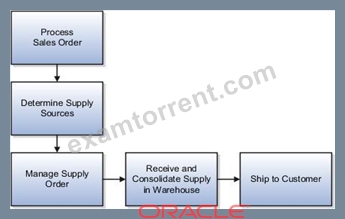
Back-to-back fulfillment is where supply is procured and then received at a warehouse only after an order is placed.
The supply is reserved against a sales order until shipping.
This process provides support to create and link supply after a sales order is entered and scheduled, allowing you to reduce your inventory while maintaining the ability to respond to customer demands.
You create supply for a back-to-back order using one or more of the following back-to-back flows:
*Buy: Procurement from an external supplier.
*Make: Production in an internal manufacturing facility (includes in-house manufacturing and contract manufacturing).
*Transfer: Transfer from another warehouse.
*On hand: Reservation of on-hand supply in the fulfillment organization.
Note: For information about back-to-back flows for contract manufacturing, see the Implementing Contract Manufacturing chapter in this guide.
After the supply is received into the fulfillment warehouse, the back-to-back order is ready for shipment to the customer.
Answer:
Explanation:
See the Explanation for the complete solution.
Explanation:
Back-to-Back Fulfillment in Oracle Inventory Cloud
Back-to-back fulfillment in Oracle Inventory Cloud is a supply chain process where supply is created only after a sales order is placed. This process links the demand (customer sales order) directly to the supply (procurement, manufacturing, transfer, or existing stock), ensuring efficient inventory management while meeting customer demands. Below is a detailed step-by-step explanation of the back-to-back fulfillment process.
1. Overview of Back-to-Back Fulfillment Process
* The back-to-back (B2B) fulfillment process ensures that supply is created only when a customer order is received.
* Supply is specifically reserved for the sales order until shipping.
* This process helps reduce excess inventory while maintaining responsiveness to customer needs.
* It supports four fulfillment strategies: Buy, Make, Transfer, and On Hand Reservation.
* Back-to-back fulfillment is mainly used in discrete manufacturing environments.
2. Step-by-Step Back-to-Back Fulfillment Process in Oracle Inventory Cloud The back-to-back fulfillment process consists of the following key steps:
Step 1: Process Sales Order
* The sales order is created in Oracle Order Management.
* The order is validated for correctness (items, quantities, prices, etc.).
* The order is scheduled, and the system checks if on-hand inventory is available.
* If no inventory is available, Oracle Supply Chain Orchestration initiates a back-to-back fulfillment request.
Step 2: Determine Supply Sources
* Oracle Supply Chain Orchestration (SCO) determines the best supply source based on predefined rules and sourcing strategies.
* The system evaluates the following supply options:
* Buy: Procurement from an external supplier.
* Make: Internal manufacturing or contract manufacturing.
* Transfer: Movement of inventory from another warehouse or distribution center.
* On Hand: Direct reservation of existing inventory.
Step 3: Create and Manage the Supply Order
* A supply order is generated in Oracle Supply Chain Orchestration.
* The order is assigned to the appropriate fulfillment method:
* Buy Order: A purchase requisition is created in Oracle Procurement Cloud, and the supplier provides the required goods.
* Make Order: A work order is created in Oracle Manufacturing Cloud, and production begins.
* Transfer Order: A transfer request is initiated in Oracle Inventory Management, moving stock from another warehouse.
* On-Hand Reservation: If stock is available, it is reserved against the sales order.
* Oracle monitors the progress of the supply order until completion.
Step 4: Receive and Consolidate Supply in Warehouse
* Once supply is procured, manufactured, or transferred, it is received in the fulfillment warehouse.
* If it is a purchased item, a receipt is created in Oracle Receiving.
* If it is a manufactured item, the work order is completed, and inventory is updated.
* The system ensures that the received inventory is linked to the original sales order.
Step 5: Ship to Customer
* The sales order is released for fulfillment.
* A Pick Release process is initiated in Oracle Inventory Cloud to allocate stock.
* The order is picked, packed, and shipped using Oracle Shipping Execution.
* A shipping confirmation is generated, and an invoice is created in Oracle Receivables.
* The sales order is marked as complete, and the supply order is closed.
3. Detailed Explanation of Back-to-Back Fulfillment Flows
1. Buy Flow (Procurement)
* If the supply is sourced externally, the system generates a purchase order in Oracle Procurement Cloud.
* The supplier delivers the goods, which are received in Oracle Receiving.
* The inventory is updated, and the order is prepared for shipment.
* The sales order is fulfilled once the goods arrive.
2. Make Flow (Manufacturing)
* If the item is manufactured internally, a work order is created in Oracle Manufacturing Cloud.
* Production is executed, and the finished product is stored in inventory.
* The system reserves the item against the sales order.
* The order is fulfilled when the product is available.
3. Transfer Flow (Warehouse Transfer)
* If the item is available in another warehouse, a transfer order is generated in Oracle Inventory Cloud.
* The inventory is moved to the fulfillment warehouse.
* Once received, the inventory is reserved and prepared for shipment.
* The sales order is completed upon shipment.
4. On Hand Flow (Inventory Reservation)
* If the item is available in stock, the system directly reserves it.
* The order moves to the shipping phase without additional procurement or manufacturing steps.
* The pick, pack, and ship process is executed, and the order is fulfilled.
4. Key Benefits of Back-to-Back Fulfillment in Oracle Inventory Cloud
# Reduced Inventory Holding Costs - Stock is only procured, manufactured, or transferred when needed.# Improved Order Fulfillment Efficiency - Orders are linked directly to supply, reducing delays.# Better Customer Satisfaction - Customers receive products faster with reduced stockouts.# Automated Supply Chain Coordination - Oracle Cloud applications ensure seamless integration between order management, procurement, manufacturing, and inventory.# Flexibility in Sourcing - Users can choose between procurement, manufacturing, transfer, or existing stock to fulfill demand efficiently.
5. Oracle Cloud Modules Involved in Back-to-Back Fulfillment
A screenshot of a computer AI-generated content may be incorrect.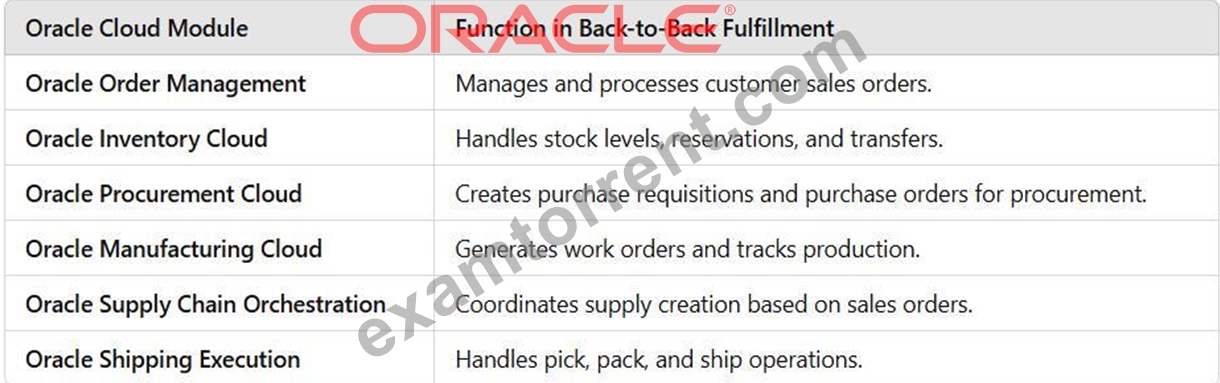
6. Example Use Case: Back-to-Back Fulfillment in Action
Scenario:A customer places an order for 100 units of Item XYZ, but there is no stock available in the warehouse.
Solution:
* The system checks stock availability and identifies that back-to-back fulfillment is required.
* The sourcing rules determine that procurement from an external supplier is the best option.
* A purchase requisition is created in Oracle Procurement Cloud.
* The supplier delivers the items, and they are received into inventory.
* The inventory is reserved against the sales order.
* The shipping process is initiated, and the order is delivered to the customer.
* The sales order and supply order are closed.
NEW QUESTION # 28
When using the Create Interorganization Transfer process, you find that there is no option to generate or create a shipment number for a direct organization transfer. The Generate Shipment Number button is disabled
/grayed out.
What could be the reason?
- A. Shipment numbers are not generated for transfers using direct organization transfer.
- B. The inventory organization is not enabled for shipment number generation.
- C. The interorganization parameter is not set up completely.
Answer: A
NEW QUESTION # 29
Your quality department wants to return some of the items to the supplier. However, you are unable to find the corresponding purchase orders to create the return.What could be the reason?
- A. The purchase order is in the Finally Closed status.
- B. The receipt includes consigned items.
- C. Receipt Close Point is set to Delivered.
Answer: A
NEW QUESTION # 30
Against a Purchase Order quantity of 100, your receiving agent has received 50 items in the receiving type subinventory. Later in the day, 25 items have been put away to inventory. What is the item availability in the Manage Item Quantity UI?
- A. On-Hand: 25, Receiving: 25, Inbound: 0
- B. On-Hand: 25, Receiving: 25, Inbound: 50 (*)
- C. On-Hand: 25, Receiving: 50, Inbound: 50
- D. On-Hand: 50, Receiving: 50, Inbound: 0
Answer: B
NEW QUESTION # 31
Which statement is true when you use kit items on a transfer order?
- A. Component-level picking, shipping, and receiving are possible.
- B. Shipment Set Behavior is not applicable for kit items.
- C. Only component-level picking is possible.
Answer: A
NEW QUESTION # 32
Which interface tables should be populated to import inventory transactions using the FBDI template?
- A. INV_BALANCE_TXNS_INT and CST_I_INCOMING_TXN_COSTS
- B. INV_RESERVATIONS_INTERFACE and INV_BALANCE_TXNS_INT
- C. CST_I_INCOMING_TXN_COSTS and INV_TRANSACTIONS_INTERFACE
Answer: C
NEW QUESTION # 33
Back-to-Back Supply Creation Flows
You can set up Oracle Fusion Cloud applications that support back-to-back fulfillment to trigger supply creations flows (buy, make, transfer, and on hand) after a sales order is entered and scheduled.
Each variant of the back-to-back flow differs in the supply document that's created and the supply execution application in which the document is created. Depending on the source of the item, supply is provided from manufacturing, procurement, or inventory. Then, after the supply is received into the fulfillment warehouse, the back-to-back order is ready for shipment to your customer.
The following table describes the supply creation flows and associated supply document supported for each flow when using back-to-back fulfillment.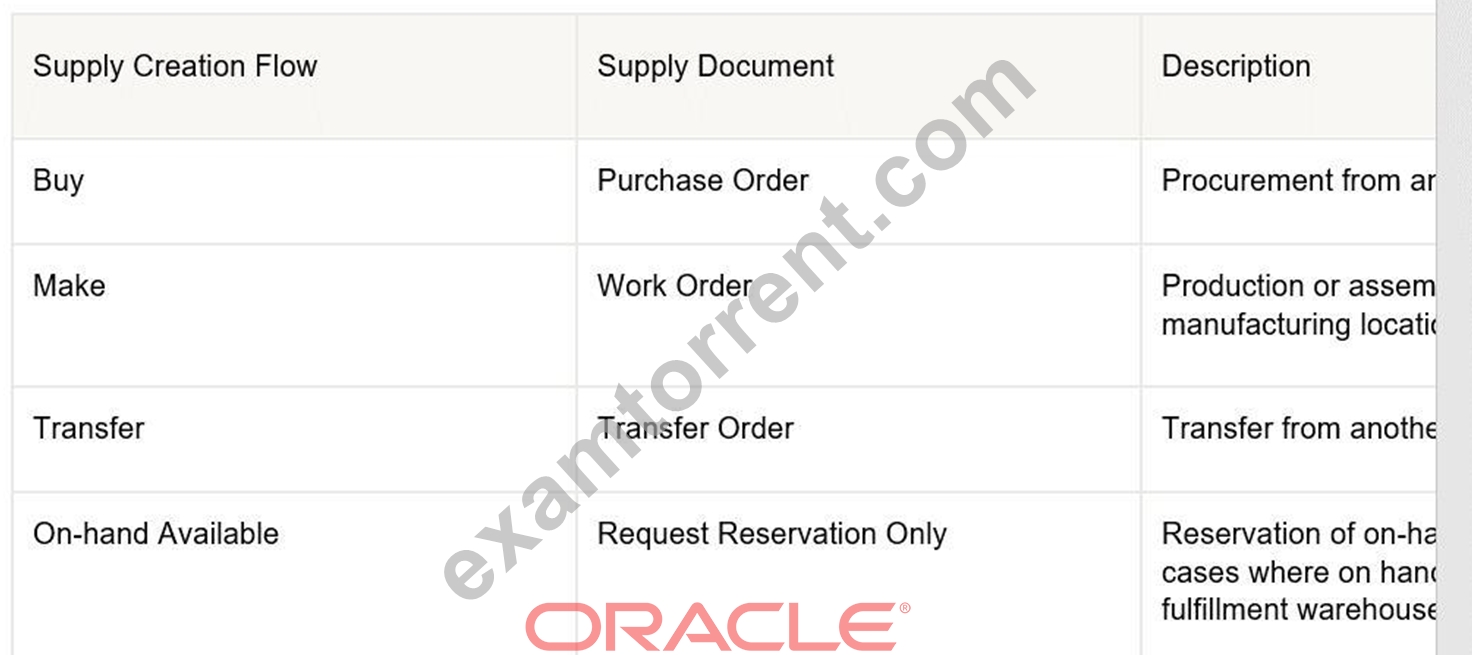
Back-to-Back Supply Creation Buy Flow
The supply document for a back-to-back buy flow is a purchase order. Based on supply recommendations from Oracle Global Order Promising, a purchase order is created and reserved against the sales order. When the purchase order is received by the supplier, on hand is created to ship out the back-to-back sales order.
The following figure shows the back-to-back supply creation buy flow.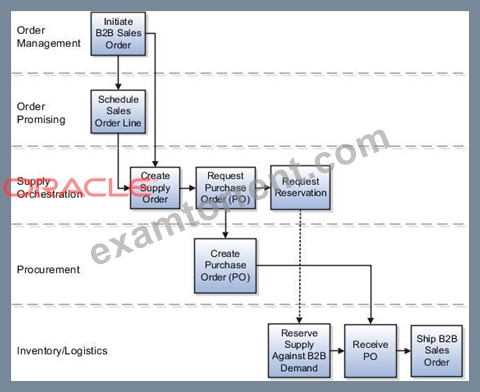
Answer:
Explanation:
See the Explanation for the complete solution.
Explanation:
Back-to-Back Supply Creation Flows in Oracle Cloud
Back-to-back (B2B) fulfillment in Oracle Fusion Cloud allows organizations to trigger supply creation (Buy, Make, Transfer, or On-Hand Reservation) after a sales order is entered and scheduled. The system dynamically generates supply documents depending on the source of the item and executes supply fulfillment through Oracle Procurement, Manufacturing, or Inventory Management.
1. Overview of Back-to-Back Supply Creation Flows
Each back-to-back flow follows these key steps:
* Sales Order Entry & Scheduling - A customer places an order that requires supply creation.
* Supply Order Generation - The system determines the best supply source based on predefined sourcing rules.
* Supply Execution - The supply is created using procurement (Buy), manufacturing (Make), transfer (Transfer), or existing stock (On-Hand).
* Receiving & Reservation - The supply is received and linked to the sales order.
* Order Fulfillment - The sales order is shipped to the customer.
2. Back-to-Back Supply Creation Buy Flow (Procurement-Based Fulfillment) The Buy Flow is used when the required item is procured from an external supplier because it is not available in stock or another warehouse.
Step-by-Step Buy Flow Process
Below is the step-by-step breakdown of the Back-to-Back Buy Flow with Oracle Fusion applications involved:
Step 1: Initiate Back-to-Back Sales Order
* The customer places a sales order in Oracle Order Management.
* The system checks stock availability in Oracle Inventory Cloud.
* If no stock is available, Oracle Supply Chain Orchestration (SCO) triggers a supply request.
* Oracle Global Order Promising (GOP) determines procurement as the best supply source.
* The sales order is scheduled for back-to-back fulfillment.
# System Action: The system marks the sales order for procurement and creates a supply order.
Step 2: Create Supply Order
* Oracle Supply Chain Orchestration (SCO) generates a Supply Order.
* The system determines that a Purchase Order (PO) is needed.
* A Purchase Requisition is created in Oracle Procurement Cloud.
# System Action: The system sends a request for procurement.
Step 3: Request Purchase Order (PO)
* Oracle Procurement Cloud converts the requisition into a Purchase Order (PO).
* The PO is sent to the external supplier.
* The PO is linked to the sales order, ensuring that supply is dedicated to fulfilling the order.
# System Action: The system creates a Purchase Order (PO) and tracks supplier delivery.
Step 4: Receive the Purchase Order (PO)
* The supplier delivers the goods to the fulfillment warehouse.
* The warehouse team receives the PO in Oracle Receiving.
* The received inventory is updated in Oracle Inventory Cloud.
* The supply is reserved against the back-to-back demand.
# System Action: The system marks the received supply as reserved for the sales order.
Step 5: Ship the Back-to-Back Sales Order
* The order is picked, packed, and shipped from the warehouse.
* Oracle Shipping Execution updates the order status.
* An invoice is generated in Oracle Receivables.
* The sales order is closed.
# Final Action: The system completes the order and ships it to the customer.
3. Oracle Fusion Cloud Applications Involved in Back-to-Back Buy Flow
A screenshot of a computer AI-generated content may be incorrect.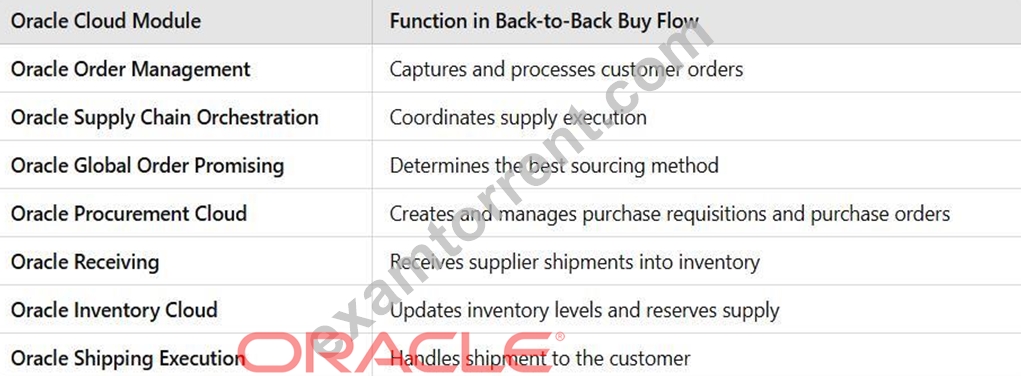
4. Benefits of the Back-to-Back Buy Flow
# Reduces Inventory Holding Costs - No need to stock large quantities in advance.# Ensures Order- Specific Procurement - Every sales order is directly linked to supply.# Automates Procurement & Order Processing - Seamless integration between Oracle modules.# Enhances Customer Satisfaction - Quick fulfillment by sourcing products efficiently.# Optimizes Supplier Collaboration - Real-time PO creation and tracking with suppliers.
5. Real-World Use Case
Scenario: Electronics Distributor Fulfilling a Large Order
A distributor selling high-end laptops does not keep them in stock but procures them from suppliers only when an order is placed.
Process Flow:
* A corporate customer places an order for 50 laptops.
* The system checks stock and finds no available inventory.
* A Purchase Order is created in Oracle Procurement Cloud and sent to the supplier.
* The supplier delivers the laptops to the warehouse.
* The laptops are reserved against the sales order.
* The laptops are shipped to the customer, and the invoice is generated.
# Result: The distributor minimizes inventory costs while fulfilling customer demand efficiently.
NEW QUESTION # 34
You created a consigned agreement with a supplier. The supplier shipped the goods, which you received in your receiving area. After two days, you transferred the goods from receiving into your inventory and used it for your interorganization transfer order.Where is the ownership of the goods?
- A. The ownership is with the buyer due to interorganization consigned inventory movement.
- B. The ownership is with the supplier because the goods are not yet consumed.
- C. The ownership changes from the supplier to the buyer as soon as the goods are received in the receiving area.
- D. The ownership is with the supplier because the supplier has not sent the consumption advice.
Answer: A
NEW QUESTION # 35
Which configuration determines whether transfer is executed using Transfer Order or Purchase Order?
- A. Manage Supply Execution Document Creation Rules.
- B. Manage Supply Order Defaulting and Enrichment Rules.
- C. Manage Sourcing Rules.
Answer: A
NEW QUESTION # 36
Which three replenishment source types are supported in PAR replenishment?
- A. Purchase requisition (*)
- B. Intraorganization internal material transfer (*)
- C. Miscellaneous receipts
- D. Movement request (*)
- E. Work order
Answer: A,B,D
NEW QUESTION # 37
An organization uses min-max planned items to generate movement requests automatically where the item's replenishment source is another subinventory. In this case, the min-max process should automatically generate a move request but it doesn't happen.
What is the reason?
- A. The source subinventory was not set at the item subinventory level.
- B. Min-max report was generated at the subinventory level.
- C. Replenishment movement requests is not enabled for status control.
- D. The source subinventory was not set at the organization level.
Answer: A
NEW QUESTION # 38
Which steps of the Supply Chain Orchestration Foundation task are used for setup? (Choose three)
- A. Manage Demand Execution Document Creation Rules
- B. Manage Supply Orchestration Attachment Categories
- C. Manage Supply Orchestration Lookups
- D. Manage Supply Order Defaulting and Enrichment Rules
Answer: B,C,D
NEW QUESTION # 39
What are the configurations required in manufacturing to enable back-to-back fulfillment using make orders?
- A. Set the sourcing rule to Global with the Make At source type.
- B. Create a work definition for a back-to-back item. (*)
- C. Enable back-to-back fulfillment in plant parameters.
- D. Set the sourcing rule to Local with the Make At source type.
Answer: B
NEW QUESTION # 40
InFusion Corporation has employees in India, Japan, and the US. The company wants all their employees to be able to request and receive goods and services. However, it wants the procurement of goods and supplier management to be centralized and consolidated from India. Which business functions must be assigned to each business unit to meet these requirements?
- A. India BU, Japan BU, and US BU - Material Management, Requisitioning, Procurement
- B. India BU - Procurement; Japan BU and US BU - Receiving, Requisitioning
- C. India BU - Receiving, Requisitioning, Procurement; Japan BU and US BU - Receiving, Requisitioning (*)
- D. India BU, Japan BU, and US BU - Receiving, Requisitioning, Procurement
Answer: C
NEW QUESTION # 41
In which two ways can ownership change for consigned goods from supplier to buyer?
- A. Create a transfer to a consigned transaction.
- B. Create a transfer to an owned transaction.
- C. Perform a subinventory transfer.
- D. Create a consumption advice.
Answer: B,C
NEW QUESTION # 42
......
1z0-1073-24 Exam Questions – Valid 1z0-1073-24 Dumps Pdf: https://vcetorrent.examtorrent.com/1z0-1073-24-prep4sure-dumps.html
