

PDF (New 2026) Actual The Open Group OGEA-103 Exam Questions
Dumps Moneyack Guarantee - OGEA-103 Dumps UpTo 90% Off
The Open Group OGEA-103 certification exam is ideal for professionals who are interested in taking their career in enterprise architecture to the next level. OGEA-103 exam is designed for individuals who want to demonstrate their expertise in the TOGAF framework and their ability to apply it to real-world situations. TOGAF Enterprise Architecture Combined Part 1 and Part 2 Exam certification is ideal for professionals who want to differentiate themselves in a competitive job market and demonstrate their commitment to professional development.
NEW QUESTION # 26
Consider the following statements
1 A whole corporation or a division of a corporation
2 A government agency or a single government department
3 Partnerships and alliances of businesses working together such as a consortium or supply chain What are those examples of according to the TOGAF Standard?
- A. Enterprises
- B. Organizations
- C. Architectures Scopes
- D. Business Units
Answer: A
Explanation:
Enterprises are examples of the scope of an architecture according to the TOGAF Standard. An enterprise is defined as any collection of organizations that has a common set of goals and/or a single bottom line. Enterprises can be whole corporations or divisions of a corporation, government agencies or single government departments, partnerships and alliances of businesses working together, etc. Reference: The TOGAF Standard | The Open Group Website, Section 2.1 Core Concepts.
NEW QUESTION # 27
Which ADM phase focuses on defining the problem to be solved, identifying the stakeholders, their concerns, and requirements?
- A. Preliminary Phase
- B. Phase
- C. Phase A
- D. Phase
Answer: C
Explanation:
Phase A: Architecture Vision is the first phase of the Architecture Development Method (ADM) cycle, which is the core of the TOGAF standard. The main purpose of this phase is to define the scope and approach of the architecture development, and to create the Architecture Vision, which is a high-level description of the desired outcomes and benefits of the proposed architecture. To achieve this purpose, this phase focuses on defining the problem to be solved, identifying the stakeholders, their concerns, and requirements, and establishing the business goals and drivers that motivate the architecture work. This phase also involves obtaining the approval and commitment of the sponsors and other key stakeholders, and initiating the Architecture Governance process.
The TOGAF Standard, Version 9.2, Part II: Architecture Development Method (ADM), Chapter 5:
Introduction to the ADM : The TOGAF Standard, Version 9.2, Part II: Architecture Development Method (ADM), Chapter 18: Phase A: Architecture Vision : The TOGAF Standard, Version 9.2, Part II: Architecture Development Method (ADM), Chapter 18.3: Inputs : The TOGAF Standard, Version 9.2, Part II: Architecture Development Method (ADM), Chapter 18.4: Steps
NEW QUESTION # 28
Refer to the table below:
Which ADM Phase does this describe?
- A. Phase A
- B. Phase F
- C. Phase E
- D. Phase G
Answer: D
Explanation:
The table describes the output, outcome, and essential knowledge of an ADM phase that oversees the implementation of changes necessary to reach the adjusted target state. This corresponds to Phase G, also known as Implementation Governance, which ensures that the architecture defined in earlier phases is realized, and it oversees the development and implementation of projects to align with this architecture. The essential knowledge required during this phase includes understanding constraints on the implementation team and adjusting stakeholder priority and preference in response to success, value, effort, and risk of change. References: TOGAF Version 9.1 - 1
NEW QUESTION # 29
Please read this scenario prior to answering the question
You are employed as an Enterprise Architect at a leading global technology enterprise specializing in digital infrastructure, cloud computing, and data-centric innovation. The company provides a vast ecosystem of platforms that serve billions of users across the globe. These platforms span online marketplaces, advanced advertising networks, Al-driven services, productivity tools, and digital entertainment experiences.
The senior leadership within the company is worried about the company's ability to address all the opportunities around artificial intelligence (Al). They feel that the business is at risk of falling behind its competitors, and that significant changes are necessary for the business to remain competitive. Most senior leaders feel that the operations need to be more efficient, and the organization needs to change to achieve its future goals.
The company has an established Enterprise Architecture (EA) program based on the TOGAF standard, sponsored jointly by the Chief Information Officer (CIO) and senior executives. In your role as an Enterprise Architect within the EA team, you work closely with the business stakeholders in the company as well as the sponsors.
The CEO has decided that reorganizing its subsidiaries around artificial intelligence and machine learning will improve the way the company creates and delivers value.
The sponsors have approved a project for the reorganization which is being led by the EA team.
The EA team have developed a strategic architecture which has been approved by the sponsors. It includes an Architecture Vision, and high-level definitions of the domain architectures. This sets out a plan over a multi-year period and covers three distinct transformations to implement the reorganization.
The sponsors have read reports that the majority of transformation projects dealing with digital and artificial intelligence are failing. They have made it clear that prior to the approval of the detailed Implementation and Migration plan, the EA team needs to address the risks associated with the reorganization. They want assurance that the reorganization will succeed and deliver the promised increases in value for the business.
Refer to the scenario
The EA team leader has asked how you would address the request from the sponsors.
Based on the TOGAF standard, which of the following is the best answer?
- A. You would assess how ready the organization is to change. This includesidentification and classification of the risks associated with the transformations,together with an approach to mitigate the risks. This includes identifyingdependencies between the set of changes, including gaps and work packages.It also identifies improvement actions to be worked into the Implementation andMigration Plan. The business value, effort, and risk associated for eachtransformation should then be identified and documented.
- B. Before preparing the detailed Implementation and Migration plan, you wouldreview and consolidate the gap analysis results from Phases B to D. Thisenables you to evaluate the implications related to potential solutions and inter-dependencies. It is used to identify the transformations required to achieve theproposed Target Architecture. You then assess the readiness of theorganization to undergo change and determine an overall direction to reachthat Target Architecture while addressing the risks identified.
The TransitionArchitectures should be planned using a state evolution table. - C. You would apply an analysis and assessment to evaluate the potential riskswith the proposed new architecture. This includes the development of a matrixshowing the organizational requirements. The degree of change should thenbe aligned with the corporate operating model to ensure risks are mitigatedand minimized. The risk mitigations can then be included within each of thetarget Transition Architectures. You would then finalize the ArchitectureRoadmap and the Implementation and Migration Plan.
- D. You would bring together information about potential approaches and produceseveral alternative target transition architectures. You would then investigatethe different architecture alternatives and discuss these with stakeholdersusing the Architecture Alternatives and Trade-offs technique. Once the targetarchitecture has been selected, it should be analyzed using a state evolutiontable to determine the Transition Architectures. A value realization processshould then be established to ensure that the concerns raised are addressed.
Answer: A
Explanation:
In this scenario, the strategic architecture is already complete and approved, and the sponsors now want assurance about risks before approving the detailed Implementation & Migration Plan. According to TOGAF, this work occurs in Phase E: Opportunities & Solutions and Phase F: Implementation & Migration, where a key activity is performing Business Transformation Readiness Assessment and Risk Assessment before finalizing the roadmap and migration plan.
Option C aligns exactly with TOGAF guidance for this stage:
Why Option C is correct
1. It starts with assessing organizational readiness for change
TOGAF Phase E requires evaluation of Business Transformation Readiness, addressing:
* Organizational capability
* Cultural readiness
* Skills and capacity
* Sponsorship and governance
This is exactly what Option C describes:
"assess how ready the organization is to change."
This directly responds to the concern in the scenario that "most senior leaders feel the operations need to be more efficient" and that "significant changes are necessary."
2. It includes identification and classification of risks
TOGAF requires performing a Risk Assessment before migration planning, ensuring risks are categorized, documented, and mitigation strategies defined.
Option C includes:
"identification and classification of the risks ... together with an approach to mitigate the risks." This is precisely what the sponsors requested: clear management of risks before approving migration planning.
3. It ties risk, dependencies, and gaps directly into the Implementation & Migration Plan TOGAF requires identifying:
* Dependencies between work packages
* Gaps between baseline and target
* Required actions to improve readiness
* Work package sequencing
Option C states:
"identifying dependencies between the set of changes, including gaps and work packages... identifying improvement actions to be worked into the Implementation and Migration Plan." This matches TOGAF Phase E and F activities exactly.
4. It evaluates business value, effort, and risk for each transformation The scenario involves three distinct transformations, and sponsors want assurance of value delivery. TOGAF Phase F includes Consolidated Gaps, Solutions, and Dependencies and migration prioritization based on value, cost, and risk.
Option C states:
"The business value, effort, and risk associated for each transformation should then be identified and documented." This is directly aligned to the TOGAF-required migration prioritization criteria.
Why the other options are incorrect
A - Focuses on gap analysis only
Gap analysis was performed during Phases B-D, and while relevant, Option A does not emphasize risk, readiness, or assurance-key concerns of the scenario.
B - Misrepresents TOGAF (organizational requirements matrix is not a formal TOGAF artifact) Also, it incorrectly focuses on aligning change with the operating model, which TOGAF does not prescribe as the primary risk-mitigation activity.
D - Focuses on architectural alternatives; the target architecture is already approved The scenario states the strategic architecture is complete and approved-there is no need to revisit alternatives. This is misaligned with the starting point of the question.
Conclusion
Option C is the only answer that conducts:
* Business transformation readiness assessment
* Risk identification and mitigation
* Dependencies, gaps, and work package analysis
* Integration of risks and improvement actions into migration planning
This matches precisely what TOGAF expects at this stage and what the sponsors requested.
NEW QUESTION # 30
Please read this scenario prior to answering the question
You are the Chief Enterprise Architect at a large food service company specializing in sales to trade and wholesale, for example, restaurants and other food retailers.
One of your company's competitors has launched a revolutionary product range and is running a very aggressive marketing campaign. Your company's resellers are successively announcing that they are not interested in your company's products and will sell your competitor's.
The CEO has stated there must be significant change to address the situation. He has made it clear that new markets must be found for the company's products, and that the business needs to pivot, and address the retail market as well as the existing wholesale market.
A consideration is the company's ability and willingness to change its business model, and if it is a temporary or permanent change. An additional risk factor is one of culture. The company has been used to a stable business with a reasonably well known and settled client base - all with its own local understandings and practices.
The CEO is the sponsor of the EA program within the company. You have been engaged with the sales, logistics, production, and marketing teams, enabling the architecture activity to start. An Architecture Vision, Architecture Principles, and Requirements have all been agreed. As you move forward to develop a possible Target Architecture you have identified that some of the key stakeholders' preferences are incompatible. The incompatibilities are focused primarily on time-to-market, cost savings, and the need to bring out a fully featured product range, but there are additional factors.
Refer to the scenario
You have been asked how you will address the incompatibilities between key stakeholder preferences.
Based on the TOGAF standard which of the following is the best answer?
- A. You would use the Architecture Vision, Principles, and Requirements to define a set of criteria for alternatives and create a set of architecture views to illustrate the impact of the alternative Target Architectures. You would identify the impact on planned projects. You would understand the strengths and weaknesses of the alternatives. You would conduct a formal stakeholder review to decide which alternative to move forward with. You will determine the funding required.
- B. You recommend that since the CEO has stated that the company must pivot, it is better to compromise on a full product range rather than time-to-market. You would develop just enough of the Target Architecture to demonstrate fitness of the proposed approach. You would limit the description to just where there is a gap between the current baseline. You would seek approval by the stakeholders to move forward with developing the Target Architecture in detail.
- C. You would review the Stakeholder Map and ensure that you have addressed and represented the concerns of all department heads. You will involve them in resolving the incompatibilities. The Communications Plan should include a report that summarizes the key features of the architecture with and how incompatibilities were resolved to reflects the stakeholders' requirements. You will check with each key stakeholder they are satisfied with how the incompatibilities have been resolved.
- D. You would seek to understand value preferences and priorities of the stakeholders. You would develop alternative Target Architectures, highlighting the gaps between current state and the alternatives. You would consider combining features from one or more alternatives in collaboration with the stakeholders. A formal stakeholder review should then be held to decide which alternative is fit for purpose and should be moved forward with. You will then secure the funding required.
Answer: A
Explanation:
Explanation
According to the TOGAF standard, the Target Architecture is the description of a future state of the architecture being developed for an organization. It should be aligned with the Architecture Vision, Principles, and Requirements that have been agreed with the stakeholders. To address the incompatibilities between key stakeholder preferences, the TOGAF standard recommends creating and evaluating multiple alternative Target Architectures that meet different sets of criteria. These criteria should reflect the value preferences and priorities of the stakeholders, as well as the business drivers and objectives. The alternative Target Architectures should be illustrated using a set of architecture views that show the impact of each alternative on the business, data, application, and technology domains. The impact on planned projects should also be identified and analyzed. The strengths and weaknesses of each alternative should be understood and documented. A formal stakeholder review should then be conducted to decide which alternative is the most fit for purpose and should be moved forward with. The funding required for implementing the chosen alternative should also be determined and secured. References:
The TOGAF Standard, Version 9.2 - Phase B: Business Architecture - The Open Group The TOGAF Standard, Version 9.2 - Phase C: Information Systems Architectures - The Open Group
[The TOGAF Standard, Version 9.2 - Phase D: Technology Architecture - The Open Group]
[The TOGAF Standard, Version 9.2 - Phase E: Opportunities and Solutions - The Open Group]
[The TOGAF Standard, Version 9.2 - Phase F: Migration Planning - The Open Group]
NEW QUESTION # 31
Please read this scenario prior to answering the question
You are employed as an Enterprise Architect at a technology company, reporting directly to the Chief Enterprise Architect. The company supplies personnel and delivers cloud- based solutions to numerous government agencies.
The nature of the business is such that the data and the information stored on the company systems is the company's major asset and is highly confidential. The company employees work remotely and need constant access to the company systems, which is done by the public infrastructure. They use message encryption, secure internet connections using Virtual Private Networks (VPNs), and other standard security measures. The company provides computer security awareness training for all its staff.
The Chief Security Officer (CSO) has noted an increase in distributed denial of service (DDoS) attacks on companies with a similar profile. The CSO understands that even with thorough preparation, a major attack could stop employees from being able to do their jobs. This could lead to a large financial loss, damage to the company's reputation with customers, and employees being unable to work.
A risk assessment has been completed and the company has looked for cyber insurance that covers such attacks. The price for this insurance is very high. The CTO has decided not to get cyber insurance to cover such attacks.
The company follows the TOGAF standard as the method and guiding framework for its Enterprise Architecture (EA) practice. The Chief Technology Officer (CTO) is the sponsor of the activity. The practice uses an iterative approach for its architecture development.
This has enabled the decision makers to gain valuable insights into the different aspects of the business Please read this scenario prior to answering the question You have been asked to describe the steps you would take to strengthen the current architecture to improve data protection.
Based on the TOGAF standard which of the following is the best answer?
- A. You would ensure that business value and cost of continuity measures are understood by key stakeholders, and that the company has in place up-to-date processes for managing change to the current Enterprise Architecture. You recommend that DDoS mitigation be addressed at the infrastructure level to ensure effective, scalable protection. Changes should be made to the baseline description of the Technology Architecture. The changes should be approved by the Architecture Board and implemented by change management techniques.
- B. You would run a planning exercise to assess the business continuity
requirements and analyze the current Enterprise Architecture for gaps. You create a formal change request related to business resilience and maintaining critical business functions. You would arrange a meeting of the Architecture Board to assess and approve the change request. Once approved you would create a new Request for Architecture Work to begin an ADM cycle to implement the changes. - C. You would request technology updates from existing suppliers that improve the company's capabilities to detect, react, and recover from an incident. You would run a simulated ransomware attack to evaluate the current Enterprise Architecture's resilience and recovery capabilities. Using the findings, you would perform a gap analysis of the current Enterprise Architecture, and prepare change requests to address identified gaps. You would document the changes implemented and add to the Architecture Repository.
- D. You would hold an Architecture Compliance Review with the scope to examine the company's ability to respond to such attacks. You would identify the departments involved and have them nominate representatives. You would then tailor checklists to address the requirement for increased business continuity and resilience. You would circulate the checklists to the nominated representatives for them to complete. You would review the completed checklists, identifying and resolving issues. You would then determine and present your recommendations to the Architecture Board.
Answer: B
Explanation:
In this scenario, the CTO has not purchased cyber-insurance, the CSO is concerned about increased DDoS risk, and YOU (the EA) are asked "to describe the steps you would take to strengthen the current architecture to improve data protection." Because the company follows the TOGAF standard and uses an iterative ADM cycle, the correct response must:
Start with the risk/continuity concern
Use the formal TOGAF change management process
Lead to a Request for Architecture Work
Initiate a new ADM cycle to update the architecture properly
Ensure Architecture Board governance
Option B is the only answer that matches TOGAF's required process.
✔ Why Option B is correct (TOGAF-aligned)
Option B follows TOGAF's Architecture Change Management (Phase H) process:
Assess the business continuity requirements
- Correct: Phase H requires evaluating change triggers such as new risks, threats, or incidents.
- DDoS risk → business continuity concern → legitimate architecture change trigger.
Analyze the current architecture for gaps
- Correct: TOGAF Phase H requires assessing whether the current baseline architecture can support required resilience.
Create a formal Change Request
- Exactly correct: Phase H outputs Architecture Change Requests (ACRs) for significant changes.
- ACR includes description, rationale, and impact (in this case: resilience, continuity, and data protection).
Architecture Board reviews/approves the change request
- Correct: All major architecture changes must go through Architecture Governance.
Create a new Request for Architecture Work (RFAW)
- Required when the change is significant and needs a new ADM cycle.
- Strengthening data protection and business continuity DEFINITELY qualifies as a major change.
Begin a new ADM cycle to implement the changes
- Perfectly aligned with TOGAF's iterative approach:
Business continuity → update Technology Architecture → updated security patterns → updated Target Architecture.
This is exactly the TOGAF-prescribed method to strengthen an architecture when significant new risks appear.
Therefore, Option B is the correct and TOGAF-compliant answer.
✘ Why the other options are incorrect
A - Not TOGAF-aligned
Starts with vendors and simulations (not TOGAF-first steps).
No mention of Architecture Board or Change Management.
No Request for Architecture Work.
Gap analysis alone is not the first step for significant architectural risk.
C - Too narrow and skips TOGAF governance
Jumps straight to modifying the Technology Architecture baseline.
No Change Request, no RFAW, no ADM cycle initiation.
Recommends a solution ("DDoS mitigation at infrastructure level") before architectural assessment.
D - Misuses Architecture Compliance Review
Architecture Compliance Reviews check conformity to an existing architecture-not evaluate new risks or design resilience enhancements.
A compliance review is not the correct first step for addressing new threats.
NEW QUESTION # 32
Which of the following best describes the purpose of the Architecture Requirements Specification?
- A. It provides a set of statements that outline what a project must do to comply with the architecture
- B. It is sent from the sponsor and triggers the start of an architecture development cycle
- C. It defines the scope and approach to complete an architecture project
- D. It contains an assessment of the current architecture requirements
Answer: A
Explanation:
The Architecture Requirements Specification is one of the TOGAF deliverables that provides a set of quantitative statements that outline what an implementation project must do in order to comply with the architecture12. It is a companion to the Architecture Definition Document, which provides a qualitative view of the solution and aims to communicate the intent of the architect. The Architecture Requirements Specification provides a quantitative view of the solution, stating measurable criteria that must be met during the implementation of the architecture3. It typically forms a major component of an implementation contract or contract for more detailed Architecture Definition4. References:
*Deliverable: Architecture Requirements Specification - The Open Group
*Architecture Requirements Specification - Visual Paradigm Community Circle
*The TOGAF Standard, Version 9.2 - Definitions - The Open Group
*The TOGAF Standard, Version 9.2 - Architecture Requirements Specification - The Open Group
NEW QUESTION # 33
Consider the following statements:
* The TOGAF ADM requires a partitioning model for architecture development
* Architectures are partitioned when different teams need to work on different elements of the architecture at the same time
* Partitions can be used to facilitate architecture re-use
Which statements about Architecture Partitioning are correct?
- A. 2 and 3
- B. 1, 2 and 3
- C. 1 and 3
- D. 1 and 2
Answer: A
NEW QUESTION # 34
Consider the following ADM phases objectives.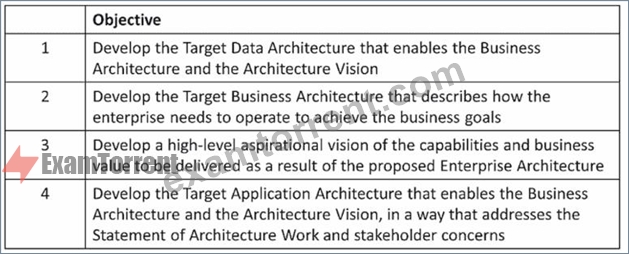
Which phase does each objective match?
- A. 1C-2B-3A-4C
- B. 1A-2B-3C-4D
- C. 1C-2D-3B-4A
- D. 1B-2D-3A-4C
Answer: A
Explanation:
The objectives listed in the question correspond to the objectives of different phases of the TOGAF ADM (Architecture Development Method), which is a method for developing and managing an enterprise architecture1.
The ADM consists of nine phases, each with a specific purpose and output. The phases are1:
Preliminary Phase: To prepare and initiate the architecture development cycle, including defining the architecture framework, principles, and governance.
Phase A: Architecture Vision: To define the scope, vision, and stakeholders of the architecture initiative, and to obtain approval to proceed.
Phase B: Business Architecture: To describe the baseline and target business architecture, and to identify the gaps between them.
Phase C: Information Systems Architectures: To describe the baseline and target data and application architectures, and to identify the gaps between them.
Phase D: Technology Architecture: To describe the baseline and target technology architecture, and to identify the gaps between them.
Phase E: Opportunities and Solutions: To identify and evaluate the opportunities and solutions for implementing the target architecture, and to define the work packages and transition architectures.
Phase F: Migration Planning: To finalize the implementation and migration plan, and to ensure alignment with the enterprise portfolio and project management.
Phase G: Implementation Governance: To provide architecture oversight and guidance for the implementation projects, and to manage any architecture change requests.
Phase H: Architecture Change Management: To monitor the changes in the business and technology environment, and to assess the impact and performance of the architecture.
Based on the above definitions, we can match each objective with the corresponding phase as follows:
Objective 1: Develop the Target Data Architecture that enables the Business Architecture and the Architecture Vision. This objective is achieved in Phase C: Information Systems Architectures, where the data architecture is defined as a subset of the information systems architecture2.
Objective 2: Develop the Target Business Architecture that describes how the enterprise needs to operate to achieve the business goals. This objective is achieved in Phase B: Business Architecture, where the business architecture is defined as a subset of the enterprise architecture3.
Objective 3: Develop a high-level aspirational vision of the capabilities and business value to be delivered as a result of the proposed Enterprise Architecture. This objective is achieved in Phase A: Architecture Vision, where the architecture vision is defined as a high-level description of the target architecture and its benefits4.
Objective 4: Develop the Target Application Architecture that enables the Business Architecture and the Architecture Vision, in a way that addresses the Statement of Architecture Work and stakeholder concerns. This objective is achieved in Phase C: Information Systems Architectures, where the application architecture is defined as a subset of the information systems architecture2.
1: The TOGAF Standard, Version 9.2, Chapter 5: Architecture Development Method (ADM)
2: The TOGAF Standard, Version 9.2, Chapter 9: Phase C: Information Systems Architectures
3: The TOGAF Standard, Version 9.2, Chapter 8: Phase B: Business Architecture
4: The TOGAF Standard, Version 9.2, Chapter 7: Phase A: Architecture Vision
NEW QUESTION # 35
Consider the following statements.
1. All processes, decision-making, and mechanisms used will be established so as to minimize or avoid potential conflicts of interest.
2. More effective strategic decision-making will be made by C-Level executives and business leaders.
3. All actions implemented and their decision support will be available for inspection by authorized organization and provider parties.
4. Digital Transformation and operations will be more effective and efficient.
Which statements highlight the value and necessity for Architecture Governance to be adopted within organizations?
- A. 2 & 4
- B. 1 & 4
- C. 2& 3
- D. 1 & 3
Answer: D
Explanation:
Statements 1 and 3 highlight the value and necessity for Architecture Governance to be adopted within organizations. Architecture Governance is the practice and orientation by which Enterprise Architectures and other architectures are managed and controlled at an enterprise-wide level12. It ensures that architectural decisions are aligned with the organization's strategy, objectives, and standards. Architecture Governance also involves establishing and maintaining processes, decision-making, and mechanisms to avoid or minimize potential conflicts of interest, such as between different stakeholders, business units, or projects34. Moreover, Architecture Governance requires transparency and accountability for all actions implemented and their decision support, so that they can be inspected and evaluated by authorized parties, such as auditors, regulators, or customers5 . References:
*The TOGAF Standard, Version 9.2 - Architecture Governance - The Open Group
*Architecture Governance - The Open Group
*Tutorial: Governance in TOGAF's Architecture Development Method (ADM)
*Architecture Governance in TOGAF: Ensuring Effective Management and Compliance
*The TOGAF Standard, Version 9.2 - Definitions - The Open Group
*[Architecture Governance in TOGAF: Ensuring Alignment and Control]
NEW QUESTION # 36
Complete the sentence The Architecture Landscape is divided into levels known as__________________________.
- A. Transitional Complete and incremental Architectures
- B. Baseline. Transition and To Be Architectures
- C. Segment Strategic and Capability Architectures
- D. Gaps Plateaus, and Target Architectures
Answer: C
Explanation:
Explanation
The Architecture Landscape is divided into levels known as Segment Strategic and Capability Architectures.
These levels correspond to different scopes and purposes of architectures within an enterprise. Segment Architectures are architectures that address specific business units, functions, or processes within an enterprise. Strategic Architectures are architectures that provide a high-level view of the enterprise's vision, goals, and direction. Capability Architectures are architectures that address specific business capabilities or services that span multiple segments or domains. Reference: The TOGAF Standard | The Open Group Website, Section 2.4 Architecture Repository.
NEW QUESTION # 37
Consider the following ADM phases objectives.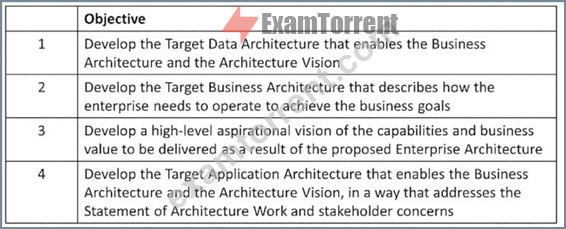
Which phase does each objective match?
- A. 1C-2B-3A-4C
- B. 1A-2B-3C-4D
- C. 1C-2D-3B-4A
- D. 1B-2D-3A-4C
Answer: A
Explanation:
* The objectives listed in the question correspond to the objectives of different phases of the TOGAF ADM (Architecture Development Method), which is a method for developing and managing an enterprise architecture1.
* The ADM consists of nine phases, each with a specific purpose and output. The phases are1:
* Preliminary Phase: To prepare and initiate the architecture development cycle, including defining the architecture framework, principles, and governance.
* Phase A: Architecture Vision: To define the scope, vision, and stakeholders of the architecture initiative, and to obtain approval to proceed.
* Phase B: Business Architecture: To describe the baseline and target business architecture, and to identify the gaps between them.
* Phase C: Information Systems Architectures: To describe the baseline and target data and application architectures, and to identify the gaps between them.
* Phase D: Technology Architecture: To describe the baseline and target technology architecture, and to identify the gaps between them.
* Phase E: Opportunities and Solutions: To identify and evaluate the opportunities and solutions for implementing the target architecture, and to define the work packages and transition architectures.
* Phase F: Migration Planning: To finalize the implementation and migration plan, and to ensure alignment with the enterprise portfolio and project management.
* Phase G: Implementation Governance: To provide architecture oversight and guidance for the implementation projects, and to manage any architecture change requests.
* Phase H: Architecture Change Management: To monitor the changes in the business and technology environment, and to assess the impact and performance of the architecture.
* Based on the above definitions, we can match each objective with the corresponding phase as follows:
* Objective 1: Develop the Target Data Architecture that enables the Business Architecture and the Architecture Vision. This objective is achieved in Phase C: Information Systems Architectures, where the data architecture is defined as a subset of the information systems architecture2.
* Objective 2: Develop the Target Business Architecture that describes how the enterprise needs to operate to achieve the business goals. This objective is achieved in Phase B: Business Architecture, where the business architecture is defined as a subset of the enterprise architecture3.
* Objective 3: Develop a high-level aspirational vision of the capabilities and business value to be delivered as a result of the proposed Enterprise Architecture. This objective is achieved in Phase A: Architecture Vision, where the architecture vision is defined as a high-level description of the target architecture and its benefits4.
* Objective 4: Develop the Target Application Architecture that enables the Business Architecture and the Architecture Vision, in a way that addresses the Statement of Architecture Work and stakeholder concerns. This objective is achieved in Phase C: Information Systems Architectures, where the application architecture is defined as a subset of the information systems architecture2.
References:
* 1: The TOGAF Standard, Version 9.2, Chapter 5: Architecture Development Method (ADM)
* 2: The TOGAF Standard, Version 9.2, Chapter 9: Phase C: Information Systems Architectures
* 3: The TOGAF Standard, Version 9.2, Chapter 8: Phase B: Business Architecture
* 4: The TOGAF Standard, Version 9.2, Chapter 7: Phase A: Architecture Vision
NEW QUESTION # 38
Which ADM phase focuses on defining the problem to be solved, identifying the stakeholders, their concerns, and requirements?
- A. Preliminary Phase
- B. Phase
- C. Phase A
- D. Phase
Answer: C
Explanation:
Phase A: Architecture Vision is the first phase of the Architecture Development Method (ADM) cycle, which is the core of the TOGAF standard. The main purpose of this phase is to define the scope and approach of the architecture development, and to create the Architecture Vision, which is a high-level description of the desired outcomes and benefits of the proposed architecture. To achieve this purpose, this phase focuses on defining the problem to be solved, identifying the stakeholders, their concerns, and requirements, and establishing the business goals and drivers that motivate the architecture work. This phase also involves obtaining the approval and commitment of the sponsors and other key stakeholders, and initiating the Architecture Governance process.
References: : The TOGAF Standard, Version 9.2, Part II: Architecture Development Method (ADM), Chapter 5: Introduction to the ADM : The TOGAF Standard, Version 9.2, Part II: Architecture Development Method (ADM), Chapter 18: Phase A: Architecture Vision : The TOGAF Standard, Version 9.2, Part II:
Architecture Development Method (ADM), Chapter 18.3: Inputs : The TOGAF Standard, Version 9.2, Part II:
Architecture Development Method (ADM), Chapter 18.4: Steps
NEW QUESTION # 39
Please read this scenario prior to answering the question
You are the Chief Enterprise Architect at a large food service company specializing in sales to trade and wholesale, for example, restaurants and other food retailers.
One of your company's competitors has launched a revolutionary product range and is running a very aggressive marketing campaign. Your company's resellers are successively announcing that they are not interested in your company's products and will sell your competitor's.
The CEO has stated there must be significant change to address the situation. He has made it clear that new markets must be found for the company's products, and that the business needs to pivot, and address the retail market as well as the existing wholesale market.
A consideration is the company's ability and willingness to change its business model, and if it is a temporary or permanent change. An additional risk factor is one of culture. The company has been used to a stable business with a reasonably well known and settled client base - all with its own local understandings and practices.
The CEO is the sponsor of the EA program within the company. You have been engaged with the sales, logistics, production, and marketing teams, enabling the architecture activity to start. An Architecture Vision, Architecture Principles, and Requirements have all been agreed. As you move forward to develop a possible Target Architecture you have identified that some of the key stakeholders' preferences are incompatible. The incompatibilities are focused primarily on time-to-market, cost savings, and the need to bring out a fully featured product range, but there are additional factors.
Refer to the scenario
You have been asked how you will address the incompatibilities between key stakeholder preferences.
Based on the TOGAF standard which of the following is the best answer?
- A. You would use the Architecture Vision, Principles, and Requirements to define a set of criteria for alternatives and create a set of architecture views to illustrate the impact of the alternative Target Architectures. You would identify the impact on planned projects. You would understand the strengths and weaknesses of the alternatives. You would conduct a formal stakeholder review to decide which alternative to move forward with. You will determine the funding required.
- B. You recommend that since the CEO has stated that the company must pivot, it is better to compromise on a full product range rather than time-to-market. You would develop just enough of the Target Architecture to demonstrate fitness of the proposed approach. You would limit the description to just where there is a gap between the current baseline. You would seek approval by the stakeholders to move forward with developing the Target Architecture in detail.
- C. You would review the Stakeholder Map and ensure that you have addressed and represented the concerns of all department heads. You will involve them in resolving the incompatibilities. The Communications Plan should include a report that summarizes the key features of the architecture with and how incompatibilities were resolved to reflects the stakeholders' requirements. You will check with each key stakeholder they are satisfied with how the incompatibilities have been resolved.
- D. You would seek to understand value preferences and priorities of the stakeholders. You would develop alternative Target Architectures, highlighting the gaps between current state and the alternatives. You would consider combining features from one or more alternatives in collaboration with the stakeholders. A formal stakeholder review should then be held to decide which alternative is fit for purpose and should be moved forward with. You will then secure the funding required.
Answer: A
Explanation:
According to the TOGAF standard, the Target Architecture is the description of a future state of the architecture being developed for an organization. It should be aligned with the Architecture Vision, Principles, and Requirements that have been agreed with the stakeholders. To address the incompatibilities between key stakeholder preferences, the TOGAF standard recommends creating and evaluating multiple alternative Target Architectures that meet different sets of criteria. These criteria should reflect the value preferences and priorities of the stakeholders, as well as the business drivers and objectives. The alternative Target Architectures should be illustrated using a set of architecture views that show the impact of each alternative on the business, data, application, and technology domains. The impact on planned projects should also be identified and analyzed. The strengths and weaknesses of each alternative should be understood and documented. A formal stakeholder review should then be conducted to decide which alternative is the most fit for purpose and should be moved forward with. The funding required for implementing the chosen alternative should also be determined and secured. References:
* The TOGAF Standard, Version 9.2 - Phase B: Business Architecture - The Open Group
* The TOGAF Standard, Version 9.2 - Phase C: Information Systems Architectures - The Open Group
* [The TOGAF Standard, Version 9.2 - Phase D: Technology Architecture - The Open Group]
* [The TOGAF Standard, Version 9.2 - Phase E: Opportunities and Solutions - The Open Group]
* [The TOGAF Standard, Version 9.2 - Phase F: Migration Planning - The Open Group]
NEW QUESTION # 40
Consider the following ADM phases objectives.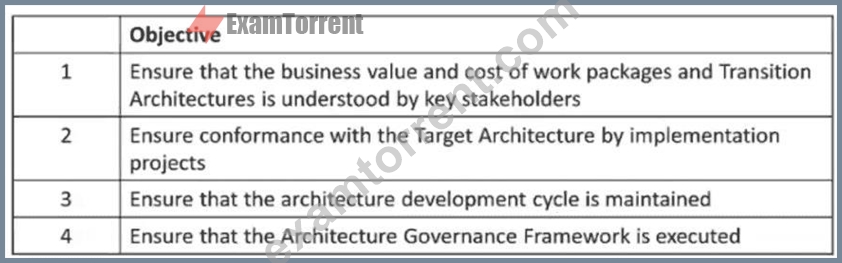
Which phase does each objective match?
- A. 1F-2G-3G-4H
- B. 1F-2G-3H-4H
- C. 1H-2F-3F-4G
- D. 1G-2H-3H-4F
Answer: C
Explanation:
According to the TOGAF Standard, Version 9.2, the ADM phases and their objectives are as follows1:
Preliminary Phase: To prepare and initiate the architecture development cycle, including defining the architecture framework, principles, and governance.
Phase A: Architecture Vision: To define the scope, vision, and stakeholders of the architecture initiative, and to obtain approval to proceed.
Phase B: Business Architecture: To describe the baseline and target business architecture, and to identify the gaps between them.
Phase C: Information Systems Architectures: To describe the baseline and target data and application architectures, and to identify the gaps between them.
Phase D: Technology Architecture: To describe the baseline and target technology architecture, and to identify the gaps between them.
Phase E: Opportunities and Solutions: To identify and evaluate the opportunities and solutions for implementing the target architecture, and to define the work packages and transition architectures.
Phase F: Migration Planning: To finalize the implementation and migration plan, and to ensure alignment with the enterprise portfolio and project management.
Phase G: Implementation Governance: To provide architecture oversight and guidance for the implementation projects, and to manage any architecture change requests.
Phase H: Architecture Change Management: To monitor the changes in the business and technology environment, and to assess the impact and performance of the architecture.
Requirements Management: To manage the architecture requirements throughout the ADM cycle, and to ensure alignment with the business requirements.
Based on the above definitions, we can match each objective with the corresponding phase as follows:
Objective 1: Ensure that the business value and cost of work packages and transition architectures is understood by key stakeholders. This objective is achieved in Phase H: Architecture Change Management, where the value realization and cost-benefit analysis of the architecture are performed2.
Objective 2: Ensure conformance with the Target Architecture by implementation projects. This objective is achieved in Phase F: Migration Planning, where the conformance requirements and criteria for the implementation projects are defined3.
Objective 3: Ensure that the architecture development cycle is maintained. This objective is achieved in Phase F: Migration Planning, where the architecture roadmap and iteration cycle are maintained3.
Objective 4: Ensure that the Architecture Governance Framework is executed. This objective is achieved in Phase G: Implementation Governance, where the architecture governance processes and procedures are applied to the implementation projects4.
1: The TOGAF Standard, Version 9.2, Chapter 5: Architecture Development Method (ADM)
2: The TOGAF Standard, Version 9.2, Chapter 21: Architecture Change Management
3: The TOGAF Standard, Version 9.2, Chapter 20: Migration Planning
4: The TOGAF Standard, Version 9.2, Chapter 19: Implementation Governance
Topic 1, Part 2
NEW QUESTION # 41
Please read this scenario prior to answering the question
You are employed as an Enterprise Architect for a company that supplies products for industrial productionautomation. You are part of an Enterprise Architecture (EA) team that has responsibilities across thecompany.
The company has multiple manufacturing plants where it assembles both standard and customizedproducts.
Each of these plants operates its own planning and production scheduling systems, as well asapplications and control systems that drive the automated production line.
During a recent management meeting, the agenda included discussion of how a competitor company hadimproved production efficiency by replacing multiple planning and scheduling systems with a single cloud-based system. This had reduced lifecycle costs through reduced duplication, lowered software maintenancecosts, and supported incremental replacement. The CIO claimed the company's current systemsarchitecture is already optimized. However, as the competitor has reported better financial results, the CEOhas requested an investigation of a cloud-based solution.
In response, the Architecture Board approved a Request for Architecture Work to find out if such anarchitecture transformation would lead to efficiency improvements. You have been asked to help thearchitecture team with this project.
A concern of the plant managers is the safety and dependability of using a remote centralized system forplanning and scheduling production. The system they choose must also be able to work with the localpartners in the supply chain at each plant.
The company has an Enterprise Architecture (EA) practice and uses the TOGAF standard as the basis for itswork. It has been running for many years and has established governance and development processes forEA. The Chief Information Officer (CIO) sponsors the Enterprise Architecture program.
Refer to the scenario
You have been asked to describe how you will start the architecture project.
Based on the TOGAF standard, which of the following is the best answer?
- A. You would gather information from your suppliers and conduct a series of briefings with those of themthat are on the current approved supplier list. Based on the findings from the research, you woulddefine a preliminary Architecture Vision including summary views, high-level requirements, and high-level definitions of the baseline and target environments from a business, information systems, andtechnology perspective. You would then use the Architecture Vision to build agreement among thekey stakeholders.
- B. You would conduct a series of workshops with the local partners to gather requirements from them. Based on the findings from the workshops, you would define a preliminary Architecture Visionincluding summary views, high-level requirements, and high-level definitions of the baseline andtarget environments from a business, information systems, and technology perspective. You wouldthen use the Architecture Vision to build agreement among the local partners.
- C. You would run a series of interviews at each manufacturing plant to discover and document businessrequirements. This would also help you understand the systems and integrations with local partners.You would create a matrix of stakeholders and their primary concerns. You would then determineand record the main stakeholder requirements for the architecture. You would then create clear high-level descriptions of the current and future architectures.
- D. You would develop baseline and target Architectures for each manufacturing plant, ensuring that theviews corresponding to selected viewpoints address key concerns of the stakeholders. A businesscase, together with performance metrics and measures should be defined to ensure the architecturemeets the business needs. A consolidated gap analysis between the architectures will then validatethe approach and determine the capability increments needed to achieve the target state.
Answer: B
Explanation:
OptionAbest aligns withTOGAF Phase A: Architecture Vision, which is thestarting phasefor an architecture development cycle in TOGAF. This phase sets the foundation for the architecture engagement and ensuresalignment with stakeholders and their concerns, especially when evaluating a major transformation like moving to acloud-based planning and scheduling system.
#Key TOGAF Concepts Supporting Option A:
1. Phase A: Architecture Vision Objectives
* Establish thehigh-level scope, constraints, and expectations.
* Identify stakeholdersand define theirconcerns and business requirements.
* Create theArchitecture Vision, which includes:
* Summary-levelBaseline and Target Architectureviews (business, data, application, and technology).
* Initialrequirementsandkey concerns.
* Stakeholder buy-inand approval for moving forward.
2. Engagement with Stakeholders
* In this case, theplant managers and local supply chain partnershave concerns regarding safety and dependability.
* TOGAF emphasizes early engagement withbusiness stakeholdersto ensure concerns are identified and incorporated into the vision.
3. Creating Architecture Vision Document
* A deliverable of Phase A.
* Includeshigh-level descriptionsof the baseline and target architectures, initialbusiness goals, and stakeholder viewpoints.
* Used tobuild agreement and obtain formal approvalto proceed with detailed architecture work in later phases (B-D).
#Why Other Options Are Incorrect:
* B: Focuses onsuppliersand not theactual stakeholdersimpacted by the architecture - i.e.,plant managers and internal operations. This diverts from TOGAF's stakeholder-driven approach in Phase A).
* C: This reflectsPhases B-Dof the ADM (Business, Information Systems, and Technology Architecture). It istoo detailed and prematurefor the start of the project. In Phase A, you don't yet develop full baseline and target architectures or conduct a consolidated gap analysis.
* D: While interviewing stakeholders is valid in Phase A, this option lacks aholistic view of the Architecture Vision development, and skips the TOGAF requirement to producesummary views of the baseline and target architecturesand to use them to drive stakeholder buy-in. It istactically correct, butstrategically incomplete.
#TOGAF Source References:
* TOGAF 9.2 - Section 6.2 (Phase A: Architecture Vision)
"The Architecture Vision describes how the proposed architecture support the business goals, and the strategic direction. It also provides a high-level description of the baseline and target architectures and identifies key stakeholders and concerns."
* TOGAF 9.2 - Part IV, Architecture Content Framework
"The Architecture Vision includes the scope, constraints, and expectations. It forms the basis for approval to proceed with further architecture development."
NEW QUESTION # 42
This deliverable is most often produced as an output of the Preliminary Phase. It can also be created because of an approved architecture change request.
What is this deliverable?
- A. Architecture Vision
- B. Requirements Impact Assessment
- C. Statement of Architecture Work
- D. Request for Architecture Work
Answer: C
Explanation:
Comprehensive and Detailed In-Depth Explanation from Expert in Enterprise Architecture, guiding in TOGAF and ArchiMate:
The Statement of Architecture Work is a key governance and control document in TOGAF. It defines:
Scope of the architecture work
Constraints and assumptions
Deliverables and milestones
Roles, responsibilities, and acceptance criteria
Governance and approval mechanisms
Why Option C is correct:
The Statement of Architecture Work is most commonly produced in the Preliminary Phase to formally define how architecture work will be conducted once the Architecture Capability is established.
It may also be re-created or updated following an approved Architecture Change Request, ensuring controlled continuation or re-initiation of architecture activities.
Why the other options are incorrect:
A . Architecture Vision: This is produced in Phase A, not the Preliminary Phase.
B . Requirements Impact Assessment: This is associated with change management and requirements handling, not a standard Preliminary Phase output.
D . Request for Architecture Work: This is typically an input to Phase A, not a primary output of the Preliminary Phase.
Authoritative TOGAF
Reference:
TOGAF Architecture Capability Framework
TOGAF ADM - Preliminary Phase
TOGAF Architecture Governance
NEW QUESTION # 43
......
The Open Group OGEA-103 Exam is a highly sought-after certification for professionals who are looking to establish themselves in the field of Enterprise Architecture. TOGAF Enterprise Architecture Combined Part 1 and Part 2 Exam certification is designed to test the knowledge and skills required to understand and apply the principles of Enterprise Architecture using the TOGAF framework. TOGAF Enterprise Architecture Combined Part 1 and Part 2 Exam certification exam is a combination of Part 1 and Part 2 of the TOGAF Enterprise Architecture certification.
Updated Mar-2026 Pass OGEA-103 Exam - Real Practice Test Questions: https://vcetorrent.examtorrent.com/OGEA-103-prep4sure-dumps.html
