

Pass APM-PMQ Exam - Real Test Engine PDF with 42 Questions
Get New APM-PMQ Certification Practice Test Questions Exam Dumps
APM APM-PMQ Exam Syllabus Topics:
| Topic | Details |
|---|---|
| Topic 1 |
|
| Topic 2 |
|
| Topic 3 |
|
| Topic 4 |
|
NEW QUESTION # 13
Select the correct options from the drop-down lists: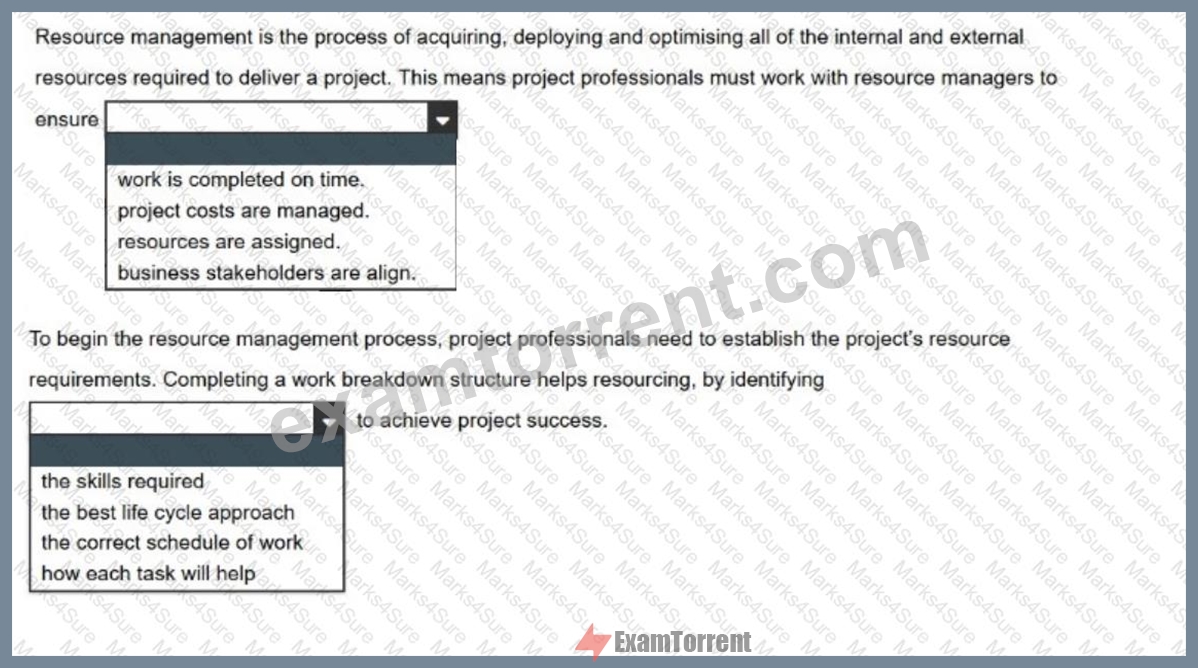
Answer:
Explanation: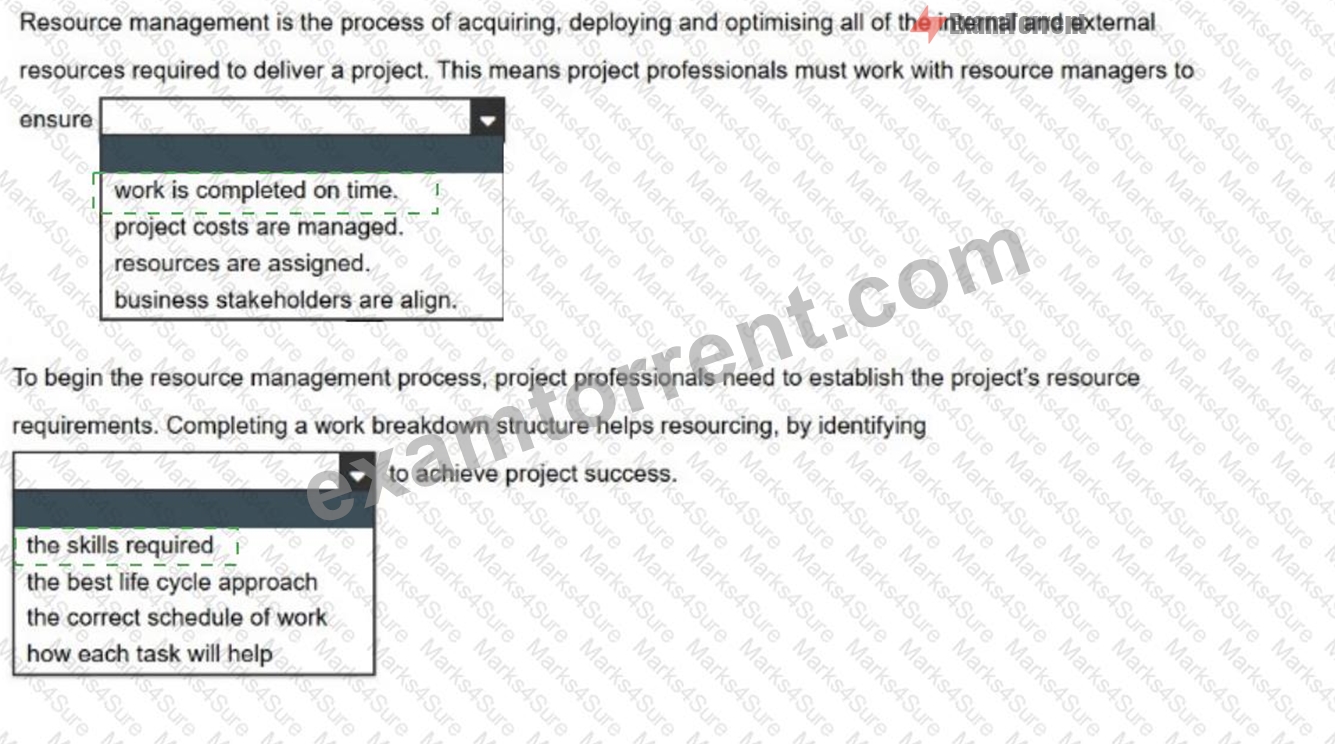
Explanation:
Work is completed on time.
The skills required.
Ensuring work is completed on time is critical to effective resource management, as it ensures the project meets its deadlines.
NEW QUESTION # 14
Why should a project professional complete continuing professional development (CPD)?
- A. To provide continuity between project leads.
- B. To achieve professional targets set by their employer.
- C. To prioritize development of their direct reports.
- D. To address any identified competency gaps.
Answer: D
Explanation:
Detailed Explanation:
NEW QUESTION # 15
Which of the activities below would provide final assurance of a project?
- A. Troubleshooting a technical fault.
- B. Testing of a product.
- C. Allocation and approval of the project budget.
- D. Developing organizational policies.
Answer: B
Explanation:
Detailed Explanation:
NEW QUESTION # 16
Select the correct options from the drop-down lists: (2 marks)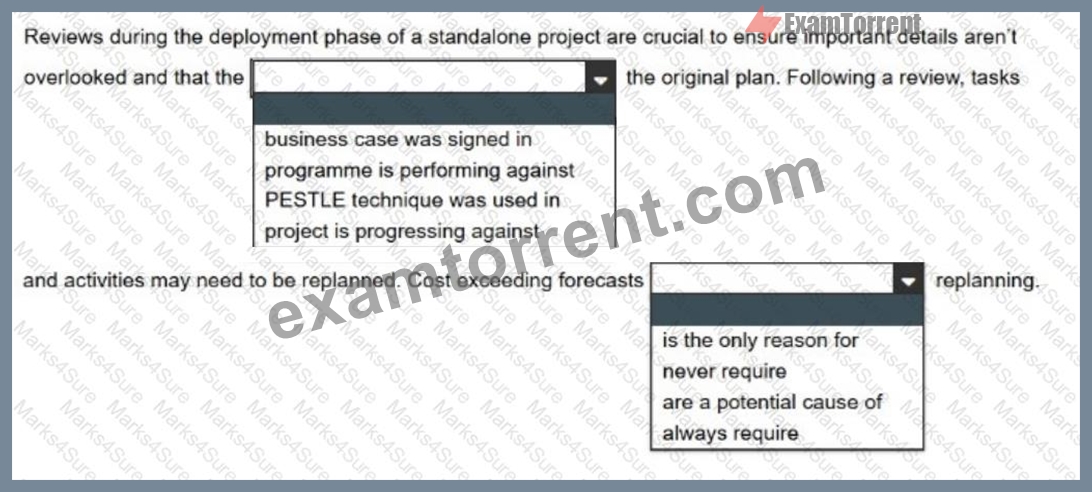
Answer:
Explanation: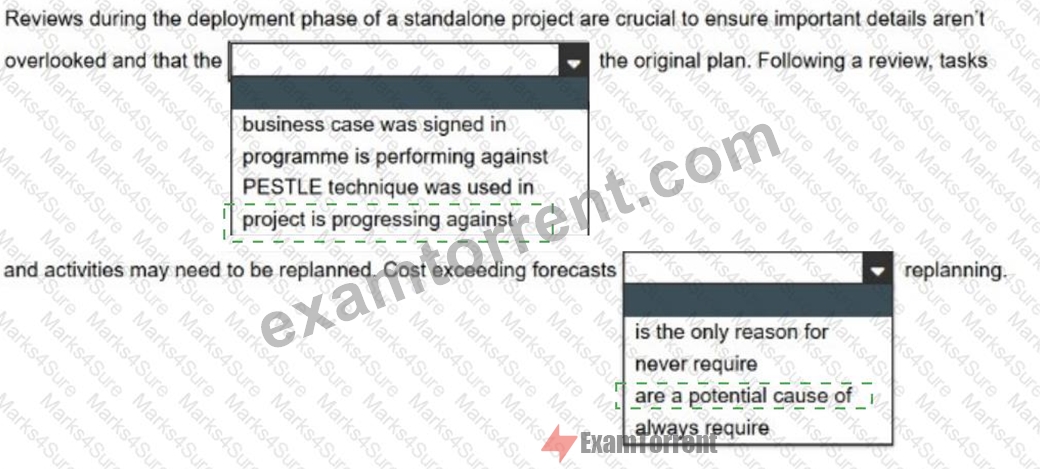
Explanation:
Project is progressing against
Are a potential cause of
Project Progress:Reviews ensure that the project is aligned with the original plan, which helps monitor and control progress effectively.
Cost Impact:Excess costs are a significant cause for replanning as they deviate from the approved project budget.
NEW QUESTION # 17
Quality control activities help to prevent problems being passed on to customers. State two quality control checks that may be carried out during a project:
Answer:
Explanation:
See the Explanation for both solutions in detail:
Explanation:
* Testing deliverables against specifications.
* Conducting milestone inspections to identify defects.
Detailed Explanation:
* Testing Deliverables:Ensures alignment with client expectations and standards.
* Inspections:Prevents issues from escalating by catching them early in the lifecycle.
NEW QUESTION # 18
You are the project manager for a large-scale rebranding project. During a critical phase, it becomes evident that additional funding is necessary to address unforeseen challenges.
Which role within the project would you approach to authorise the updated business case and secure the necessary funds to ensure the project's continuation?
- A. Product owner.
- B. Project sponsor.
- C. Project steering board.
- D. Quality manager.
Answer: B
Explanation:
Detailed Explanation:
* Theproject sponsoris responsible for securing and authorizing funding for the project.
NEW QUESTION # 19
A financial services company is launching a new banking product for which the sponsors have set a challenging timeline for an initial launch. The stakeholders have provided a list of conflicting requirements to be included in the new product design and build.
The project manager has decided to deliver the project in an iterative life cycle due to the time constraints.
Answer:
Explanation:
See the Explanation for both solutions in detail:
Explanation:
Part A:State two reasons why an iterative approach would benefit solutions development in this scenario.
* Faster delivery of prioritized features.
* Flexibility to adapt to evolving stakeholder requirements.
Part B:Explain three requirement prioritization approaches the project team could focus on to meet the deadline in this scenario.
* MoSCoW Method:Categorizes requirements as "Must Have," "Should Have," "Could Have," and
"Won't Have," focusing on essential features.
* Cost-Benefit Analysis:Focuses on implementing high-value, low-cost features first.
* Value-Risk Matrix:Balances high-value requirements with low risk to ensure a feasible and impactful scope.
Detailed Explanation:
NEW QUESTION # 20
You have been appointed as project manager on a transformation project which is looking to improve the recruitment process for a large engineering company. The project has a clearly defined scope, as well as clear milestones and timescales. A hybrid life cycle is being used for this project.
State a total of five features from both linear and iterative life cycles and describe why you recommend incorporating each one in this scenario.
Answer:
Explanation:
See the Explanation for both solutions in detail:
Explanation:
* Linear Features:
* Defined Scope: Ensures clarity and alignment with organizational objectives.
* Milestone Tracking: Tracks progress against fixed timelines.
* Iterative Features:3. Feedback Loops: Allows adjustments based on user feedback.4. Incremental Delivery: Provides early value by delivering in parts.5. Flexibility: Adapts to evolving requirements.
Detailed Explanation:
NEW QUESTION # 21
Explain how business-as-usual activities can impact the project schedule, considering each of the following elements:
Answer:
Explanation:
See the Explanation for both solutions in detail:
Explanation:
* Cost:Additional operational expenses reduce project funding.
* Quality:Competing priorities can lead to rushed deliverables, affecting quality.
* Scope:Limited resources may result in deprioritizing certain scope items.
* Risk:Overlapping activities introduce unforeseen risks.
* Resource Allocation:Business-as-usual tasks strain shared resources, delaying progress.
Detailed Explanation:
* Cost:Regular operations may consume budgetary reserves, requiring reallocation.
* Quality:Lower prioritization of project tasks can lead to reduced standards.
* Scope:Non-critical deliverables may be delayed or omitted.
* Risk:Uncoordinated overlaps increase vulnerabilities.
* Resource Strain:Teams split between routine and project tasks face inefficiencies.
NEW QUESTION # 22
You are managing a project to transform your organization's ways of working. You are currently in the definition phase, working with team members and stakeholders to establish the project's scope. Because the project impacts the entire organization, it is highly visible. As such, there are many highly invested stakeholders to manage, and the project's budget is under tight scrutiny.
Identify two techniques that can be used to gather requirements from stakeholders with limited time:
Answer:
Explanation:
See the Explanation for both solutions in detail:
Explanation:
Workshops and Focus Groups
Detailed Explanation:
* Workshops:Allows gathering insights efficiently from multiple stakeholders at once.
* Focus Groups:Helps gain deep insights from key stakeholders in a time-constrained setting.
Impacts of Failing to Gather Stakeholder Requirements:
* Project Budget:Scope creep can lead to unplanned costs, exceeding the budget.
* Project Success:Deliverables may fail to meet stakeholder needs, leading to dissatisfaction.
NEW QUESTION # 23
You are managing a large UK-based team to design and build a multi-billion dollar railway in the Middle East. You have completed a stakeholder analysis and identified a diverse range of stakeholders, each with differing levels of power and interest in the project.
Describe the engagement approach you would take with both of these stakeholder groups and why you would take that approach.
Answer:
Explanation:
See the Explanation for both solutions in detail:
Explanation:
* International Banking Group:Inform and consult regularly to build confidence and align interests.
* Local Government Department:Actively engage and ensure compliance with regulations to avoid permit-related delays.
Detailed Explanation:
* Engagement for International Banking Group:As financial backers, keeping them informed ensures alignment with long-term funding goals.
* Engagement for Government Department:Their regulatory authority can impact project timelines; active collaboration avoids unnecessary delays.
Communication Barriers and Mitigations:
* Cultural Differences:Sensitivity training and local liaisons.
* Language Barriers:Professional interpreters and translated materials.
* Time Zone Differences:Schedule meetings at convenient times and use asynchronous updates.
NEW QUESTION # 24
Which of the following statements best describes the purpose of an integrated project management plan?
- A. It sets the baseline for the project and cannot be changed after the definition phase.
- B. It is managed by the project sponsor to track the project's progress against the business case.
- C. It details the "why," "what," "when," "who," "how," "where," and "how much" of a project.
- D. It is a document used exclusively within linear project life cycles to set the project's baseline.
Answer: C
Explanation:
Detailed Explanation:
* Purpose of the Plan:It provides a comprehensive roadmap for executing, monitoring, and controlling the project.
* Why Other Options Are Incorrect:
* A: Integrated plans are not limited to linear life cycles.
* B: Sponsors use it but do not manage it.
* C: Plans can evolve to reflect project changes.
NEW QUESTION # 25
You are a project manager leading a newly formed project team. Which factor should NOT influence your decision when assigning roles and responsibilities to your team members?
- A. Project management qualifications.
- B. Preferred communication style.
- C. Relevant industry experience.
- D. Number of years in post.
Answer: D
Explanation:
Detailed Explanation:
* Why It's Not Relevant:The number of years in a post does not necessarily equate to competence or suitability for specific roles.
* Key Factors:
* Qualifications and experience ensure members can meet technical requirements.
* Communication style is essential for collaboration.
NEW QUESTION # 26
You have been assigned to manage a new project team. The team has recently been set up to improve service levels which have drastically reduced over the past year.
Only a few of the team members have worked together before. It is your responsibility as the leader to facilitate the team's development.
Question:Identify two models you could use to facilitate developing your team. (2 marks) Question:Explain three ways team development models can help the team meet their objective to improve service levels. (3 marks)
Answer:
Explanation:
See the Explanation for both solutions in detail:
Explanation:
Two Models to Facilitate Team Development
* Tuckman's Model of Group Development
* This model outlines stages (forming, storming, norming, performing, and adjourning) to help a team transition from initial formation to effective collaboration.
* Belbin's Team Roles Model
* This model identifies various roles team members can adopt to ensure a balanced and efficient team dynamic, focusing on individual strengths and contributions.
Three Ways Team Development Models Help Meet Objectives
* Improving Collaboration and Communication:
* Team development models emphasize open communication, enabling team members to understand each other's strengths and establish trust, which is critical for improving service levels.
* Enhancing Role Clarity and Efficiency:
* Models like Belbin's ensure that roles and responsibilities are aligned with individual strengths, minimizing conflicts and optimizing task execution.
* Building a Cohesive and Motivated Team:
* By addressing the interpersonal and performance dynamics (e.g., through Tuckman's stages), these models help develop a motivated and well-aligned team capable of achieving high service standards.
NEW QUESTION # 27
Structure is the most common temporary structure used to manage projects. This allows the balance of authority between the functional line manager and the project manager. In a permanent structure, allocated tasks will match an individual's capability so may be more repetitive and less varied.
- A. Matrix Structure
- B. Hybrid Structure
- C. Functional Structure
- D. Projectized Structure
Answer: A
Explanation:
Detailed Explanation:TheMatrix Structureis the correct answer because:
* Balanced Authority:It balances control between project managers and functional managers, making it ideal for temporary structures.
* Project Alignment:Resources are shared across projects and functions for optimal efficiency.
* Permanent Structures:Repetitive tasks align with functional setups, not matrix structures.
NEW QUESTION # 28
You start mentoring a junior team member who is new to the project profession. In the first month of mentoring them, you notice their attitude towards stakeholders is poor.
State two impacts this lack of professionalism and knowledge could have on the project's performance.
Answer:
Explanation:
See the Explanation for both solutions in detail:
Explanation:
* Stakeholder disengagement.
* Decreased team morale.
Detailed Explanation:
* Poor stakeholder management leads to reduced buy-in and lack of valuable input, which can derail project objectives.
NEW QUESTION # 29
Which of the following are not typical responses to risks?
* Complete root cause analysis to understand why the situation has occurred.
* Reduce the probability of the threat occurring or the impact on the project.
* Change objectives or practices to change the cause of the threat so it can no longer occur.
* There are no acceptable or viable approaches to take to avoid or reduce, so the threat and any residual risk must be managed.
* Prepare a risk management plan to document the risk and give it to your sponsor.
* Pass the responsibility for bearing the impact of the threat from one party to another.
- A. 1 and 5.
- B. 4 and 5.
- C. 3 and 4.
- D. 2 and 6.
Answer: B
Explanation:
Detailed Explanation:
* Preparing a risk management plan (5) is part of risk planning, not a direct response to risks.
NEW QUESTION # 30
......
APM-PMQ Exam Dumps - PDF Questions and Testing Engine: https://vcetorrent.examtorrent.com/APM-PMQ-prep4sure-dumps.html
