

(Mar-2026) Latest NSE7_EFW-7.2 Dumps for Success in Actual Fortinet Certified
Changing the Concept of NSE7_EFW-7.2 Exam Preparation 2026
NEW QUESTION # 20
Refer to the exhibit, which shows device registration on FortiManager.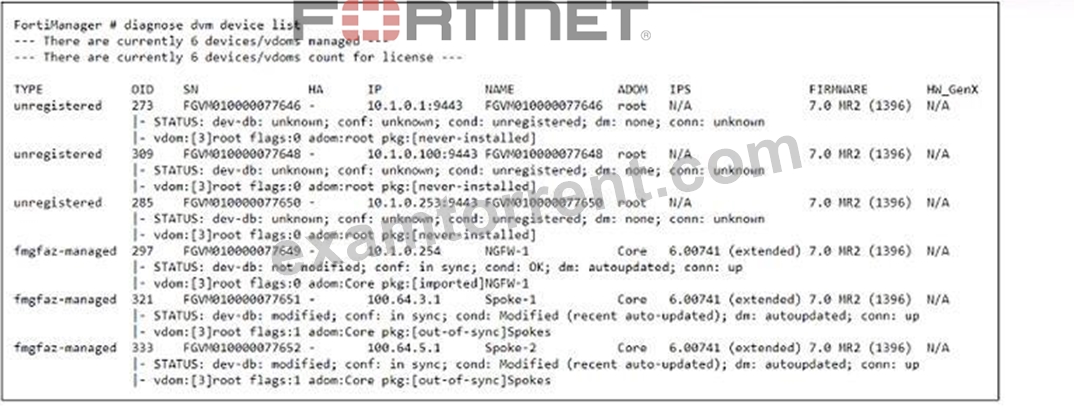
What can you conclude about the Spoke-1 and Spoke-2 configurations with respect to the information cond: Modified (recent auto-updated)?
- A. Based on the policy configuration on NGFW-1, the configuration on both spokes is modified and automatically updated.
- B. Spoke-1 and Spoke-2 are sharing the same security policy configuration and the same policy package.
- C. On NGFW-A, the configuration was changed and spokes are wailing for an autoupdate.
- D. On both Spoke-1 and Spoke-2, the configuration was changed directly on the FortiGate device, and the changes were automatically retrieved by the device database.
Answer: C
NEW QUESTION # 21
Which two statements about ADVPN are true? (Choose two.)
- A. All FortiGate devices must be in the same autonomous system (AS).
- B. The hub adds routes based on IKE negotiations.
- C. You must disable add-route in the hub.
- D. You must configure phase 2 quick mode selectors to 0.0.0.0 0.0.0.0.
Answer: C,D
NEW QUESTION # 22
Which statement about network processor (NP) offloading is true?
- A. You can disable the NP for each firewall policy using the command np-acceleration st to loose.
- B. The NP provides IPS signature matching
- C. The NP checks the session key or IPSec SA
- D. For TCP traffic FortiGate CPU offloads the first packets of SYN/ACK and ACK of the three-way handshake to NP
Answer: B
Explanation:
Network processors (NPs) are specialized hardware within FortiGate devices that accelerate certain security functions. One of the primary functions of NPs is to provide IPS signature matching (B), allowing for high-speed inspection of traffic against a database of known threat signatures.
NEW QUESTION # 23
Refer to the exhibit, which contains the partial ADVPN configuration of a spoke.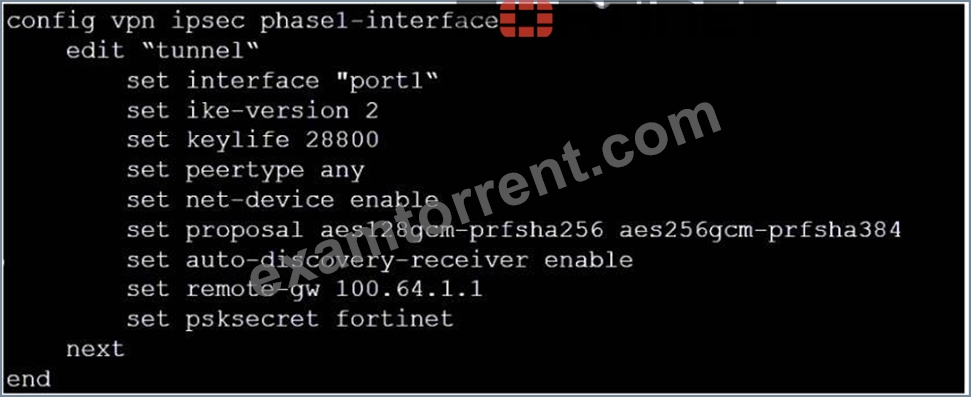
Which two parameters must you configure on the corresponding single hub? (Choose two.)
- A. Set auto-discovery-receiver enable
- B. Set ike-version 2
- C. Set auto-discovery-forwarder enable
- D. Set auto-discovery-sender enable
Answer: B,D
NEW QUESTION # 24
Refer to the exhibit, which contains an active-active toad balancing scenario.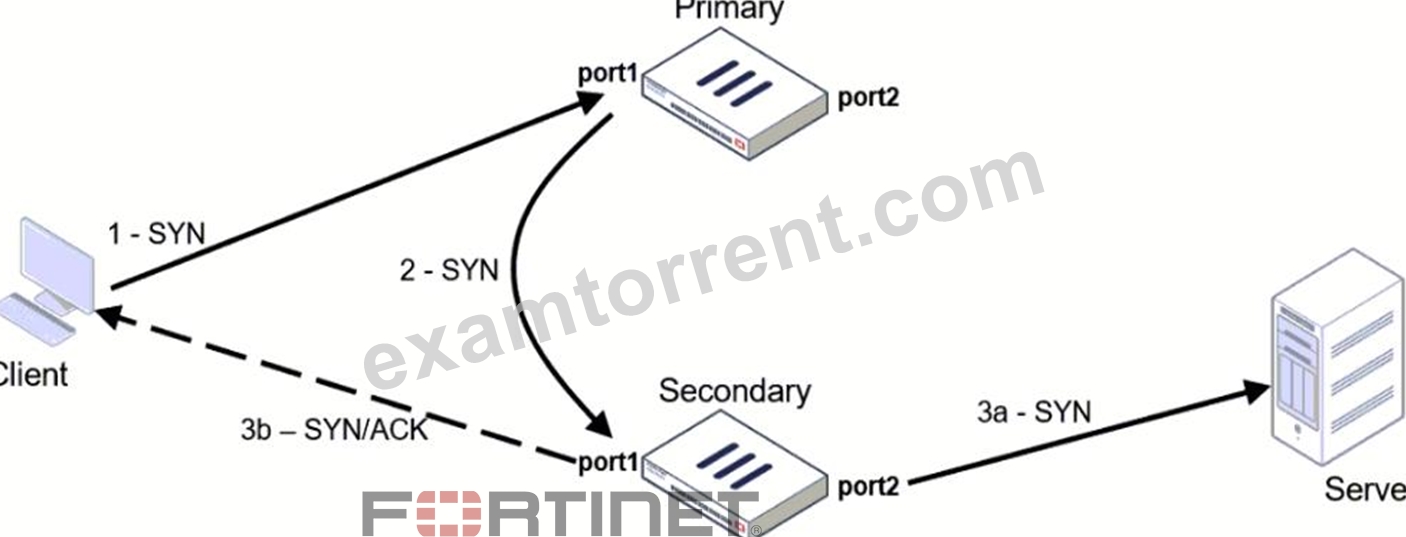
During the traffic flow the primary FortiGate forwards the SYN packet to the secondary FortiGate.
What is the destination MAC address or addresses when packets are forwarded from the primary FortiGate to the secondary FortiGate?
- A. Secondary virtual MAC port1 then physical MAC port1
- B. Secondary physical MAC port2 then virtual MAC port2
- C. Secondary physical MAC port1
- D. Secondary virtual MAC port1
Answer: C
Explanation:
In an active-active load balancing scenario, when the primary FortiGate forwards the SYN packet to the secondary FortiGate, the destination MAC address would be the secondary's physical MAC on port1, as the packet is being sent over the network and the physical MAC is used for layer 2 transmissions.
NEW QUESTION # 25
Which two statements about the Security fabric are true? (Choose two.)
- A. Only FortiGate devices with configuration-sync receive and synchronize global CMDB objects that the toot FortiGate sends
- B. FortiGate uses the FortiTelemetry protocol to communicate with FortiAnatyzer.
- C. Only the root FortiGate collects network topology information and forwards it to FortiAnalyzer
- D. Only the root FortiGate sends logs to FortiAnalyzer
Answer: B,C
Explanation:
In the Security Fabric, only the root FortiGate sends logs to FortiAnalyzer (B). Additionally, only FortiGate devices with configuration-sync enabled receive and synchronize global Central Management Database (CMDB) objects that the root FortiGate sends (C). FortiGate uses the FortiTelemetry protocol to communicate with other FortiGates, not FortiAnalyzer (A). The last option (D) is incorrect as all FortiGates can collect and forward network topology information to FortiAnalyzer.
References:
* FortiOS Handbook - Security Fabric
NEW QUESTION # 26
You contoured an address object on the tool fortiGate in a Security Fabric. This object is not synchronized with a downstream device. Which two reasons could be the cause? (Choose two)
- A. The root FortiGate has configuration-sync set to enable
- B. The address object on the tool FortiGate has fabric-object set to disable
- C. The downstream TortiGate has fabric-object-unification set to local
- D. The downstream FortiGate has configuration-sync set to local
Answer: B,C
Explanation:
* Option A is correct because the address object on the tool FortiGate will not be synchronized with the downstream devices if it has fabric-object set to disable. This option controls whether the address object is shared with other FortiGate devices in the Security Fabric or not1.
* Option C is correct because the downstream FortiGate will not receive the address object from the tool FortiGate if it has fabric-object-unification set to local. This option controls whether the downstream FortiGate uses the address objects from the root FortiGate or its own local address objects2.
* Option B is incorrect because the root FortiGate has configuration-sync set to enable by default, which means that it will synchronize the address objects with the downstream devices unless they are disabled by the fabric-object option3.
* Option D is incorrect because the downstream FortiGate has configuration-sync set to local by default, which means that it will receive the address objects from the root FortiGate unless they are overridden by the fabric-object-unification option4. References: =
* 1: Group address objects synchronized from FortiManager5
* 2: Security Fabric address object unification6
* 3: Configuration synchronization7
* 4: Configuration synchronization7
* : Security Fabric - Fortinet Documentation
NEW QUESTION # 27
Exhibit.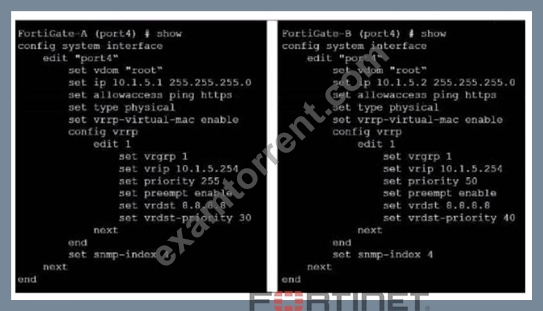
Refer to the exhibit, which contains the partial interface configuration of two FortiGate devices.
Which two conclusions can you draw from this con figuration? (Choose two)
- A. The VRRP domain uses the physical MAC address of the primary FortiGate
- B. By default FortiGate B is the primary virtual router
- C. On failover new primary device uses the same MAC address as the old primary
- D. 10.1.5.254 is the default gateway of the internal network
Answer: A,C
Explanation:
The configuration shows that VRRP (Virtual Router Redundancy Protocol) is enabled and both FortiGates have the vrrp-virtual-mac enable command, meaning they share the same MAC address. The primary FortiGate uses its physical MAC address as indicated by the set type physical command. The priority value determines which FortiGate is the primary virtual router, and in this case, FortiGate-A has a higher priority than FortiGate-B, so it is the primary by default. The IP address 10.1.5.254 is the virtual IP address of the VRRP group, not the default gateway of the internal network. Reference: You can find more information about VRRP configuration and troubleshooting in the following Fortinet Enterprise Firewall 7.2 documents:
VRRP
Technical Tip: FortiGate VRRP configuration and debug
Configuration Example: How to configure VRRP between a FortiGate and a Cisco router
NEW QUESTION # 28
Refer to the exhibit, which shows the output of a BGP summary.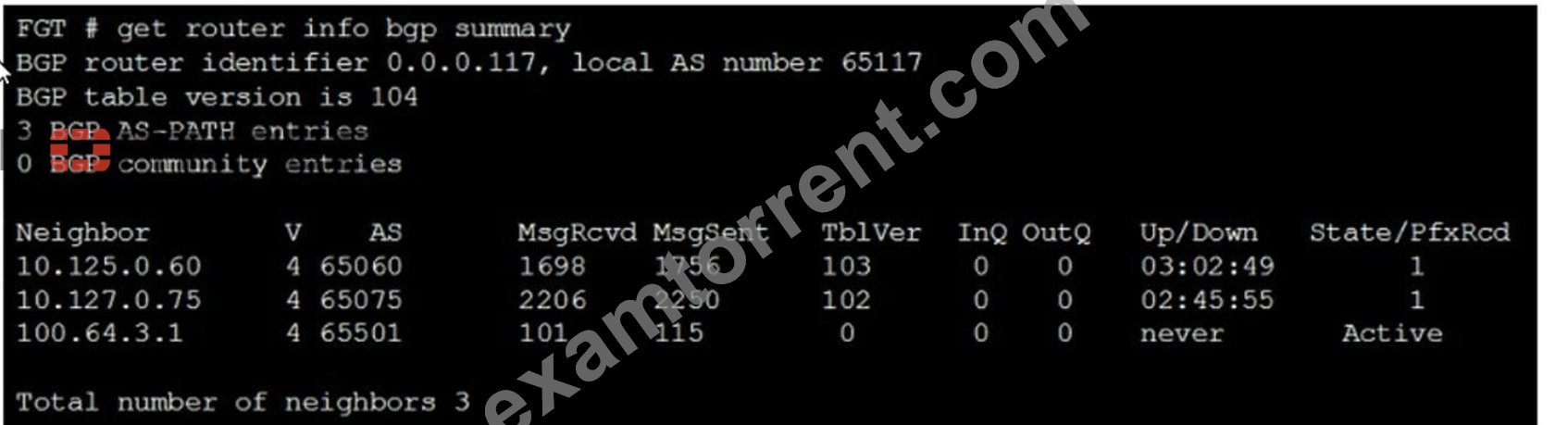
What two conclusions can you draw from this BGP summary? (Choose two.)
- A. The BGP session with peer 10. 127. 0. 75 is established.
- B. The neighbors displayed are linked to a local router with the neighbor-range set to a value of 4.
- C. External BGP (EBGP) exchanges routing information.
- D. The router 100. 64. 3. 1 has the parameter bfd set to enable.
Answer: A,C
Explanation:
The output of the BGP (Border Gateway Protocol) summary shows details about the BGP neighbors of a router, their Autonomous System (AS) numbers, the state of the BGP session, and other metrics like messages received and sent.
From the BGP summary provided:
A: External BGP (EBGP) exchanges routing information.
This conclusion can be inferred because the AS numbers for the neighbors are different from the local AS number (65117), which suggests that these are external connections.
B: The BGP session with peer 10.127.0.75 is established.
This is indicated by the state/prefix received column showing a numeric value (1), which typically means that the session is established and a number of prefixes has been received.
C: The router 100.64.3.1 has the parameter bfd set to enable.
This cannot be concluded directly from the summary without additional context or commands specifically showing BFD (Bidirectional Forwarding Detection) configuration.
D: The neighbors displayed are linked to a local router with the neighbor-range set to a value of 4.
The neighbor-range concept does not apply here; the value 4 in the 'V' column stands for the BGP version number, which is typically 4.
NEW QUESTION # 29
Which statement about meta fields is true?
- A. Meta fields must be set to required.
- B. Meta fields can be used as variables in scripts or provisioning templates.
- C. Meta fields are useful for creating multiple objects with the same logical name but different values.
- D. Meta field changes are applied only at the ADOM level.
Answer: C
Explanation:
Meta fields are useful when an enterprise has global offices or branches and the FortiManager administrator must creation multiple objects with the same logical name, but different values.
NEW QUESTION # 30
Refer to the exhibit, which shows the output of a BGP summary.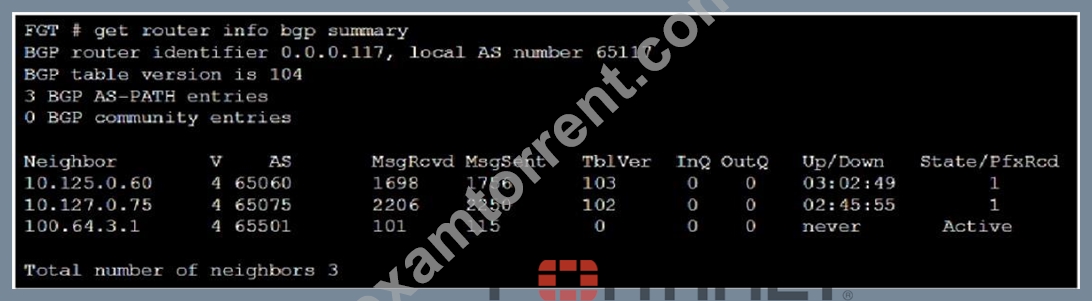
What two conclusions can you draw from this BGP summary? (Choose two.)
- A. The BGP session with peer 10.127.0.75 is established.
- B. The neighbors displayed are linked to a local router with the neighbor-range set to a value of 4.
- C. External BGP (EBGP) exchanges routing information.
- D. The router 100.64.3.1 has the parameter bfd set to enable.
Answer: A,C
Explanation:
The output of the BGP (Border Gateway Protocol) summary shows details about the BGP neighbors of a router, their Autonomous System (AS) numbers, the state of the BGP session, and other metrics like messages received and sent.
From the BGP summary provided:
A). External BGP (EBGP) exchanges routing information.
This conclusion can be inferred because the AS numbers for the neighbors are different from the local AS number (65117), which suggests that these are external connections.
B). The BGP session with peer 10.127.0.75 is established. This is indicated by the state/prefix received column showing a numeric value (1), which typically means that the session is established and a number of prefixes has been received.
C). The router 100.64.3.1 has the parameter bfd set to enable. This cannot be concluded directly from the summary without additional context or commands specifically showing BFD (Bidirectional Forwarding Detection) configuration.
D). The neighbors displayed are linked to a local router with the neighbor-range set to a value of 4. The neighbor- range concept does not apply here; the value 4 in the 'V' column stands for the BGP version number, which is typically 4.
NEW QUESTION # 31
Refer to the exhibit, which shows a custom signature.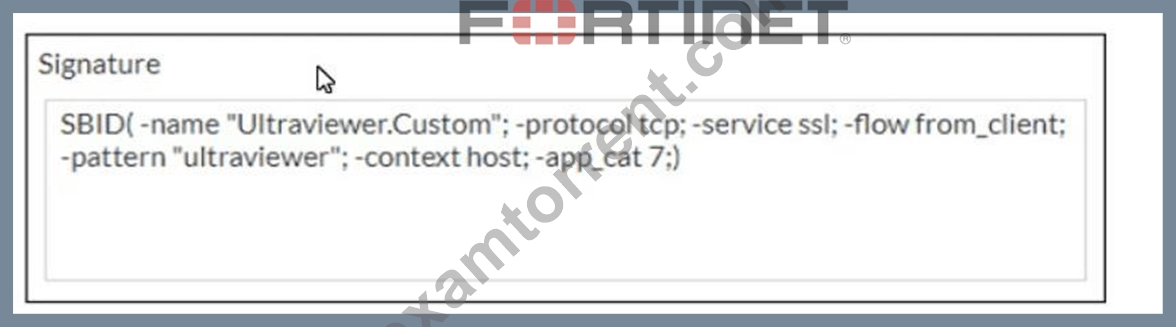
Which two modifications must you apply to the configuration of this custom signature so that you can save it on FortiGate? (Choose two.)
- A. Ensure that the header syntax is F-SBID.
- B. Start options with --.
- C. Add severity.
- D. Add attack_id.
Answer: A,C
Explanation:
For a custom signature to be valid and savable on a FortiGate device, it must include certain mandatory fields.
Severity is used to specify the level of threat that the signature represents, and attack_id is a unique identifier for the signature. Without these, the signature would not be complete and could not be correctly utilized by the FortiGate's Intrusion Prevention System (IPS).
NEW QUESTION # 32
Which two statements about the Security fabric are true? (Choose two.)
- A. FortiGate uses the FortiTelemetry protocol to communicate with FortiAnatyzer.
- B. Only FortiGate devices with configuration-sync receive and synchronize global CMDB objects that the toot FortiGate sends
- C. Only the root FortiGate collects network topology information and forwards it to FortiAnalyzer
- D. Only the root FortiGate sends logs to FortiAnalyzer
Answer: B,C
Explanation:
In the Security Fabric, only the root FortiGate sends logs to FortiAnalyzer (B). Additionally, only FortiGate devices withconfiguration-syncenabled receive and synchronize global Central Management Database (CMDB) objects that the root FortiGate sends (C). FortiGate uses the FortiTelemetry protocol to communicate with other FortiGates, not FortiAnalyzer (A). The last option (D) is incorrect as all FortiGates can collect and forward network topology information to FortiAnalyzer.
References:
* FortiOS Handbook - Security Fabric
NEW QUESTION # 33
Which statement about ADVPN is true?
- A. lt is a combination of hub-and spoke and full-mesh topologies
- B. It requires all the devices must be on the same AS for inter-region ADVPN topology
- C. lt only uses BGP for dynamic routing
- D. It supports only on single hub-and spoke architecture
Answer: A
NEW QUESTION # 34
You want to configure faster failure detection for BGP.
Which parameter should you enable on both connected FortiGate devices?
- A. Distribute-list-in
- B. Ebgp-enforce-multihop
- C. Graceful-restart
- D. bfd
Answer: D
Explanation:
BFD (Bidirectional Forwarding Detection) is a protocol that provides fast failure detection for BGP by sending periodic messages to verify the connectivity between two peers1. BFD can be enabled on both connected FortiGate devices by using the command set bfd enable under the BGP configuration2. References:
= Technical Tip : FortiGate BFD implementation and examples ..., Configure BGP | FortiGate / FortiOS 7.0.2
- Fortinet Documentation
NEW QUESTION # 35
Which two statements about the BFD parameter in BGP are true? (Choose two.)
- A. The two routers must be connected to the same subnet.
- B. It detects only two-way failures.
- C. It allows failure detection in less than one second.
- D. It is supported for neighbors over multiple hops.
Answer: C,D
Explanation:
Bidirectional Forwarding Detection (BFD) is a rapid protocol for detecting failures in the forwarding path between two adjacent routers, including interfaces, data links, and forwarding planes. BFD is designed to detect forwarding path failures in a very short amount of time, often less than one second, which is significantly faster than traditional failure detection mechanisms like hold-down timers in routing protocols.
Fortinet supports BFD for BGP, and it can be used over multiple hops, which allows the detection of failures even if the BGP peers are not directly connected. This functionality enhances the ability to maintain stable BGP sessions over a wider network topology and is documented in Fortinet's guides.
NEW QUESTION # 36
You created a VPN community using VPN Manager on FortiManager. You also added gateways to the VPN community. Now you are trying to create firewall policies to permit traffic over the tunnel; however, the VPN interfaces do not appear as available options.
What step must you take to resolve this issue?
- A. Install the VPN community and gateway configuration on the FortiGate devices so that the VPN interfaces appear on the Policy Objects on FortiManager.
- B. Create interface mappings for the IPsec VPN interfaces before you use them in a policy.
- C. Configure the phase 1 settings in the VPN community that you didn't initially configure. FortiGate automatically generates the interfaces after you configure the required settings.
- D. Refresh the device status using the Device Manager so that FortiGate populates the IPSec interfaces.
Answer: A
Explanation:
To use the VPN interfaces in a policy, you need to install the VPN community and gateway configuration on the FortiGate devices first. This will create the VPN interfaces on the FortiGate and sync them with FortiManager.
NEW QUESTION # 37
How are bulk configuration changes made using FortiManager CLI scripts? (Choose two.)
- A. When run on the Policy Package, ADOM database, you must use the installation wizard to apply the changes to the managed FortiGate device.
- B. When run on the Device Database, changes are applied directly to the managed FortiGate device.
- C. When run on the All FortiGate in ADOM, changes are automatically installed without the creation of a new revision history.
- D. When run on the Remote FortiGate directly, administrators do not have the option to review the changes prior to installation.
Answer: A,D
NEW QUESTION # 38
Refer to the exhibit, which contains a partial BGP combination.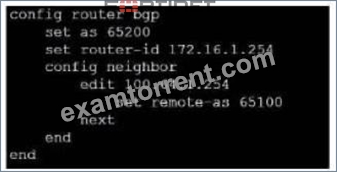
You want to configure a loopback as the OGP source.
Which two parameters must you set in the BGP configuration? (Choose two)
- A. ebgp-enforce-multihop
- B. update-source
- C. recursive-next-hop
- D. ibgp-enfoce-multihop
Answer: A,B
Explanation:
To configure a loopback as the BGP source, you need to set the "ebgp-enforce-multihop" and "update-source" parameters in the BGP configuration. The "ebgp-enforce-multihop" allows EBGP connections to neighbor routers that are not directly connected, while "update-source" specifies the IP address that should be used for the BGP session1. References := BGP on loopback, Loopback interface, Technical Tip: Configuring EBGP Multihop Load-Balancing, Technical Tip: BGP routes are not installed in routing table with loopback as update source
NEW QUESTION # 39
Refer to the exhibit which shows an ADVPN network.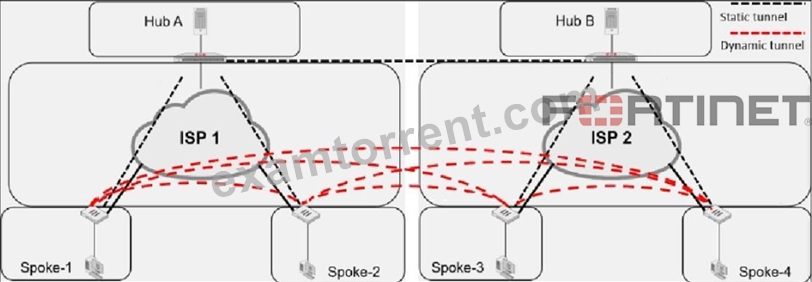
Which VPN phase 1 parameters must you configure on the hub for the ADVPN feature to function? (Choose two.)
- A. set auto-discovery-sender enable
- B. set auto-discovery-receiver enable
- C. set add-route enable
- D. set auto-discovery-forwarder enable
Answer: A,D
NEW QUESTION # 40
......
Fortinet NSE7_EFW-7.2 Exam Syllabus Topics:
| Topic | Details |
|---|---|
| Topic 1 |
|
| Topic 2 |
|
| Topic 3 |
|
| Topic 4 |
|
| Topic 5 |
|
NSE7_EFW-7.2 Exam Crack Test Engine Dumps Training With 82 Questions: https://vcetorrent.examtorrent.com/NSE7_EFW-7.2-prep4sure-dumps.html
