

[Mar 20, 2026] Lesson Brilliant PDF for the NSE7_OTS-7.2 Tests Free Updated Today
Get New 2026 Valid Practice NSE 7 Network Security Architect NSE7_OTS-7.2 Q&A - Testing Engine
Fortinet NSE7_OTS-7.2 exam covers a broad range of topics related to OT security. NSE7_OTS-7.2 exam comprises of 60 multiple-choice questions, and the candidate has 120 minutes to complete the test. NSE7_OTS-7.2 exam content includes OT security concepts, OT network design, OT security policies, OT security products, and OT security management.
The NSE7_OTS-7.2 certification is highly regarded in the industry and is recognized as a benchmark for OT security professionals. Fortinet NSE 7 - OT Security 7.2 certification demonstrates that the candidate has the skills and knowledge required to design, implement, and manage secure OT networks and systems using Fortinet solutions. Fortinet NSE 7 - OT Security 7.2 certification is valid for two years and requires candidates to renew their certification by passing a recertification exam or earning continuing education credits.
To pass the Fortinet NSE7_OTS-7.2 exam, candidates must demonstrate a deep understanding of OT security concepts, including risk assessment, threat management, and incident response. They must also be able to apply this knowledge to real-world scenarios, such as the detection and mitigation of cyber attacks on industrial control systems. Successful candidates will have the skills they need to design, implement, and manage effective OT security solutions for their organizations.
NEW QUESTION # 37
Refer to the exhibit.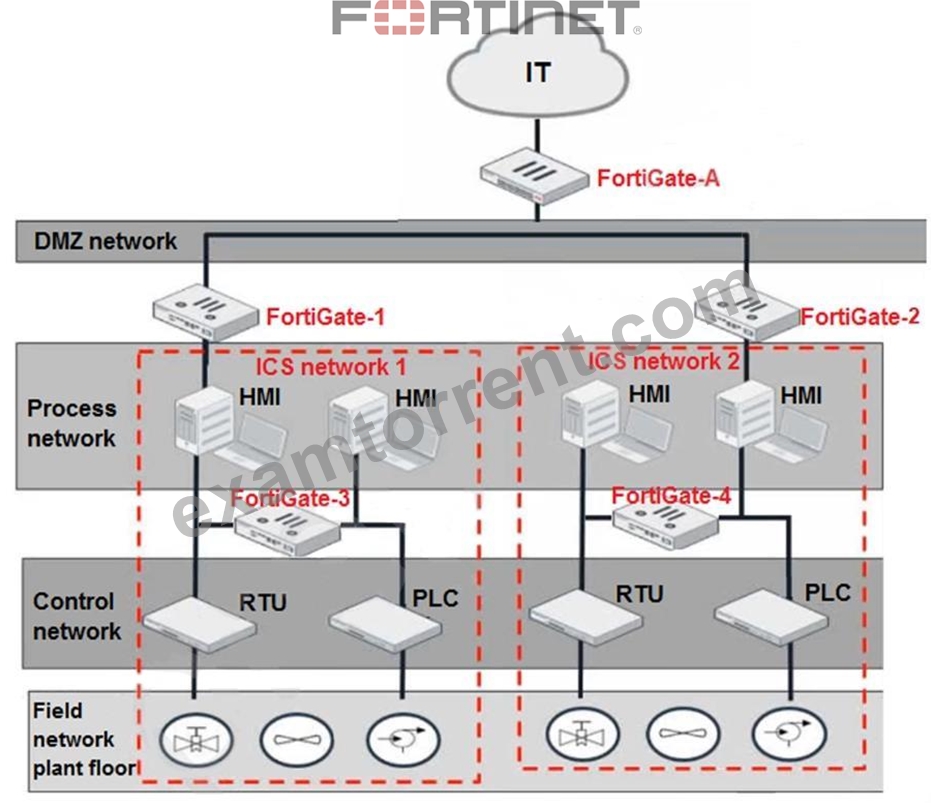
Based on the topology designed by the OT architect, which two statements about implementing OT security are true? (Choose two.)
- A. IT and OT networks are separated by segmentation.
- B. FortiGate-3 and FortiGate-4 devices must be in a transparent mode.
- C. Micro-segmentation can be achieved only by replacing FortiGate-3 and FortiGate-4 with a pair of FortiSwitch devices.
- D. Firewall policies should be configured on FortiGate-3 and FortiGate-4 with industrial protocol sensors.
Answer: A,D
NEW QUESTION # 38
An OT customer is using multiple FortiGate devices in their network to implement two-factor authentication with hardware FortiTokens. A supervisor is carrying multiple FortiTokens to be used when logging in to a critical server behind different FortiGate devices.
As an OT network architect, which approach must you take in order to assign one token per user and still use two-factor authentication on multiple FortiGate devices?
- A. Implement a FortiManager and manage all FortiGate devices in the OT network to share the FortiTokens database.
- B. Provision the Edge-FortiGate device with all the FortiTokens and configure it as a remote authentication server on other FortiGate devices.
- C. Implement FortiAuthenticator with FortiTokens provisioned for each user, and configure FortiAuthenticator as remote authentication server on all FortiGate devices in the OT network.
- D. Configure FSSO-based two-factor authentication.
Answer: C
NEW QUESTION # 39
Refer to the exhibits. Which statement is true about the traffic passing through to PLC-2?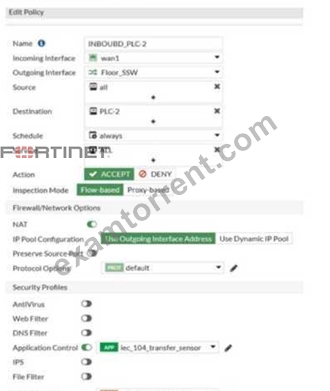
- A. SSL Inspection must be set to deep-inspection to correctly apply application control.
- B. IEC 104 signatures are all allowed except the C.BO.NA 1 signature.
- C. The application filter overrides the default action of some IEC 104 signatures.
- D. IPS must be enabled to inspect application signatures.
Answer: C
NEW QUESTION # 40
An OT architect has deployed a Layer 2 switch in the OT network at Level 1 the Purdue model-process control. The purpose of the Layer 2 switch is to segment traffic between PLC1 and PLC2 with two VLANs.
All the traffic between PLC1 and PLC2 must first flow through the Layer 2 switch and then through the FortiGate device in the Level 2 supervisory control network.
What statement about the traffic between PLC1 and PLC2 is true?
- A. PLC1 and PLC2 traffic must flow through the Layer-2 switch trunk link to the FortiGate device.
- B. In order to communicate, PLC1 must be in the same VLAN as PLC2.
- C. The Layer 2 switch rewrites VLAN tags before sending traffic to the FortiGate device.
- D. The Layer 2 switches routes any traffic to the FortiGate device through an Ethernet link.
Answer: A
Explanation:
The statement that is true about the traffic between PLC1 and PLC2 is that PLC1 and PLC2 traffic must flow through the Layer-2 switch trunk link to the FortiGate device.
NEW QUESTION # 41
Refer to the exhibit.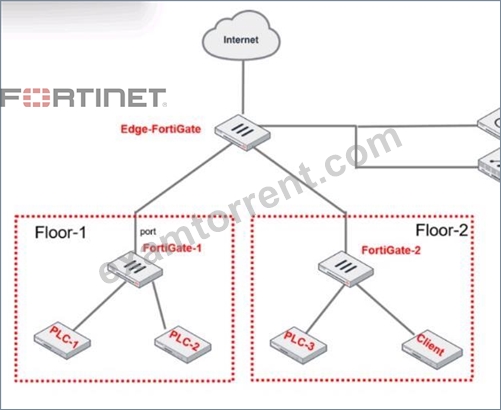
PLC-3 and CLIENT can send traffic to PLC-1 and PLC-2. FGT-2 has only one software switch (SSW-1) connecting both PLC-3 and CLIENT. PLC-3 and CLIENT can send traffic to each other at the Layer 2 level.
What must the OT admin do to prevent Layer 2-level communication between PLC-3 and CLIENT?
- A. Enable explicit intra-switch policy to require firewall policies on FGT-2.
- B. Implement policy routes on FGT-2 to control traffic between devices.
- C. Set a unique forward domain for each interface of the software switch.
- D. Create a VLAN for each device and replace the current FGT-2 software switch members.
Answer: C,D
NEW QUESTION # 42
An OT administrator deployed many devices to secure the OT network. However, the SOC team is reporting that there are too many alerts, and that many of the alerts are false positive. The OT administrator would like to find a solution that eliminates repetitive tasks, improves efficiency, saves time, and saves resources.
Which products should the administrator deploy to address these issues and automate most of the manual tasks done by the SOC team?
- A. FortiSandbox and FortiSIEM
- B. A syslog server and FortiSIEM
- C. FortiSIEM and FortiManager
- D. FortiSOAR and FortiSIEM
Answer: D
NEW QUESTION # 43
What are two benefits of a Nozomi integration with FortiNAC? (Choose two.)
- A. Direct VLAN assignment
- B. Adapter consolidation for multi-adapter hosts
- C. Enhanced point of connection details
- D. Importation and classification of hosts
Answer: B,D
Explanation:
The two benefits of a Nozomi integration with FortiNAC are enhanced point of connection details and importation and classification of hosts. Enhanced point of connection details allows for the identification and separation of traffic from multiple points of connection, such as Wi-Fi, wired, cellular, and VPN. Importation and classification of hosts allows for the automated importing and classification of host and device information into FortiNAC. This allows for better visibility and control of the network.
NEW QUESTION # 44
Refer to the exhibit.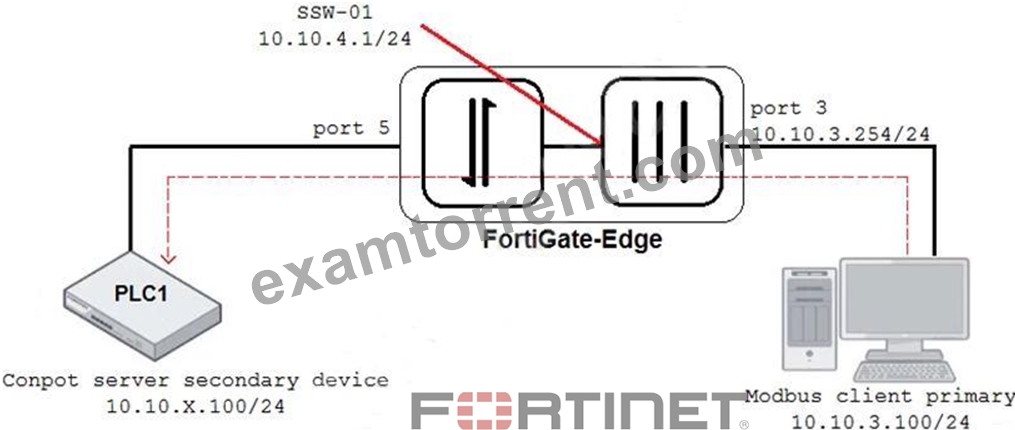
An OT architect has implemented a Modbus TCP with a simulation server Conpot to identify and control the Modus traffic in the OT network. The FortiGate-Edge device is configured with a software switch interface ssw-01.
Based on the topology shown in the exhibit, which two statements about the successful simulation of traffic between client and server are true? (Choose two.)
- A. The FortiGate-Edge device must be in NAT mode.
- B. Port5 is not a member of the software switch.
- C. NAT is disabled in the FortiGate firewall policy from port3 to ssw-01.
- D. The FortiGate devices is in offline IDS mode.
Answer: A,C
NEW QUESTION # 45
Refer to the exhibits.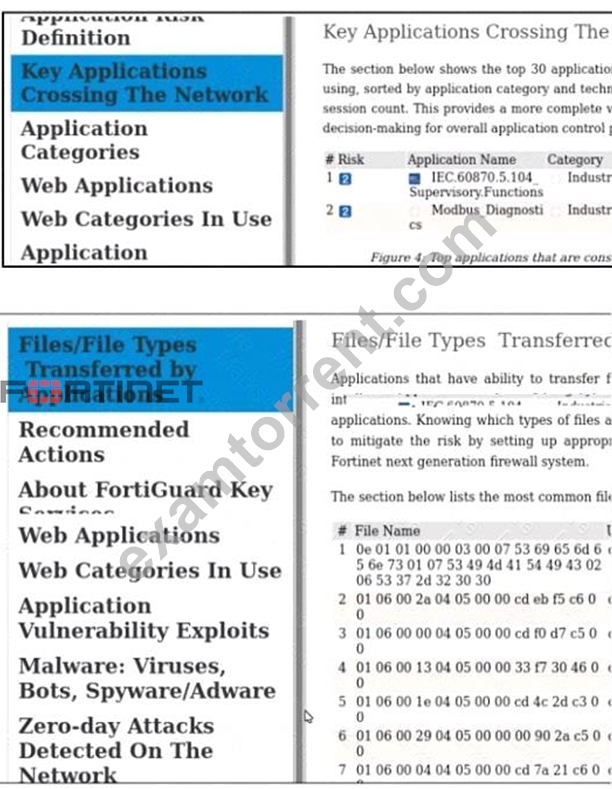
Which statement about some of the generated report elements from FortiAnalyzer is true?
- A. The report confirms Modbus and IEC 104 are the key applications crossing the network.
- B. FortiGate collects the logs and generates the report to FortiAnalyzer.
- C. The file types confirm the infected applications on the PLCs.
- D. This report is predefined and is not available for customization.
Answer: A
NEW QUESTION # 46
The OT network analyst runs different level of reports to quickly explore threats that exploit the network.
Such reports can be run on all routers, switches, and firewalls. Which FortiSIEM reporting method helps to identify these type of exploits of image firmware files?
- A. Threat hunting reports
- B. Compliance reports
- C. OT/loT reports
- D. CMDB reports
Answer: A
NEW QUESTION # 47
Refer to the exhibit and analyze the output.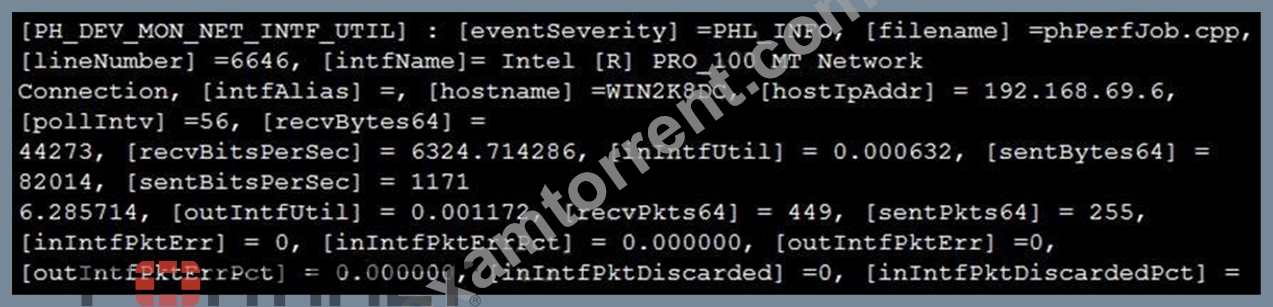
Which statement about the output is true?
- A. This is a sample of an SNMP temperature control event log.
- B. This is a sample of FortiGate interface statistics.
- C. This is a sample of a PAM event type.
- D. This is a sample of a FortiAnalyzer system interface event log.
Answer: C
NEW QUESTION # 48
An OT network architect needs to secure control area zones with a single network access policy to provision devices to any number of different networks. On which device can this be accomplished?
- A. FortiGate
- B. FortiEDR
- C. FortiNAC
- D. FortiSwitch
Answer: A
Explanation:
An OT network architect can accomplish the goal of securing control area zones with a single network access policy to provision devices to any number of different networks on a FortiGate device.
NEW QUESTION # 49
A supervisor is configuring a software switch on a FortiGate device. What must the supervisor configure on FortiGate to control the traffic between member interfaces on the software switch, using firewall policies?
- A. The supervisor must configure a separate forward domain for the software switch.
- B. The supervisor must configure intra-switch-policy to explicit.
- C. The supervisor must configure the software switch with at least one wireless interface and one VLAN interface.
- D. The supervisor must add different VLAN interfaces to the software switch.
Answer: B
NEW QUESTION # 50
Refer to the exhibit, which shows a non-protected OT environment.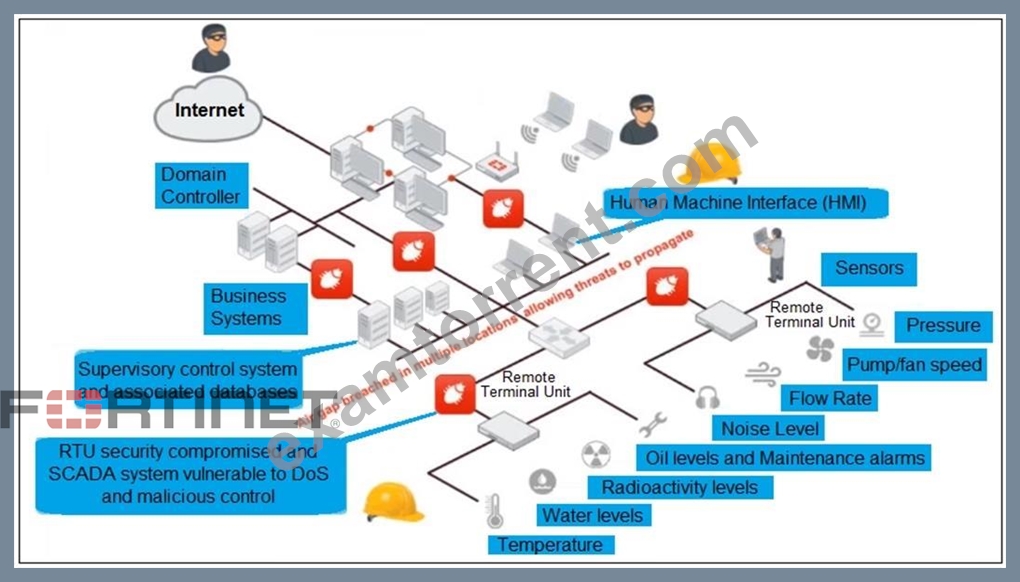
An administrator needs to implement proper protection on the OT network. Which three steps should an administrator take to protect the OT network? (Choose three.)
- A. Deploy an edge FortiGate between the internet and an OT network as a one-arm sniffer.
- B. Configure firewall policies with web filter to protect the different ICS networks.
- C. Configure firewall policies with industrial protocol sensors
- D. Deploy a FortiGate device within each ICS network.
- E. Use segmentation
Answer: A,B,C
NEW QUESTION # 51
Refer to the exhibit.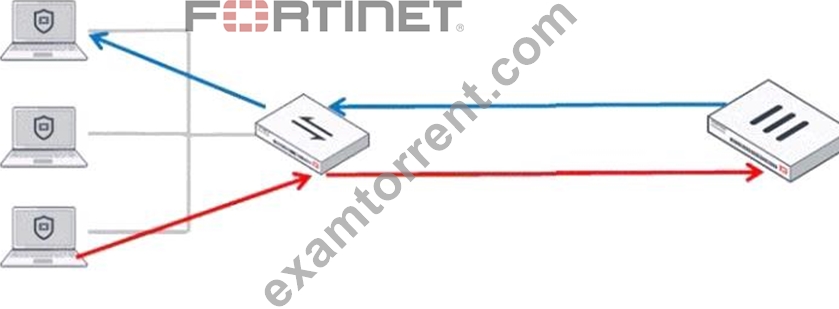
In order for a FortiGate device to act as router on a stick, what configuration must an OT network architect implement on FortiGate to achieve inter-VLAN routing?
- A. Set a software switch on FortiGate to handle inter-VLAN traffic.
- B. Set a FortiGate interface with the switch to operate as an 802.1 q trunk.
- C. Set FortiGate to operate in transparent mode.
- D. Set a unique forward domain on each interface on the network.
Answer: B
NEW QUESTION # 52
Refer to the exhibit, which shows a non-protected OT environment.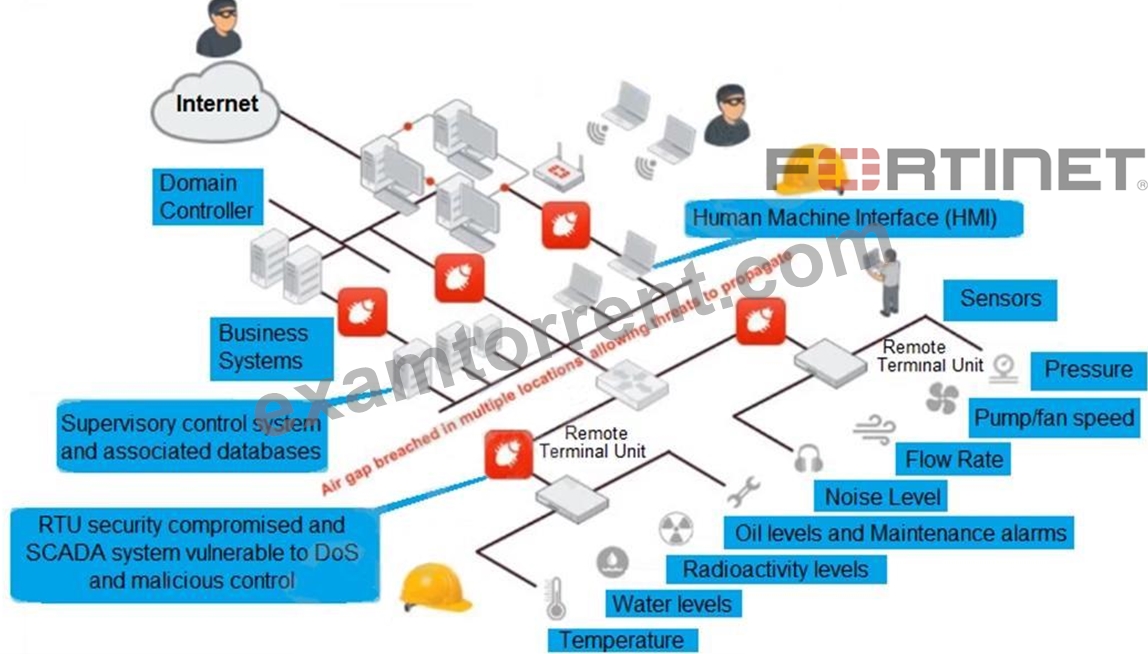
An administrator needs to implement proper protection on the OT network.
Which three steps should an administrator take to protect the OT network? (Choose three.)
- A. Deploy an edge FortiGate between the internet and an OT network as a one-arm sniffer.
- B. Configure firewall policies with web filter to protect the different ICS networks.
- C. Configure firewall policies with industrial protocol sensors
- D. Deploy a FortiGate device within each ICS network.
- E. Use segmentation
Answer: A,B,C
NEW QUESTION # 53
......
NSE7_OTS-7.2 Dumps PDF - 100% Passing Guarantee: https://vcetorrent.examtorrent.com/NSE7_OTS-7.2-prep4sure-dumps.html
