

[Mar 01, 2026] CIS-EM Test Engine files, CIS-EM Dumps PDF
Latest ServiceNow CIS-EM PDF and Dumps (2026) Free Exam Questions Answers
ServiceNow is a leading provider of enterprise solutions, and the CIS-EM certification exam is a valuable credential for professionals who work with Event Management in ServiceNow. Certified Implementation Specialist-Event Management Exam certification verifies the skills and knowledge necessary to configure, implement, and manage Event Management in ServiceNow. By obtaining this certification, professionals can showcase their proficiency in ServiceNow Event Management and gain recognition in the industry.
ServiceNow CIS-EM certification program is an excellent option for IT professionals who want to specialize in event management. The program is designed for individuals who already have some experience in IT and want to take their skills to the next level. Certified Implementation Specialist-Event Management Exam certification program is a comprehensive course that covers all aspects of event management, from identifying and correlating events to notifying stakeholders and monitoring metrics. Certified Implementation Specialist-Event Management Exam certification provides a comprehensive roadmap to event management excellence.
The CIS-EM certification exam is intended for professionals who want to advance their careers in the field of ServiceNow event management. CIS-EM exam is recommended for professionals who have experience working with ServiceNow's event management solution and are interested in demonstrating their expertise by becoming certified. Certified Implementation Specialist-Event Management Exam certification provides professionals with an opportunity to showcase their knowledge and experience in implementing ServiceNow solutions to potential employers, which can lead to career growth.
NEW QUESTION # 25
By default, Event Management tries to bind an alert to CI (configuration item), by matching the node name in the event to which three items in the CMDB (configuration management database)?
- A. CI name, Fully qualified domain name, SSH public host keys
- B. CI name, Webserver name, IP or MAC address
- C. System class name, Fully qualified domain name, IP or MAC address
- D. CI name, Fully qualified domain name, IP or MAC address
Answer: D
Explanation:
Explanation/Reference: https://docs.servicenow.com/bundle/orlando-it-operations-management/page/product/event- management/reference/r_EMHowAlertsBindCI.html
NEW QUESTION # 26
When creating an alert management rule, where would you specify a workflow to resolve a given condition?
- A. From the Actions tab
- B. In the Related Links section
- C. From the Remediation tab
- D. From the Launcher tab
Answer: C
Explanation:
Reference: https://docs.servicenow.com/bundle/orlando-it-operations-management/page/product/event- management/task/create-alert-management-rule.html
NEW QUESTION # 27
What feature would you use to trigger a workflow or automatically generate tasks via templates?
- A. Event rules
- B. Alert correlation rules
- C. Task rules
- D. Alert management rules
Answer: A
NEW QUESTION # 28
What would you use as a central location to explore the CMDB class hierarchy, CI table definitions, and CIs?
- A. CI Relation Types
- B. Process to CI Type Mapping
- C. CI Identifiers
- D. CI Class Manager
- E. CI Remediations
Answer: D
NEW QUESTION # 29
If events are not matching to alerts as you would like, what field should be changed?
- A. Message Key
- B. Resource
- C. Node
- D. Metric Name
Answer: D
NEW QUESTION # 30
What are the two most accurate statements regarding the ServiceNow CMDB (configuration management database) and CIs (configuration items)?
- A. The CMDB is a dynamic list that tracks both the CIs within your platform and the relationship between those items.
- B. A CI is any component within your infrastructure that needs to be managed in order to deliver Services.
- C. All CIs stored in the CMDB must have an assigned IP address within your infrastructure.
- D. The CMDB is a series of tables that contain only key hardware components located in critical paths within your platform that must be managed.
Answer: A,B
NEW QUESTION # 31
What would be the primary use case for creating Javascripts in Event Management?
- A. To automatically populate the Configuration Management Database (CMDB)
- B. To parse a nodename out of your raw event data in an event rule
- C. To run as part of a remediation workflow for IT alerts that fail to execute
- D. To create a customized pull connector to retrieve events on behalf of an event source
Answer: D
Explanation:
Reference: https://docs.servicenow.com/bundle/orlando-it-operations-management/page/product/event- management/task/t_EMCreateCustomConnectorDefinition.html
NEW QUESTION # 32
By default, the Alert Console displays what type of alerts?
- A. All Primary and Secondary Open alerts with a Severity of Critical, Major, Minor, and Warning that are not in Maintenance mode
- B. All Primary, Open alerts and anomaly alerts with a Severity of Critical, Major, Minor, and Warning that are not in Maintenance mode
- C. All Primary and Secondary Open alerts and anomaly alerts with a Severity of Critical, Major, Minor, and Warning that are not in Maintenance mode
- D. All Primary, Open alerts with a Severity of Critical, Major, Minor, and Warning that are not in Maintenance mode
- E. All Primary alerts with a Severity of Critical, Major, Minor, Warning that are not in Maintenance mode
Answer: A
Explanation:
Explanation/Reference: https://docs.servicenow.com/bundle/orlando-it-operations-management/page/product/event- management/concept/alert-priority.html
NEW QUESTION # 33
What are the valid states an alert can be in during its lifecycle?
- A. Open, Reopen, Flapping, Closed
- B. Open, Updating, Swinging, Closed
- C. Open, Warning, Flapping, Clear
- D. New, Updating, Waiting, Complete
Answer: A
Explanation:
Reference: https://docs.servicenow.com/bundle/orlando-it-operations-management/page/product/event- management/task/t_EMSetTheAlertActiveInterval.html
NEW QUESTION # 34
When sending data from the monitoring source to the additional_info field, what format is supported?
- A. YAML
- B. JSON
- C. Comma separated
- D. XML
Answer: B
NEW QUESTION # 35
What is an alert called that moves from an open to a closed state multiple times within a designated time-frame?
- A. Flapping
- B. Flipping
- C. Fluctuating
- D. Swinging
Answer: A
NEW QUESTION # 36
In what sequence are events processed?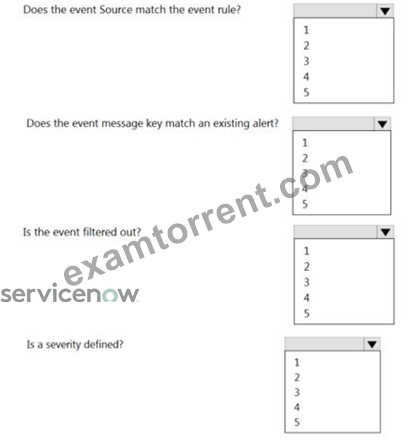
Answer:
Explanation: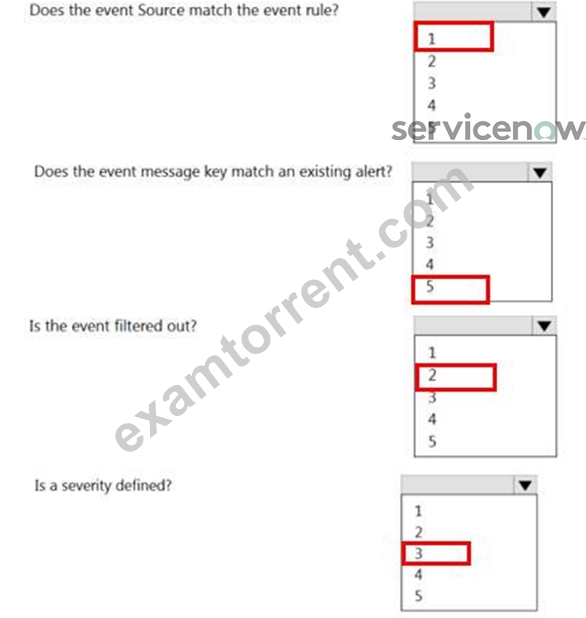
NEW QUESTION # 37
What would be the primary use case for creating Javascripts in Event Management?
- A. To automatically populate the Configuration Management Database (CMDB)
- B. To parse a nodename out of your raw event data in an event rule
- C. To run as part of a remediation workflow for IT alerts that fail to execute
- D. To create a customized pull connector to retrieve events on behalf of an event source
Answer: D
Explanation:
Explanation/Reference: https://docs.servicenow.com/bundle/orlando-it-operations-management/page/product/event- management/task/t_EMCreateCustomConnectorDefinition.html
NEW QUESTION # 38
Agent Client Collector can perform application service monitoring by configuring what option?
- A. A REST API
- B. A proxy agent
- C. An event rule
- D. A distributed cluster
- E. An alert management rule
Answer: B
NEW QUESTION # 39
Which is an invalid state for an alert?
- A. Closed
- B. Processed
- C. Flapping
- D. Reopen
Answer: B
NEW QUESTION # 40
What is the primary function of the link view feature in the Service Operations Workspace express list?
- A. To automatically generate incidents from linked alerts
- B. To manage user permissions across teams
- C. To update the CMDB dependency map
- D. To visualize tag-based alert groups
Answer: D
NEW QUESTION # 41
By default, the Alert Console displays what type of alerts?
- A. All Primary and Secondary Open alerts with a Severity of Critical, Major, Minor, and Warning that are not in Maintenance mode
- B. All Primary, Open alerts and anomaly alerts with a Severity of Critical, Major, Minor, and Warning that are not in Maintenance mode
- C. All Primary and Secondary Open alerts and anomaly alerts with a Severity of Critical, Major, Minor, and Warning that are not in Maintenance mode
- D. All Primary, Open alerts with a Severity of Critical, Major, Minor, and Warning that are not in Maintenance mode
- E. All Primary alerts with a Severity of Critical, Major, Minor, Warning that are not in Maintenance mode
Answer: A
NEW QUESTION # 42
Agent Client Collector is built on what framework that enables you to adopt and extend monitoring checks from the community?
- A. Icinga
- B. Nagios
- C. Zabbix
- D. SolarWinds
- E. Sensu
Answer: E
NEW QUESTION # 43
When creating an alert management rule, where would you specify a workflow to resolve a given condition?
- A. From the Actions tab
- B. In the Related Links section
- C. From the Remediation tab
- D. From the Launcher tab
Answer: C
Explanation:
Explanation/Reference: https://docs.servicenow.com/bundle/orlando-it-operations-management/page/product/event-management/task/create-alert-management-rule.html
NEW QUESTION # 44
Given the following Impact settings and Alerts in a three node cluster that makes up the components of a Business Service, what is the overall service health of this Business Service?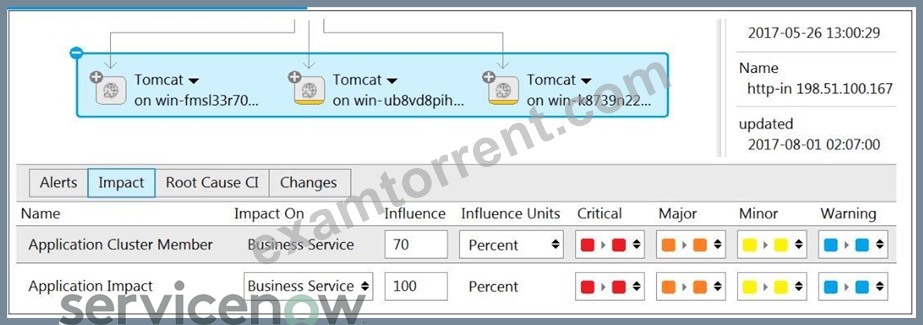
- A. Clear
- B. Error
- C. Critical
- D. Major
- E. Minor
- F. Warning
Answer: A
NEW QUESTION # 45
By default, the Alert Console displays what type of alerts?
- A. All Primary and Secondary Open alerts with a Severity of Critical, Major, Minor, and Warning that are not in Maintenance mode
- B. All Primary, Open alerts and anomaly alerts with a Severity of Critical, Major, Minor, and Warning that are not in Maintenance mode
- C. All Primary and Secondary Open alerts and anomaly alerts with a Severity of Critical, Major, Minor, and Warning that are not in Maintenance mode
- D. All Primary, Open alerts with a Severity of Critical, Major, Minor, and Warning that are not in Maintenance mode
- E. All Primary alerts with a Severity of Critical, Major, Minor, Warning that are not in Maintenance mode
Answer: A
Explanation:
Reference: https://docs.servicenow.com/bundle/orlando-it-operations-management/page/product/event- management/concept/alert-priority.html
NEW QUESTION # 46
What is the default collection/polling interval applied to all event connectors?
- A. Every 40 seconds
- B. Every 10 seconds
- C. Every 120 seconds
- D. Every 5 seconds
- E. Every 60 seconds
Answer: B
Explanation:
Reference: https://docs.servicenow.com/bundle/orlando-servicenow-platform/page/use/collaboration/task/ t_ConfigureThePollingInterval.html
NEW QUESTION # 47
If a Message Key is not provided, which fields are concatenated to make our own?
- A. Source, Type, DNS, Additional info, Metric Name
- B. Source, Type, Node, Resource, Metric Name
- C. Source, DNS, Node, Additional info, Metric Name
- D. Source, Source Instance, Node, Type, Resource
Answer: B
NEW QUESTION # 48
......
Pass Your CIS-Event Management CIS-EM Exam on Mar 01, 2026 with 118 Questions: https://vcetorrent.examtorrent.com/CIS-EM-prep4sure-dumps.html
