

Practice Cybersecurity Defense Analyst SPLK-5002 exam. Online Exam Practice Tests with detailed explanations! Pass SPLK-5002 with confidence!
SPLK-5002 - Splunk Certified Cybersecurity Defense Engineer Practice Tests 2026 | ExamTorrent
NEW QUESTION # 71
Which features of Splunk are crucial for tuning correlation searches?(Choosethree)
- A. Enabling event sampling
- B. Reviewing notable event outcomes
- C. Optimizing search queries
- D. Using thresholds and conditions
- E. Disabling field extractions
Answer: B,C,D
Explanation:
Correlation searches are a key component of Splunk Enterprise Security (ES) that help detect and alert on security threats by analyzing machine data across various sources. Proper tuning of these searches is essential to reduce false positives, improve performance, and enhance the accuracy of security detections in a Security Operations Center (SOC).
Crucial Features for Tuning Correlation Searches
#1. Using Thresholds and Conditions (A)
Thresholds help control the sensitivity of correlation searches by defining when a condition is met.
Setting appropriate conditions ensures that only relevant events trigger notable events or alerts, reducing noise.
Example:
Instead of alerting on any failed login attempt, a threshold of 5 failed logins within 10 minutes can be set to identify actual brute-force attempts.
#2. Reviewing Notable Event Outcomes (B)
Notable events are generated by correlation searches, and reviewing them is critical for fine-tuning.
Analysts in the SOC should frequently review false positives, duplicates, and low-priority alerts to refine rules.
Example:
If a correlation search is generating excessive alerts for normal user activity, analysts can modify it to exclude known safe behaviors.
#3. Optimizing Search Queries (E)
Efficient Splunk Search Processing Language (SPL) queries are crucial to improving search performance.
Best practices include:
Using index-time fields instead of extracting fields at search time.
Avoiding wildcards and unnecessary joins in searches.
Using tstats instead of regular searches to improve efficiency.
Example:
Using:
| tstats count where index=firewall by src_ip
instead of:
index=firewall | stats count by src_ip
can significantly improve performance.
Incorrect Answers & Explanation
#C. Enabling Event Sampling
Event sampling helps analyze a subset of events to improve testing but does not directly impact correlation search tuning in production.
In a SOC environment, tuning needs to be based on actual real-time event volumes, not just sampled data.
#D. Disabling Field Extractions
Field extractions are essential for correlation searches because they help identify and analyze security-related fields (e.g.,user,src_ip,dest_ip).
Disabling them would limit the visibility of important security event attributes, making detections less effective.
Additional Resources for Learning
#Splunk Documentation & Learning Paths:
Splunk ES Correlation Search Documentation
Best Practices for Writing SPL
Splunk Security Essentials - Use Cases
SOC Analysts Guide for Correlation Search Tuning
#Courses & Certifications:
Splunk Enterprise Security Certified Admin
Splunk Core Certified Power User
Splunk SOAR Certified Automation Specialist
NEW QUESTION # 72
How can you incorporate additional context into notable events generated by correlation searches?
- A. By optimizing the search head memory
- B. By configuring additional indexers
- C. By using the dedup command in SPL
- D. By adding enriched fields during search execution
Answer: D
Explanation:
In Splunk Enterprise Security (ES), notable events are generated by correlation searches, which are predefined searches designed to detect security incidents by analyzing logs and alerts from multiple data sources. Adding additional context to these notable events enhances their value for analysts and improves the efficiency of incident response.
To incorporate additional context, you can:
Use lookup tables to enrich data with information such as asset details, threat intelligence, and user identity.
Leverage KV Store or external enrichment sources like CMDB (Configuration Management Database) and identity management solutions.
Apply Splunk macros orevalcommands to transform and enhance event data dynamically.
Use Adaptive Response Actions in Splunk ES to pull additional information into a notable event.
The correct answer is A. By adding enriched fields during search execution, because enrichment occurs dynamically during search execution, ensuring that additional fields (such as geolocation, asset owner, and risk score) are included in the notable event.
References:
Splunk ES Documentation on Notable Event Enrichment
Correlation Search Best Practices
Using Lookups for Data Enrichment
NEW QUESTION # 73
Which of the following macro values will exclude all of the company networks if it is called from the following search?
index=firewall sourcetype=pan:traffic NOT "company_networks"
- A. (src_ip IN (151.157.30.0/24, 26.06.18.0/24))
- B. (src_ip=151.157.30.0/24 AND src_ip=26.06.18.0/24)
- C. NOT (src_ip=151.157.30.0/24 AND src_ip=26.06.18.0/24)
- D. NOT (src_ip IN (151.157.30.0/24, 26.06.18.0/24))
Answer: D
Explanation:
To exclude all company networks from the search, the macro should negate the source IPs using NOT (src_ip IN (...)). This ensures that any traffic originating from the specified company networks is filtered out of the results.
NEW QUESTION # 74
Which syntax is correct to create two new rows on an existing threat intelligence collection?
- A. curl -k -u admin:pass https://localhost:8089/services/data/threat_intel/item/email_intel -d item='[{"src_user": "user_new", "subject":"click this"}]'
- B. curl -k -u admin:pass https://localhost:8089/services/data/threat_intel/item/email_intel -d item='[{"src_user": "user_new", "subject":"click this"}]' -G -X
- C. curl -k -u admin:pass https://localhost:8089/services/data/threat_intel/item/email_intel -d item='[{"src_user": "user_new", "subject":"click this"},{"src_user": "user2_new", "subject":"click this"}]' -G -X
- D. curl -k -u admin:pass https://localhost:8089/services/data/threat_intel/item/email_intel -d item="[{"src_user": "user_new", "subject":"click this"},{"src_user": "user2_new", "subject":"click this"}]'
Answer: D
Explanation:
This syntax is valid because it passes multiple JSON objects inside a single array for the item parameter, ensuring both new rows are added to the collection in one request.
NEW QUESTION # 75
A cyber defense engineer plays a role in maintaining a secure SOAR Cloud configuration. Which network security statement is correct about SOAR Cloud?
- A. The Automation Broker initiates an outbound SSL connection to Splunk Cloud, and the managed endpoint initiates an outbound connection to the Automation Broker.
- B. The Automation Broker initiates an inbound SSL connection to Splunk Cloud, and also initiates an outbound connection to the managed endpoints.
- C. The Automation Broker initiates an outbound SSL connection to Splunk Cloud, and also initiates an outbound connection to the managed endpoints.
- D. Splunk Cloud initiates an outbound SSL connection to both the Automation Broker and managed endpoints.
Answer: C
Explanation:
In Splunk SOAR Cloud, the Automation Broker is responsible for maintaining connectivity. It initiates an outbound SSL connection to Splunk Cloud (so no inbound firewall rules are needed) and also makes outbound connections to the managed endpoints to execute playbook actions securely.
NEW QUESTION # 76
A cybersecurity engineer notices a delay in retrieving indexed data during a security incident investigation.
The Splunk environment has multiple indexers but only one search head.
Which approach can resolve this issue?
- A. Configure a search head cluster to distribute search queries.
- B. Implement accelerated data models for faster querying.
- C. Increase search head memory allocation.
- D. Optimize search queries to use tstats instead of raw searches.
Answer: D
Explanation:
Why Usetstatsfor Faster Searches?
When a cybersecurity engineer experiences delays in retrieving indexed data, the best way to improve search performance is to usetstatsinstead of raw searches.
#What iststats?tstatsis a high-performance command that queries data from indexed fields only, rather than scanning raw events. This makes searches significantly faster and more efficient.
#Why is This the Best Approach?
tstatssearches are 10-100x faster than raw event searches.
It leverages metadata and indexed fields, reducing search load.
It minimizes memory and CPU usage on the search head and indexers.
#Example Use Case:#Scenario: The SOC team is investigating failed logins across multiple indexers.#Using a raw search:
index=security sourcetype=auth_logs action=failed | stats count by user
#Problem: This query scans millions of raw events, causing slow performance.
#Optimized usingtstats:
| tstats count where index=security sourcetype=auth_logs action=failed by user
#Advantage: Faster results without scanning raw events.
Why Not the Other Options?
#A. Increase search head memory allocation - May help, but inefficient queries will still slow down searches.
#C. Configure a search head cluster - A single search head isn't necessarily the problem; improvingsearch performance is more effective.#D. Implement accelerated data models - Useful for prebuilt dashboards, but won't improve ad-hoc searches.
NEW QUESTION # 77
Which search command was used to generate the result in the image below?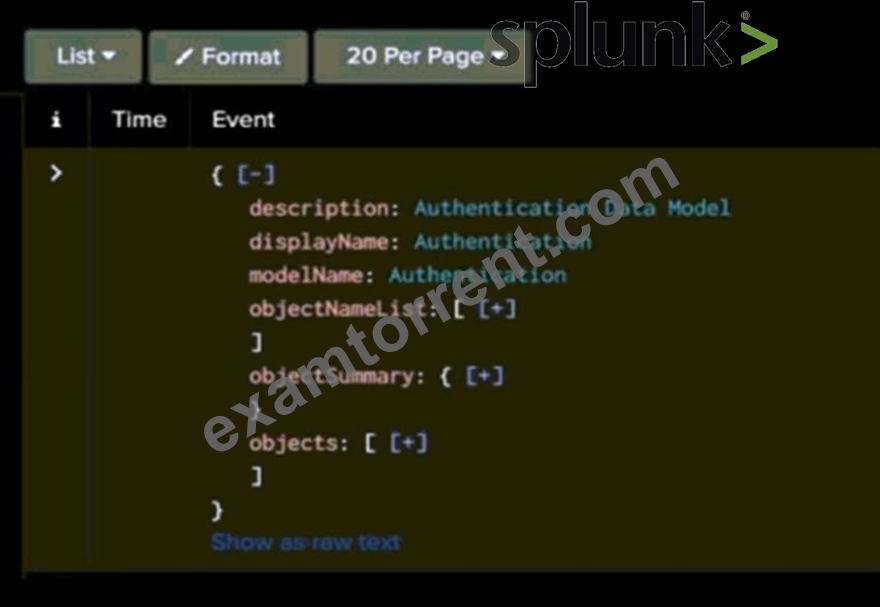
- A. metadata
- B. datatype
- C. datamodel
- D. cim
Answer: C
Explanation:
The result in the image shows details of the Authentication Data Model (description, displayName, modelName, objectNameList, etc.). This output is generated by the datamodel search command, which is used to list and inspect available data models in Splunk.
NEW QUESTION # 78
Which tool can help provide a baseline of the data sources in a given Splunk environment?
- A. Splunk Security Essentials Analytic Stories
- B. Splunk Security Essentials Data Inventory
- C. Enterprise Security Data Library
- D. Enterprise Security Content Update
Answer: C
Explanation:
The Enterprise Security Data Library (ESDL) provides a baseline of the data sources available in a Splunk environment. It helps identify which data sources are present, how they map to security use cases, and whether they align with Enterprise Security requirements.
NEW QUESTION # 79
What is an essential step in building effective dashboards for program analytics?
- A. Limiting the number of visualizations
- B. Using predefined templates without modification
- C. Applying accelerated data models for better performance
- D. Avoiding the use of filters and tokens
Answer: C
Explanation:
Building Effective Dashboards for Program Analytics
Well-designed dashboards help SOC teams visualize security trends, performance metrics, and compliance adherence efficiently.
#1. Applying Accelerated Data Models for Better Performance (B)
Speeds up dashboard loading times by using pre-aggregated datasets.
Improves SIEM performance when analyzing large volumes of security logs.
Example:
Instead of running a full search, an accelerated data model pre-indexes event counts by severity level.
#Incorrect Answers:
A: Using predefined templates without modification # Dashboards should be customized for security needs.
C: Avoiding the use of filters and tokens # Filters improve usability by allowing analysts to refine searches.
D: Limiting the number of visualizations # Dashboards should balance performance and visibility rather than limit insights.
#Additional Resources:
Splunk Accelerated Data Models
Building Fast and Efficient Dashboards
NEW QUESTION # 80
In Enterprise Security, what is the name of the threat intelligence lookup pertaining to files?
- A. user_hash
- B. file_hash
- C. file_intel
- D. user_intel
Answer: C
Explanation:
In Splunk Enterprise Security, the file_intel lookup is used for threat intelligence related to files, such as file hashes or suspicious file indicators. This lookup allows correlation searches and risk scoring to incorporate known malicious file information.
NEW QUESTION # 81
How can you ensure efficient detection tuning?(Choosethree)
- A. Use detailed asset and identity information.
- B. Disable correlation searches for low-priority threats.
- C. Perform regular reviews of false positives.
- D. Automate threshold adjustments.
Answer: A,C,D
Explanation:
Ensuring Efficient Detection Tuning in Splunk Enterprise Security
Detection tuning is essential to minimize false positives and improve security visibility.
#1. Perform Regular Reviews of False Positives (A)
Reviewing false positives helps refine detection logic.
Analysts should analyze past alerts and adjust correlation rules.
Example:
Tuning a failed login correlation search to exclude known legitimate admin accounts.
#2. Use Detailed Asset and Identity Information (B)
Enriches detections with asset and user context.
Helps differentiate high-risk vs. low-risk security events.
Example:
A login from an executive's laptop is higher risk than from a test server.
#3. Automate Threshold Adjustments (D)
Dynamic thresholds adjust based on activity baselines.
Reduces false positives while maintaining security coverage.
Example:
A brute-force detection rule dynamically adjusts its alerting threshold based on normal user behavior.
C: Disable correlation searches for low-priority threats # Instead of disabling, adjust the rule sensitivity or lower alert severity.
#Additional Resources:
Splunk Security Essentials: Detection Tuning Guide
Tuning Correlation Searches in Splunk ES
NEW QUESTION # 82
What Splunk feature is most effective for managing the lifecycle of a detection?
- A. Metrics indexing
- B. Summary indexing
- C. Content management in Enterprise Security
- D. Data model acceleration
Answer: C
Explanation:
Why Use "Content Management in Enterprise Security" for Detection Lifecycle Management?
The detection lifecycle refers to the process of creating, managing, tuning, and deprecating security detections over time. In Splunk Enterprise Security (ES), Content Management helps security teams:
#Create, update, and retire correlation searches and security content#Manage use case coverage for different threat categories#Tune detection rules to reduce false positives#Track changes in detection rules for better governance
#Example in Splunk ES:#Scenario: A company updates its threat detection strategy based on new attack techniques.#SOC analysts use Content Management in ES to:
Review existing correlation searches
Modify detection logic to adapt to new attack patterns
Archive outdated detections and enable new MITRE ATT&CK techniques
Why Not the Other Options?
#A. Data model acceleration - Improves search performance but does not manage detection lifecycles.#C.
Metrics indexing - Used for time-series data (e.g., system performance monitoring), not formanaging detections.#D. Summary indexing - Stores precomputed search results but does not control detection content.
References & Learning Resources
#Splunk ES Content Management Documentation: https://docs.splunk.com/Documentation/ES#Best Practices for Security Content Management in Splunk ES: https://www.splunk.com/en_us/blog/security#MITRE ATT&CK Integration with Splunk: https://attack.mitre.org/resources
NEW QUESTION # 83
When building a metrics dashboard for the SOC manager, which metric would represent how long it takes to fully complete an investigation?
- A. MTTD
- B. MTTR
- C. MTBF
- D. MTTA
Answer: B
Explanation:
MTTR (Mean Time to Resolution/Recovery/Respond) measures how long it takes to fully complete an investigation or resolve an incident. This is the key metric for tracking investigation completion time in SOC performance dashboards.
NEW QUESTION # 84
Which of the following is the most efficient search to return a list of all visible indexes and the sourcetypes contained within them?
- A. | tstats values(sourcetype) where index=true
- B. | tstats values(sourcetype) where index=* by index
- C. index=* sourcetype=* | stats values(sourcetype) by index
- D. index=* | stats count by sourcetype, index
Answer: B
Explanation:
The most efficient way to return all visible indexes and their sourcetypes is with | tstats values(sourcetype) where index=* by index. The tstats command leverages data model acceleration and metadata, making it faster and more resource-efficient than raw searches like index=*.
NEW QUESTION # 85
Which REST API actions can Splunk perform to optimize automation workflows?(Choosetwo)
- A. PUT for updating index configurations
- B. POST for creating new data entries
- C. GET for retrieving search results
- D. DELETE for archiving historical data
Answer: B,C
Explanation:
The Splunk REST API allows programmatic access to Splunk's features, helping automate security workflows in a Security Operations Center (SOC).
Key REST API Actions for Automation:
POST for creating new data entries (A)
Used to send logs, alerts, or notable events to Splunk.
Essential for integrating external security tools with Splunk.
GET for retrieving search results (C)
Fetches logs, alerts, and notable event details programmatically.
Helps automate security monitoring and incident response.
NEW QUESTION # 86
What cardinality of data should be used in an indexed field to optimize and speed up searches?
- A. Secure cardinality, meaning that only security relevant values are contained in the field.
- B. Low cardinality, meaning that there is little variance in the data contained in the field.
- C. Compliant cardinality, meaning that only values that contain non-PII/PHI are contained in the field.
- D. High cardinality, meaning that there is a great deal of variance in the data contained in the field.
Answer: B
Explanation:
To optimize and speed up searches, indexed fields should have low cardinality, meaning they contain relatively few unique values (e.g., status codes, country codes). Low cardinality fields are more efficient for indexing and searching compared to high cardinality fields with many unique values (like usernames or IP addresses).
NEW QUESTION # 87
What is the primary purpose of data indexing in Splunk?
- A. To visualize data using dashboards
- B. To ensure data normalization
- C. To store raw data and enable fast search capabilities
- D. To secure data from unauthorized access
Answer: C
Explanation:
Understanding Data Indexing in Splunk
In Splunk Enterprise Security (ES) and Splunk SOAR, data indexing is a fundamental process that enables efficient storage, retrieval, and searching of data.
Why is Data Indexing Important?
Stores raw machine data (logs, events, metrics) in a structured manner. Enables fast searching through optimized data storage techniques. Uses an indexer to process, compress, and store data efficiently.
Why the Correct Answer is B?
Splunk indexes data to store it efficiently while ensuring fast retrieval for searches, correlation searches, and analytics.
It assigns metadata to indexed events, allowing SOC analysts to quickly filter and search logs.
NEW QUESTION # 88
Which of the following is not a type of metadata that can be returned by the metadata command?
- A. assets
- B. sourcetypes
- C. sources
- D. hosts
Answer: A
Explanation:
The metadata command in Splunk can return information about sourcetypes, hosts, and sources, but it does not return data about assets. Assets are managed separately in Enterprise Security's asset and identity framework, not through the metadata command.
NEW QUESTION # 89
What are the benefits of incorporating asset and identity information into correlation searches?
(Choose two)
- A. Accelerating data ingestion rates
- B. Enhancing the context of detections
- C. Reducing the volume of raw data indexed
- D. Prioritizing incidents based on asset value
Answer: B,D
Explanation:
Why is Asset and Identity Information Important in Correlation Searches?
Correlation searches in Splunk Enterprise Security (ES) analyze security events to detect anomalies, threats, and suspicious behaviors. Adding asset and identity information significantly improves security detection and response by:
1. Enhancing the Context of Detections - (Answer A)
Helps analysts understand the impact of an event by associating security alerts with specific assets and users.
Example: If a failed login attempt happens on a critical server, it's more serious than one on a guest user account.
2. Prioritizing Incidents Based on Asset Value - (Answer C)
High-value assets (CEO's laptop, production databases) need higher priority investigations.
Example: If malware is detected on a critical finance server, the SOC team prioritizes it over a low-impact system.
NEW QUESTION # 90
What are key elements of a well-constructed notable event?(Choosethree)
- A. Minimal use of contextual data
- B. Meaningful descriptions
- C. Proper categorization
- D. Relevant field extractions
Answer: B,C,D
Explanation:
A notable event in Splunk Enterprise Security (ES) represents a significant security detection that requires investigation.
#Key Elements of a Good Notable Event:#Meaningful Descriptions (Answer A) Helps analysts understand the event at a glance.
Example: Instead of "Possible attack detected," use "Multiple failed admin logins from foreign IP address".
#Proper Categorization (Answer C)
Ensures events are classified correctly (e.g., Brute Force, Insider Threat, Malware Activity).
Example: A malicious file download alert should be categorized as "Malware Infection", not just "General Alert".
#Relevant Field Extractions (Answer D)
Ensures that critical details (IP, user, timestamp) are present for SOC analysis.
Example: If an alert reports failed logins, extracted fields should include username, source IP, and login method.
Why Not the Other Options?
#B. Minimal use of contextual data - More context helps SOC analysts investigate faster.
References & Learning Resources
#Building Effective Notable Events in Splunk ES: https://docs.splunk.com/Documentation/ES#SOC Best Practices for Security Alerts: https://splunkbase.splunk.com#How to Categorize Security Alerts Properly:
https://www.splunk.com/en_us/blog/security
NEW QUESTION # 91
What are the key components of Splunk's indexing process?(Choosethree)
- A. Searching
- B. Indexing
- C. Parsing
- D. Alerting
- E. Input phase
Answer: B,C,E
Explanation:
Key Components of Splunk's Indexing Process
Splunk's indexing process consists of multiple stages that ingest, process, and store data efficiently for search and analysis.
#1. Input Phase (E)
Collects data from sources (e.g., syslogs, cloud services, network devices).
Defines where the data comes from and applies pre-processing rules.
Example:
A firewall log is ingested from a syslog server into Splunk.
#2. Parsing (A)
Breaks raw data into individual events.
Applies rules for timestamp extraction, line breaking, and event formatting.
Example:
A multiline log file is parsed so that each log entry is a separate event.
#3. Indexing (C)
Stores parsed data in indexes to enable fast searching.
Assigns metadata like host, source, and sourcetype.
Example:
An index=firewall_logs contains all firewall-related events.
#Incorrect Answers:
B: Searching # Searching happens after indexing, not during the indexing process.
D: Alerting # Alerting is part of SIEM and detection, not indexing.
#Additional Resources:
Splunk Indexing Process Documentation
Splunk Data Processing Pipeline
NEW QUESTION # 92
......
The best SPLK-5002 exam study material and preparation tool is here: https://vcetorrent.examtorrent.com/SPLK-5002-prep4sure-dumps.html
